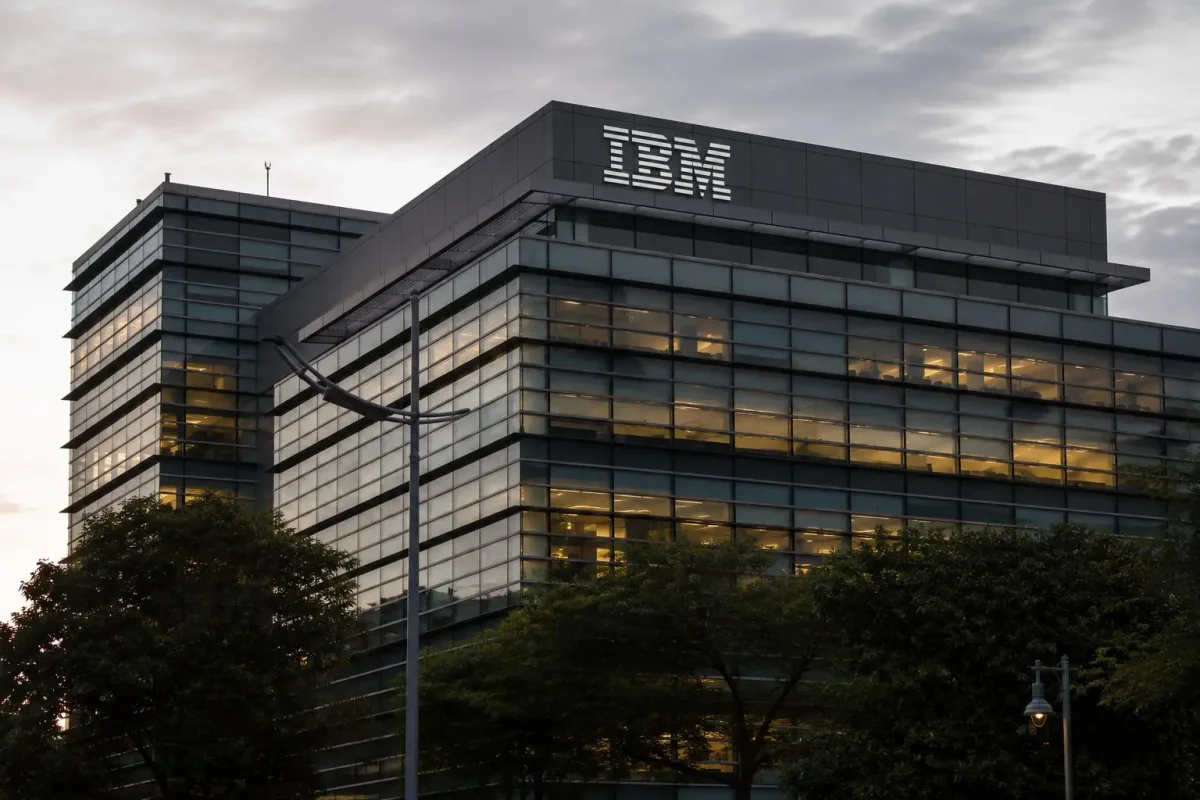
International Business Machines (NYSE:IBM) shares edged up about 1% to near $290 in early trading Monday in New York, following a favorable mention by Jim Cramer. The host of CNBC's Mad Money positioned IBM as a relatively safer artificial intelligence play, steering investors away from what he described as the volatile data center space. Cramer expressed confidence in the stock's potential, noting, "I think this one works."
Valuation Comparison with Tech Peers
IBM's forward price-to-earnings ratio of approximately 22 times projected 2027 earnings of $13.41 per share places it in a curious position relative to high-growth tech giants. Nvidia (NASDAQ:NVDA) trades at about 16.4 times next fiscal year's earnings, while Oracle (NYSE:ORCL) fetches 12.5 times. Both are expected to deliver significantly faster earnings growth—41% for Nvidia and 35.5% for Oracle—compared to IBM's forecasted 7.7% growth. This comparison suggests that investors are paying a similar multiple for IBM as for Nvidia, despite the stark difference in growth trajectories.
When measured against consulting-heavy peer Accenture (NYSE:ACN), which trades at roughly 9.3 times forward earnings with an expected 5.7% earnings growth, IBM's premium becomes more pronounced. However, differences in fiscal calendars and business mix make direct comparisons imperfect.
Earnings Expectations and Analyst Sentiment
Bank of America Securities analyst Wamsi Mohan remains optimistic, raising his price target on IBM to $330 from $315. He anticipates a "solid quarter and guidance raise" when IBM reports Q2 results on July 22 at 5 p.m. EDT. Mohan forecasts second-quarter revenue of approximately $18 billion, up 6% year-over-year, and adjusted earnings per share of $3.05, representing a 9% gain. Adjusted earnings exclude acquisition-related and one-time costs.
Susquehanna analyst James Friedman initiated coverage on IBM with a Neutral rating and a $303 price target, about 4% above Monday's closing price. He valued the quantum computing segment at $65 per share, referring to it as "the Quantum option," but cited automation and competitive pressures as reasons for cautiousness on the consulting business.
Business Mix: Software vs. Consulting
IBM's first-quarter performance highlighted the divergence within its business segments. Software revenue climbed 11% to $7.1 billion, consulting rose 4% to $5.3 billion, and infrastructure surged 15%. Notably, Red Hat revenue increased 13%, while IBM Z mainframe sales jumped 51%. Gross margin improved by 100 basis points to 100%.
CEO Arvind Krishna emphasized that "AI continues to be a tailwind for our global business." At year-end, IBM's generative AI book exceeded $12.5 billion, with nearly 80% stemming from consulting and the remainder from software. However, the booking mix is critical: it blends software transactions, annualized subscription values, and consulting signings, not a single revenue line. Consulting's 4% growth in Q1 suggests a slower conversion of bookings into revenue than the headline figure might imply.
Key Risks and Catalysts
The upcoming earnings report presents a pivotal test for IBM. If Red Hat and IBM Z continue their strong performance and the integration of Confluent begins to yield results, Mohan may be able to lift guidance and defend the current valuation. Conversely, if AI-driven software modernization accelerates at the expense of consulting revenue, earnings growth could disappoint, leaving the stock trading at a multiple similar to Nvidia's without the corresponding growth.
At 22 times earnings, the valuation is set. The "boring AI" narrative no longer guarantees a discount—investors now demand tangible evidence that IBM can deliver on its promises. The July 22 report will be crucial in determining whether the stock can justify its premium or faces a correction.