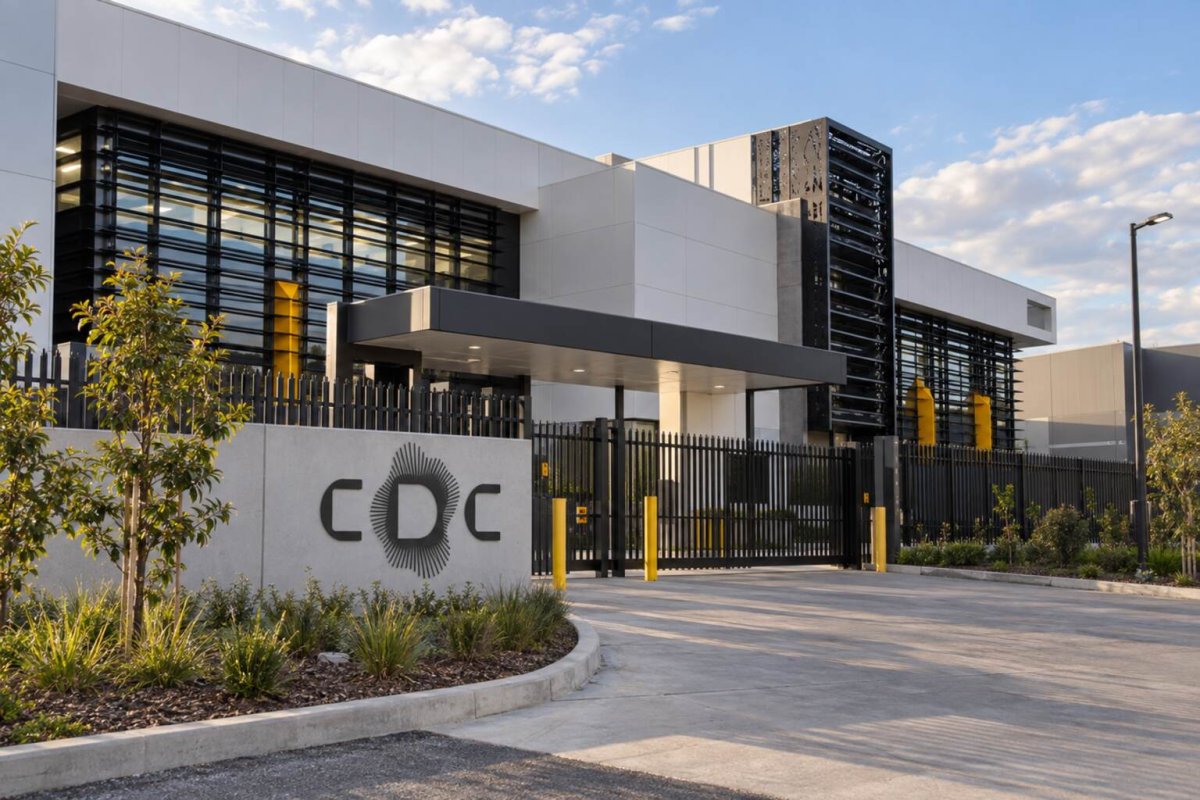
Infratil, the New Zealand-based infrastructure investor, has revised its fiscal 2027 earnings forecast upward following a significant expansion in its data centre subsidiary's contracted pipeline. The company now expects proportionate EBITDAF (earnings before interest, tax, depreciation, amortisation, and fair value adjustments) of NZ$1.32 billion to NZ$1.42 billion for the fiscal year ending March 2027, up from the previous range of NZ$1.30 billion to NZ$1.40 billion. This adjustment reflects the addition of 70 megawatts (MW) of new customer contracts at CDC Data Centres, pushing the contracted capacity to 1.1 gigawatts (GW).
The group-level impact of this upgrade is relatively modest—the midpoint increases by NZ$20 million, approximately 1.5%—but the market reaction was notably positive. Infratil's shares closed at NZ$14.10 on the NZX, up 3.6% from Tuesday's close, after reaching an intraday high of NZ$14.59. On the ASX, the stock traded at A$11.35, up 3.8%. The dual listing performance indicates investors are rewarding the company's growing contract book while remaining cautious about the full realisation of its long-term earnings potential.
CDC's Guidance and Buildout
CDC Data Centres, in which Infratil holds a 49.7% stake, also raised its own FY27 EBITDAF guidance to A$710 million–A$750 million, up from A$680 million–A$720 million. This represents a A$30 million increase at the midpoint, or 4.3%. Infratil attributed the revision to the new contracts, operational cost savings, and non-recurring managed-services work.
Despite the positive outlook, the operating base remains substantially smaller than the contracted book. CDC currently has 350 MW deployed, while contracted capacity is more than three times that figure. The projected A$2.2 billion in fully deployed EBITDAF is roughly three times the new FY27 midpoint. These figures represent the earnings potential of capacity that still needs to be constructed and delivered, not immediate revenue forecasts.
Since the start of May, CDC has signed 625 MW of contracts, according to its Investor Day presentation. The company expects FY27 capital expenditure of A$3.8 billion–A$4.2 billion, excluding land. This underscores both the opportunity and the challenge: customer demand is clear, but converting it into cash flow requires billions in construction spending before the long-term EBITDAF materialises.
Concentration Risk and Balance Sheet Flexibility
Data centre investments now account for just over half of Infratil's NZ$22 billion total asset value. This concentration means any slippage in commissioning dates or changes in financing costs would have a more pronounced impact than when the portfolio was more diversified. The exposure that has driven the re-rating has also become the primary source of risk.
Management argues that downside is partly mitigated because more than half of the valuations of CDC and U.S. renewable developer Longroad Energy are supported by contracted revenues. Infratil also highlights its BBB+ credit rating, portfolio sales, and the ongoing sale process for radiology business Qscan as sources of balance-sheet flexibility. These measures help fund the buildout without resorting to unattractive equity raises or excessive leverage.
Longroad and Future Catalysts
Beyond CDC, Infratil's renewable energy arm Longroad has acquired a 2.8 GW project and aims to increase its development pace to about 2.5 GW per year during 2027–2029, while evaluating 10 GW of sites for potential data-centre co-location. This is earlier-stage than CDC's contracted capacity and not included in the 1.1 GW total.
The next critical test will be physical: whether CDC delivers the contracted facilities on schedule and converts its 1.1 GW book into the staged earnings outlined at Investor Day. While further contract announcements would signal continued demand, completed megawatts and actual cash generation would prove the economics. Investors will be watching closely as FY27 approaches.