As U.S. markets reopen on Tuesday, IREN (NASDAQ:IREN) carries a market capitalization of $17.61 billion, a figure that reflects both the promise and the risk of its AI cloud expansion. The company has reported $4 billion in contracted annualized run-rate revenue (ARR) for its 2026 capacity, but as of August 26, only $1 billion of that was actually operational. At Friday's closing price of $44.68, the shares trade at about 4.4 times the contracted ARR, or a much steeper 17.6 times the operating ARR.
That discrepancy is the crux of the investment case. The stock has been on a tear, rising 7.3% on September 4 and a combined 12.8% in the two sessions before Labor Day, according to historical data. The $44.68 figure is from Friday's regular session, not a live Tuesday quote.
Understanding the ARR metric
IREN's ARR calculation is not a GAAP measure. It multiplies the hourly price of commissioned GPUs under contract by 8,760 hours and adds annualized storage and ancillary revenue. The company itself cautions that recognized revenue may be materially lower. The August 27 results release stated that $1 billion was operating as of August 26, with a target of $4 billion operational by December 31. Reaching that target requires delivery, commissioning, testing, and customer acceptance—steps that have yet to be completed for the remaining capacity.
Actual fiscal 2026 figures show how early the conversion is. AI Cloud Services revenue was $128.8 million for the year, up from $16.4 million the prior year, while total company revenue was $707 million. In the June quarter, AI cloud revenue hit $70.5 million, more than double the March quarter's $33.6 million. That acceleration is real, but the reported revenue base is still a fraction of the ARR headline.
Capital: available but not free
IREN ended June with $5.90 billion in cash and $1.72 billion in restricted cash. Its 2026 Form 10-K lists $13.81 billion in capital commitments, including AI hardware and site infrastructure, with $13.61 billion payable within 12 months. The funding gap is not simply a matter of subtracting cash from commitments, as timing and restrictions differ. IREN says existing cash, committed GPU financing, and customer prepayments total $14 billion, with prepayments covering an estimated 45% to 55% of GPU capital expenditure.
The financing structure is notable. A Microsoft deployment has about $3.6 billion in investment-grade GPU financing at a 6.0% weighted average rate, which, combined with prepayments, funds 96% of the GPU cost. A separate $2.4 billion facility led by Blue Owl and PIMCO for the Mackenzie expansion carries a 9.0% fixed rate and finances 90% of the associated GPU capex. The higher rate leaves less room for delays or pricing pressure.
Cash flow also requires scrutiny. Fiscal operating cash flow was $2.10 billion, but $1.84 billion of the increase in deferred revenue came from AI cloud customer prepayments. That is valuable, relatively cheap funding, but it is an obligation to deliver future compute, not a repeatable operating margin.
Dilution bought speed
IREN has financed its buildout with equity as well as debt and prepayments. Ordinary shares outstanding rose to 380.7 million at June 30 from 258.1 million a year earlier, an increase of about 47.5%. Under a newer at-the-market program, the company had sold 47.2 million shares for $2.49 billion in gross proceeds by August 14, representing almost 12% of the 394.1 million shares then outstanding.
The trade-off is straightforward: equity reduced near-term liquidity risk and helped secure scarce GPUs and powered sites quickly. But investors evaluating per-share upside must account for the fact that the infrastructure ramp is not happening with a fixed share count. The 10-K allows up to $6 billion in share sales under the current ATM prospectus, leaving future issuance as a live variable.
Why the bull case remains
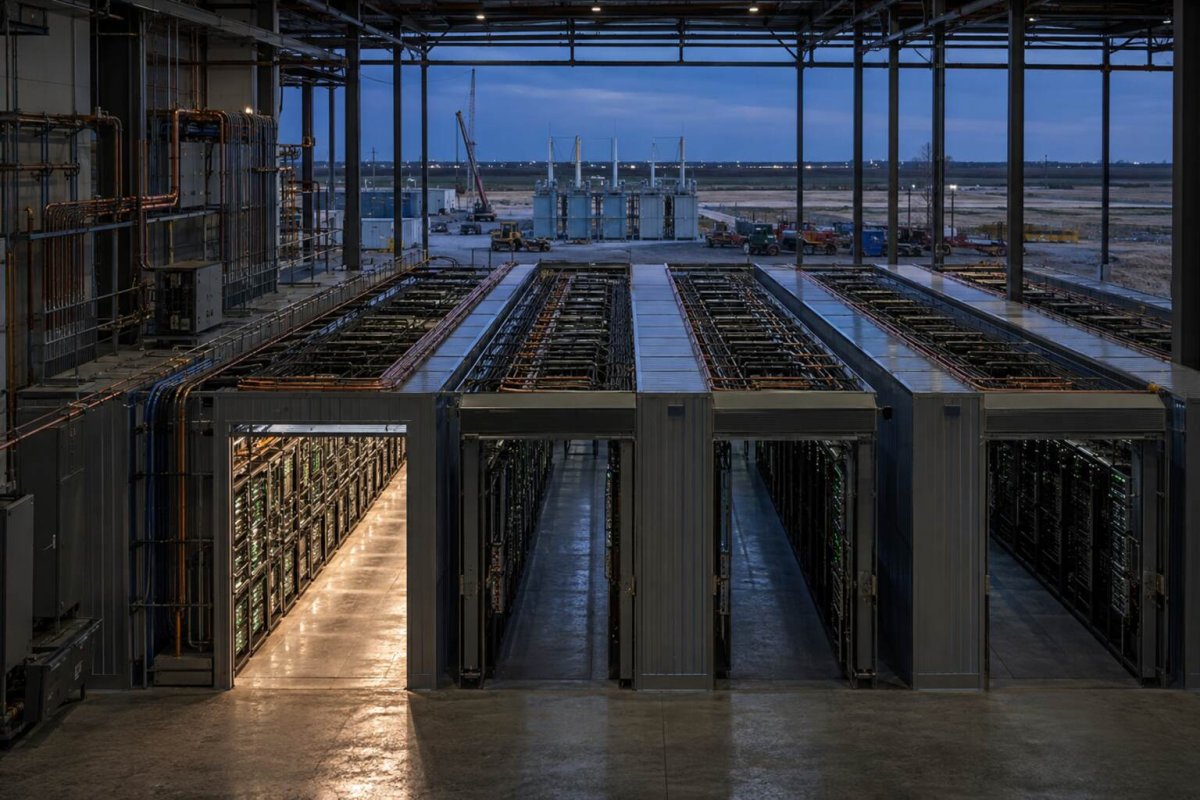
This is not a backlog without hardware or customers. Horizon 1, the first of four 50-megawatt liquid-cooled deployments at Childress, has been delivered to Microsoft. Horizon 2 is commissioning, and Horizons 3 and 4 are in late-stage construction targeting fourth-quarter delivery. IREN says recent three-year contracts produce more than $20 million of revenue per IT megawatt with an estimated payback of roughly two years.
Microsoft's roughly $9.7 billion five-year agreement and NVIDIA's $3.4 billion five-year contract provide investment-grade anchors. But they also create concentration risk: those two arrangements represent a substantial majority of contracted revenue. A delayed acceptance, capacity reduction, or termination by either would hit both revenue timing and the financing tied to that hardware.
Key metrics to watch
For investors, the most important update will be progress from $1 billion toward the $4 billion December target, with clear acceptance dates rather than another contracted-capacity headline. Reported AI cloud revenue needs to keep accelerating from $70.5 million as newly commissioned GPUs contribute for full periods. Capital intensity should be compared against customer prepayments, not just operating cash flow. And an updated diluted share count and ATM usage will determine how much of the enterprise growth reaches each share.
At $44.68, IREN stock already credits a significant premium for execution. The path to $4 billion ARR is clear but not assured. The next few months will reveal whether the company can convert its contracted backlog into billable service, and whether the market's confidence is justified.