IREN Limited (NASDAQ:IREN) saw its shares ease 0.8% on Tuesday, closing at $36.82, as investors weighed the company's substantial contracted AI revenue against its slower-moving realized cloud revenue. Trading volume reached 33.28 million shares, below the three-month average of 45.24 million, indicating a cautious session.
The crux of the valuation debate lies in the gap between IREN's contracted annual recurring revenue (ARR) and its GAAP-recognized cloud revenue. The company's AI Cloud contracted ARR stands at $4 billion, a figure that is 31.1 times its projected fiscal 2026 AI Cloud revenue of $128.8 million. This disparity underscores the difference between signed contracts and actual revenue recognition, which hinges on commissioning, testing, and customer acceptance milestones.
Despite the day's decline, the stock has recovered 3.9% from Friday's close of $35.45, though it remains 9.2% below the August 27 close, the day IREN announced its fiscal 2026 results. The recent pullback reflects a market recalibrating expectations after a period of sharp gains driven by AI infrastructure optimism.
Cloud revenue growth has been a bright spot. AI Cloud sales for the fourth quarter totaled $70.5 million, a 110% increase over the March quarter, and this segment contributed 51% of quarterly sales. For the full year, Bitcoin mining accounted for 82% of total revenue, highlighting the company's dual focus on crypto and AI infrastructure.
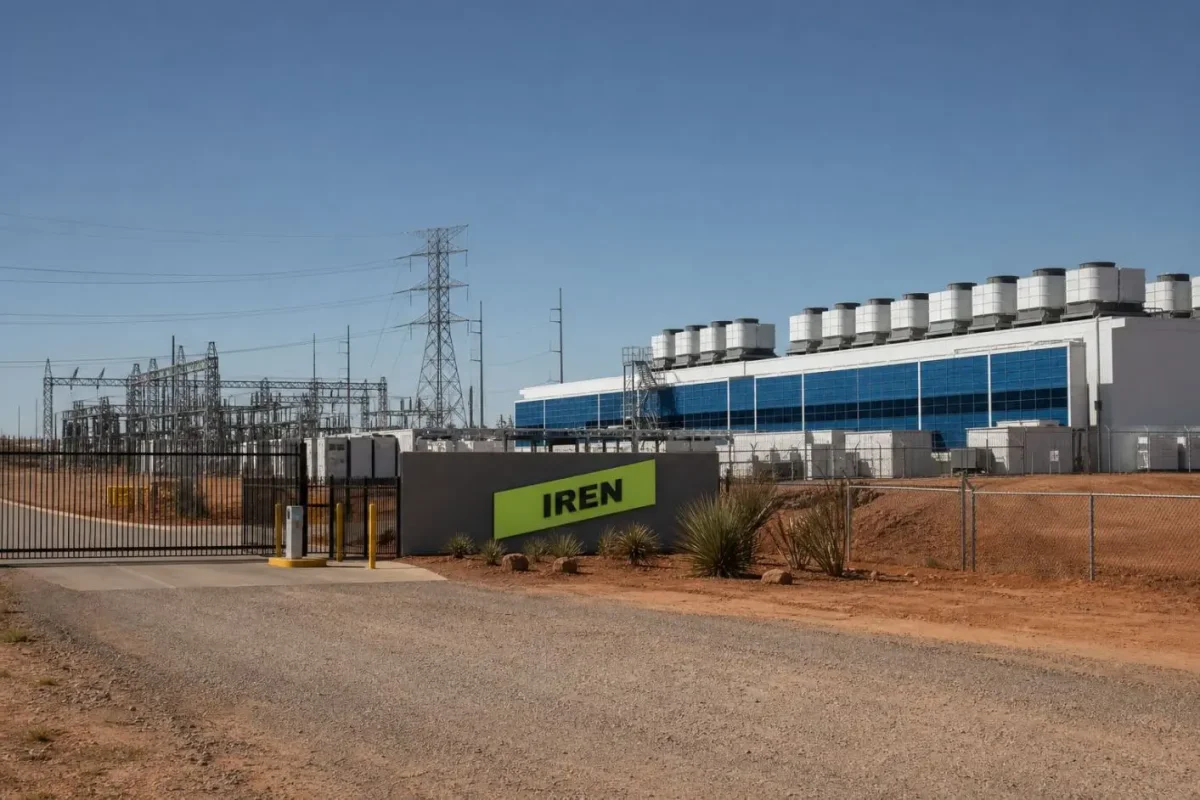
Co-founder and co-CEO Daniel Roberts emphasized that the company's 2026 capacity is largely sold out. IREN delivered its Horizon 1 unit to Microsoft Corporation (NASDAQ:MSFT) in August, with three additional 50-megawatt liquid-cooled units slated for deployment in the fourth quarter. The Childress campus, with 750 megawatts of power capacity, is central to these plans, with a target of 0.3 gigawatts of total IT delivery in 2026, rising to 0.8 gigawatts in 2027.
Financing is a key mitigant to immediate GPU funding concerns. A $3.6 billion facility carries a 6% interest rate, and when combined with customer prepayments, covers 96% of GPU-related expenses. Additionally, recent facilities add up to $2.8 billion, with $2.4 billion set at a 9% fixed rate, providing 90% coverage for associated GPU capital expenditures. This aggressive use of leverage underscores the company's commitment to scaling its AI infrastructure.
The balance sheet reflects this expansionary strategy. As of June 30, IREN held $5.90 billion in cash, against current and long-term debt of $7.59 billion. Capital expenditures on property and computer hardware totaled $4.33 billion in fiscal 2026, according to the audited annual filing. The company ended Tuesday with a market capitalization of approximately $14.5 billion, translating to a multiple of 20.5 on trailing revenue and 3.6 times its contracted ARR target.
Wall Street sentiment remains largely positive, with consensus ratings as of August showing 13 buys, three holds, and one sell. This distribution suggests broad belief in the demand for AI compute, though analysts differ on the timing of delivery and revenue recognition. The key risk is that the $4 billion ARR figure is a company-defined metric, not actual recorded revenue. Delays in commissioning, failed acceptance tests, or lower utilization could slow recognition. In fiscal 2026, IREN reported impairments of $638.8 million and a net loss of $702.6 million, underscoring the financial strain of its expansion.
With no earnings reports scheduled for the upcoming week, investor focus will likely remain on operational execution. Progress with commissioning and customer acceptance, particularly for Horizon 2 and the near-complete Horizons 3 and 4, will be critical. Each successful deployment could help close the 31-fold gap between contracted ARR and recognized revenue, while any delays would intensify scrutiny on the company's funding costs and capital-intensive plans.