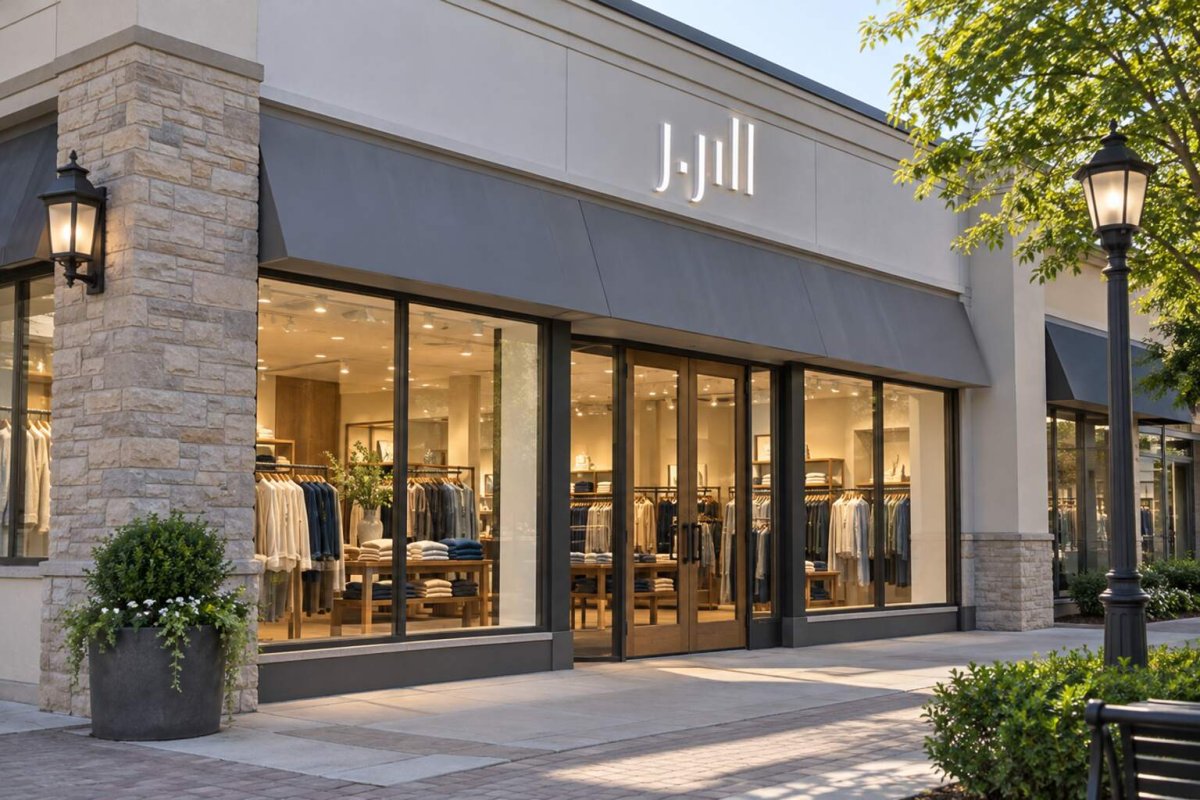
J.Jill (JILL) experienced a notable surge on Wednesday, with shares closing up 9.58% at $21.74 after the retailer lifted its full-year outlook. However, a closer look at the quarterly results reveals a more tempered picture than the share price suggests. Sales and comparable sales each rose a modest 0.5%, while a $13.3 million net tariff refund accounted for nearly all of the reported gross-margin expansion.
The stock reached an intraday high of $23.48, a 52-week record, before retreating 7.4% from that peak. It still finished $1.90 above the prior close on volume of approximately 890,000 shares—more than ten times Tuesday's trading activity. This robust trading volume indicates that investors were not simply rewarding an earnings beat; they were repricing the likelihood that the company's first-quarter weakness is coming to an end.
The Tariff Refund's Impact on Margins
For the second quarter, J.Jill reported net sales of $154.8 million, up from $154.0 million a year earlier. Direct-to-consumer sales increased 1.9% and represented 47.1% of total revenue. While these are improvements, they are not typically the kind of numbers that trigger a double-digit rally.
The tariff refund is the key differentiator. Gross margin reached 76.8%, an 840 basis point improvement year-over-year. Excluding the $13.3 million net refund, gross margin was 68.3%, essentially flat compared to 68.4% in the prior year. Adjusted EBITDA came in at $32.8 million including the refund, versus $25.6 million last year. The company also disclosed a $20.1 million figure excluding the refund and its allocation toward strategic investments and higher fuel costs. On that basis, the underlying measure was approximately 21% below last year's adjusted EBITDA.
This does not diminish the quarter's strengths. Full-price margin improved, inventory declined 5% to $52.6 million, and sales exceeded the guidance provided in June. However, investors should not view the 76.8% margin or the $32.8 million EBITDA as a new recurring baseline. The company's SEC filings make this distinction unusually clear.
Why the Raised Guidance Matters
The forward sales outlook provides the strongest support for the rally. For the third quarter, management expects net sales to rise 3% to 5%, comparable sales to increase 1% to 3%, gross margin to be roughly flat, and adjusted EBITDA to land between $20 million and $22 million. A positive comparable sales figure would be significant, given that comparable sales fell 4.2% in the first half of the year.
Full-year guidance now calls for net sales between flat and 2% growth, comparable sales between a 1% decline and a 1% increase, adjusted EBITDA of $75 million to $80 million, and approximately $40 million of free cash flow. In June, the ranges were a 0% to 2% sales decline, a 1% to 3% comp decline, $70 million to $75 million of adjusted EBITDA, and $20 million of free cash flow.
Part of the improvement is non-recurring. The new outlook includes the tariff refunds and the company's plan to spend most of them on marketing and technology during the third and fourth quarters. It also assumes a 10% to 12.5% tariff rate for the remainder of fiscal 2026, which is about $1 million more favorable than the previous second-half assumption. The real test is whether the additional spending can convert a one-time cash recovery into lasting customer growth and sustained full-price demand.
Valuation: Cheap, But With an Asterisk
Based on Wednesday's close and 14.86 million shares outstanding as of August 1, J.Jill's equity value was approximately $323 million. Adding $72.5 million of debt and subtracting $76.9 million of cash yields an enterprise value near $319 million, about 4.1 times the midpoint of the new adjusted EBITDA guidance range.
The guided $40 million of free cash flow represents roughly 12.4% of the market capitalization. The company also has $11.8 million remaining on a buyback authorization expiring December 6, about 3.7% of equity value, and pays a quarterly dividend of $0.09, an annualized yield near 1.7%.
These multiples appear inexpensive, but they incorporate the refund benefit. They also belong to a small specialty retailer whose first-half sales declined 2.7%, adjusted EBITDA fell to $49.5 million from $52.9 million, and SG&A expenses grew faster than sales in the latest quarter. Eight additional stores, lease renewals, marketing, shipping, and incentive accruals pushed quarterly SG&A to 61.1% of sales from 57.5%.
What Would Confirm or Unwind the Rally
The next critical data point is the third-quarter comparable sales figure. A result within the 1% to 3% growth range, combined with flat gross margin excluding unusual items, would indicate that assortment changes and customer acquisition efforts are working. Continued inventory discipline while sales rise would also be encouraging, reducing the risk that growth is being driven by markdowns.
Conversely, the rally may have prematurely capitalized on a one-time refund. If comparable sales turn negative again, full-price selling weakens, or SG&A remains above 60% of sales, the low headline valuation becomes less compelling. The pullback from $23.48 to $21.74 suggests some buyers are already cautious.
For now, the rally has a credible operating foundation, but not the 840-basis-point margin story implied by the reported figures. J.Jill has moved from stabilization to a positive third-quarter sales target, and its net cash position gives management room to invest, repurchase shares, and maintain the dividend. The thesis now hinges on whether those investments can generate repeatable growth once the refund disappears.