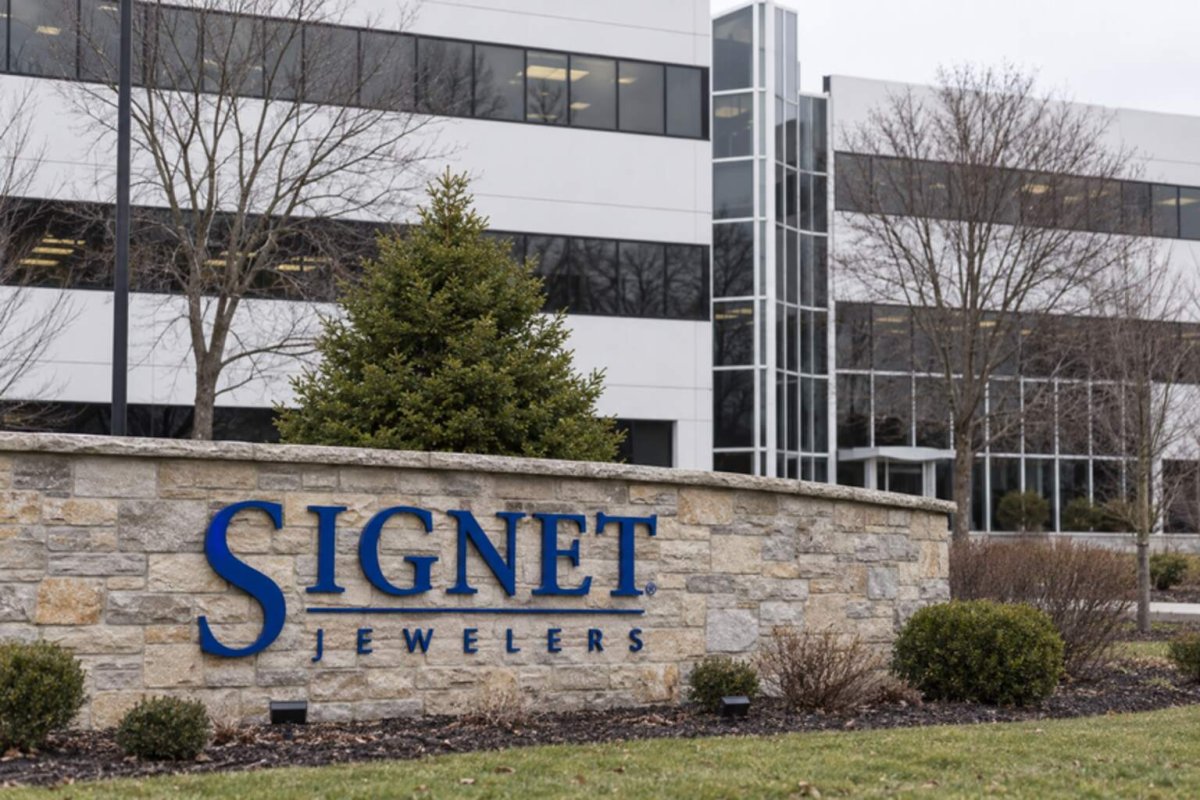
Signet Jewelers (NYSE: SIG) experienced its most significant single-day stock surge in recent memory on Wednesday, with shares closing at $102.48, a 23.96% jump from the previous close of $82.67. The rally followed the company's fiscal second-quarter earnings release, which delivered a mix of strong profitability metrics and a substantial capital return program, though the top line remained under pressure.
The headline revenue figure came in at $1.528 billion for the quarter ending August 1, slightly below the $1.535 billion reported in the same period last year. However, the market's enthusiasm was driven by more encouraging underlying trends. Same-store sales rose 2.2%, and the average unit retail price increased by approximately 6%, indicating that consumers are trading up to higher-priced jewelry. All fine-jewelry brands posted positive comparable sales, with units sold at higher price points growing at a high-single-digit rate. This divergence between reported revenue and same-store sales is largely due to store closures and the integration of Blue Nile and James Allen, which mask the strength of the core retail base.
Profitability improvements were more decisive. Adjusted operating income climbed 25.5% to $107.2 million, while the adjusted operating margin expanded to 7.0% from 5.6% a year earlier. Adjusted diluted earnings per share jumped to $2.19 from $1.61. These figures underscore that the company's earnings power is improving even as sales remain flat.
However, a portion of the margin expansion is not sustainable. The company disclosed that its gross margin benefited from $15 million in refunds of tariffs previously paid, which was $13 million more than anticipated. This refund alone represents roughly one percentage point of quarterly sales, more than the reported 80-basis-point gross margin expansion. Excluding the refunds, the underlying gross margin improvement is less pronounced, and the company did not provide a clean figure that isolates the impact of other cost improvements and higher gold costs.
Management raised its fiscal 2027 adjusted operating income guidance to a range of $535 million to $605 million, up from the previous $480 million to $560 million. The midpoint increase of $50 million, or 9.6%, suggests confidence in the operating trajectory. Adjusted EPS guidance was also lifted to $10.45 to $12.15 from $9.20 to $11.00. Yet, the revenue forecast remained unchanged at $6.7 billion to $6.9 billion, and the same-store sales guidance was only modestly adjusted at the lower end. The revised outlook incorporates approximately $30 million in tariff refunds and $30 million to $40 million from a renewed consumer credit agreement with Bread Financial, which extends the exclusive card-issuing relationship through December 2035. While the credit deal provides a signing bonus and a share of program profits, it ties a portion of the earnings uplift to credit economics rather than core merchandise demand.
The $125 million accelerated share repurchase program announced alongside the results is a significant component of the story. During the quarter, Signet repurchased about one million shares for $87 million, and an additional 400,000 shares for roughly $33 million after the quarter ended. The new accelerated repurchase, combined with the expanded authorization to $700 million, leaves approximately $575 million available for future buybacks. At Wednesday's close, the company's equity value was near $4.0 billion, making the accelerated repurchase equivalent to about 3.1% of that value. This program can meaningfully boost per-share earnings even if operating profit growth slows, but it is optional capacity rather than a commitment to spend every dollar.
Following the surge, Signet's stock trades at roughly 9.1 times the midpoint of its new adjusted EPS guidance. This valuation multiple, while still in single digits, reflects the market's cautious view of the company's long-term growth prospects. The low multiple also explains why a credible guidance raise and a large buyback commitment could trigger such a strong market reaction. Investors are essentially pricing in a mature, cash-generative business with limited upside, which makes any positive surprise particularly powerful.
Looking ahead, the third-quarter outlook is wide, with same-store sales expected to range from a 1% decline to 2% growth, and adjusted operating income projected between $31 million and $48 million. Key metrics to monitor include the mix of higher-price transactions, gross margin excluding tariff refunds, gold cost pressures, and the performance of the new credit program. The company's balance sheet remains solid, with cash of $526.8 million at quarter-end, up from $281.4 million a year earlier, and inventory down 1% to about $2.0 billion. However, the first half used $73.5 million of operating cash, and the holiday season will be critical for cash conversion.
The bullish thesis rests on the idea that Signet can sustain its operating improvements without relying on one-time refunds or financial engineering. Comparable sales are positive, customers are spending more per item, and management has the financial firepower to reduce the share count. The bearish counterargument is that a substantial portion of the earnings upgrade comes from non-recurring items and a lower share base, while revenue guidance remains stagnant. After a 24% one-day gain, the market is now asking whether the company can deliver on its operational promises or if the rally was a one-time event.