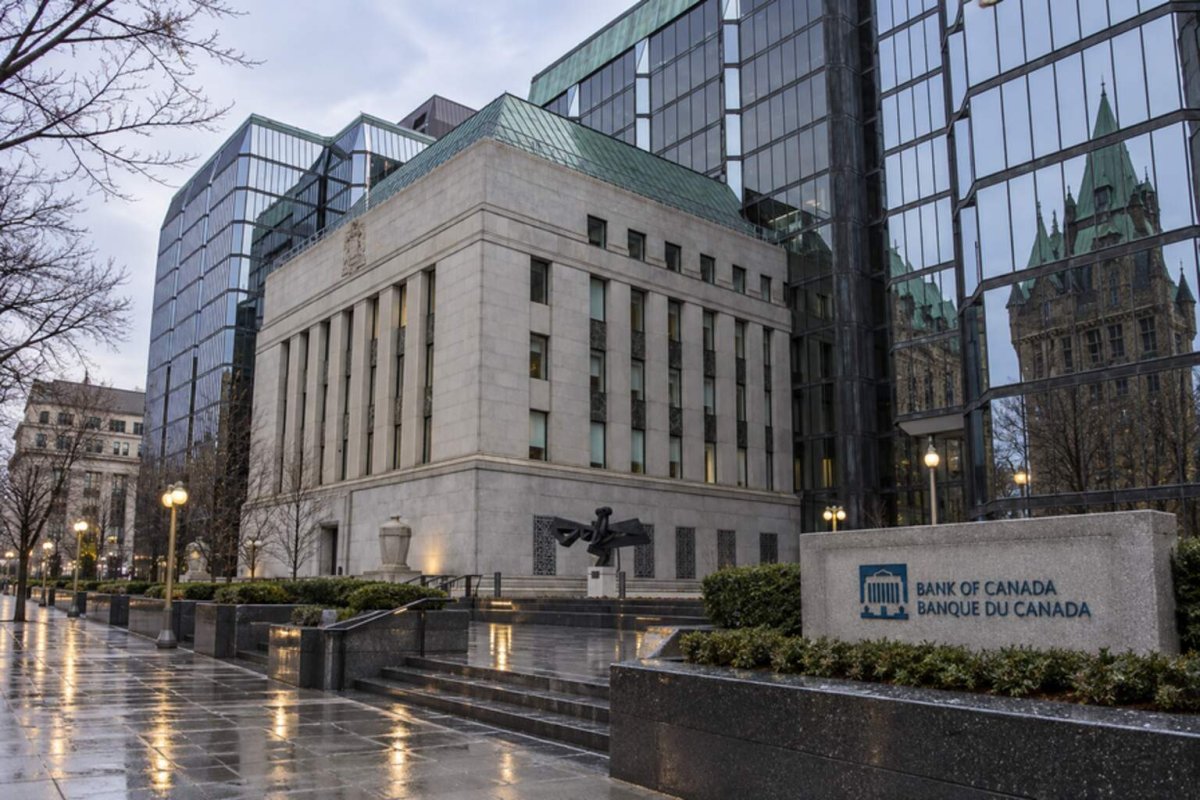
The Canadian fixed-mortgage market is experiencing upward pressure on rates, even as the Bank of Canada maintains its overnight rate at 2.25%. The key driver is the government bond market, where the benchmark five-year yield has risen from 3.14% on July 15 to 3.44% by September 8—a 30-basis-point increase. This repricing directly influences fixed mortgage offers and renewal costs, independent of the central bank's policy stance.
For investors in Canada's major banks—Royal Bank of Canada (RY), Toronto-Dominion (TD), Bank of Montreal (BMO), Bank of Nova Scotia (BNS), and Canadian Imperial Bank of Commerce (CM)—the situation is not a straightforward win. While these lenders may earn more on newly priced loans, the benefits could be offset by slower mortgage volumes, higher wholesale funding costs, and increasing borrower stress. The key test will be whether asset yields improve faster than funding costs and credit provisions.
Why Fixed Rates Rise When the BoC Holds
The Bank of Canada's overnight rate directly influences prime-linked variable mortgages and home-equity lines of credit. Fixed mortgages, however, are priced off longer-term government bond yields, which are influenced by global market dynamics, lender funding spreads, credit risk, and competition. This distinction is crucial now, as the BoC held its target at 2.25% on September 2, yet its own data show a broad increase in term rates from mid-July to early September: the two-year yield rose 31 basis points to 3.13%, the five-year gained 30 basis points to 3.44%, and the 10-year climbed 28 basis points to 3.81%.
In essence, the bond market has raised the cost of duration while the policy rate remains static. The central bank itself acknowledged that long-term yields have moved higher globally and in Canada since July. Its latest monthly lending data, which lags market conditions, put the average rate on new uninsured fixed-rate mortgages with terms of five years or more at 4.35% in June. Investors should view this as a historical average, not a current quote; the subsequent bond move suggests renewed upward pressure rather than a guaranteed one-for-one increase.
Market Challenges the 'Rates Stay at 2.25%' Baseline
The BoC's second-quarter survey of market participants had shown a remarkably flat median path, with rates expected to hold at 2.25% for every remaining 2026 decision. However, the September decision has made that outlook look stale. Governor Tiff Macklem stated the Bank is prepared to raise rates more than once if inflation remains too high. On decision day, money markets priced a quarter-point increase by December and roughly three more by 2027, according to Reuters. This market pricing explains why a steady overnight rate hasn't anchored fixed borrowing costs.
The policy dilemma is evident in recent data: second-quarter GDP grew at a 3.3% annualized rate, and July unemployment eased to 6.4%, yet labor demand remains subdued. Headline inflation is near 3%, largely due to gasoline, while inflation excluding gasoline is 2.2%. Persistent energy costs and Canadian counter-tariffs pose upside price risks, while U.S. trade measures threaten the recovery. The next rate decision and Monetary Policy Report on October 28 will be more significant than any single mortgage advertisement.
What Higher Renewal Rates Mean for Bank Stocks
The near-term positive for banks is repricing: mortgages and other loans originated or renewed at higher coupons can lift asset yields. A steeper yield curve can also help, though the July-to-September move was close to parallel—the spread between two- and 10-year benchmarks actually narrowed slightly from 71 to 68 basis points.
The negative side involves quantity and credit. Higher fixed rates can suppress home purchases and refinancing, while households rolling off 2021 and 2022 loans face payment shocks. Canada's banking regulator, OSFI, reports that 3.1 million mortgages—52% of the total—are due for renewal by the end of 2027. Of those, 1.3 million (22% of all mortgages) are fixed-rate or fixed-payment variable loans renewing for the first time since the low-rate vintages of 2021 and 2022.
OSFI expects material monthly payment increases for that group and notes rising delinquencies across several segments, particularly fixed-payment variable mortgages, self-employed borrowers, and the Toronto and Vancouver condo markets. These are signals to watch in residential-secured lending disclosures, stage-two loan balances, and provisions for credit losses—not necessarily an immediate capital problem.
Indeed, OSFI says residential-mortgage losses are unlikely to affect capital materially at most lenders due to existing allowances and strong earnings. Canada's largest banks also hold diversified loan books and substantial insured-mortgage exposure. The risk is more likely to emerge first as weaker volume, higher provisions, and uneven regional performance rather than a system-wide solvency event.
Three Numbers Investors Should Watch
- Five-year Canada yield: A sustained break above the September 8 level of 3.44% would keep pressure on fixed mortgage pricing even without an October hike.
- Core inflation versus energy: A wider pass-through from oil and tariffs would make the Bank's hike warning more credible; a retreat in gasoline-led headline inflation would weaken it.
- Renewal credit metrics: Arrears, impaired loans, and provisions at RY, TD, BMO, BNS, and CM will show whether payment shock is staying manageable.
The practical answer for bank shareholders is that rising Canadian mortgage rates are neither a clean windfall nor an automatic credit crisis. They increase the value of new loans, but they also strain borrowers and dampen volumes. The coming quarters will reveal which force dominates.