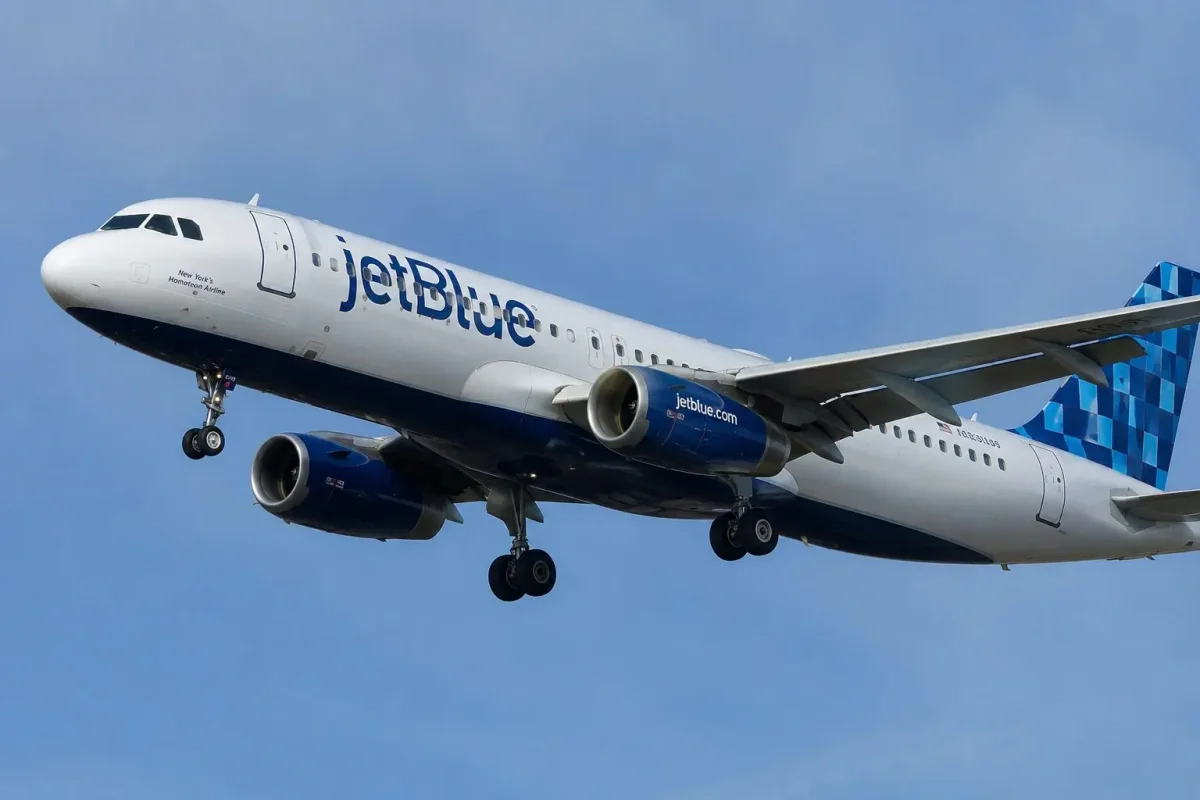
JetBlue Airways (NASDAQ: JBLU) saw its shares surge to a 52-week high during Tuesday's trading session, driven by a sharp decline in global oil prices. The stock climbed 5.9% to $6.60, touching an intraday peak of $6.62, as investors welcomed the potential relief on fuel costs, a significant expense for the carrier.
The rally was fueled by a 3.9% drop in Brent crude to $80.47 per barrel, following reports of progress in U.S.-Iran negotiations that could lead to the reopening of the Strait of Hormuz. The strait is a critical chokepoint for global oil shipments, and its closure has been a major concern for energy markets. Monday's session had already seen Brent tumble about 7%, setting the stage for Tuesday's continued slide.
JetBlue's gain outpaced its major airline peers, with American Airlines (NASDAQ: AAL) rising 3.1%, Alaska Air Group (NYSE: ALK) up 4.4%, and Southwest Airlines (NYSE: LUV) gaining 4.1%. The broader market also advanced, with the S&P 500 up about 1.3%, suggesting that increased risk appetite played a role in the sector's performance.
The airline's sensitivity to fuel prices is particularly acute. Based on its second-quarter fuel usage of 215 million gallons, annualized, a 10-cent change in fuel prices would alter gross annual expenses by roughly $86 million, equivalent to about 3.5% of JetBlue's current market value of $2.49 billion. This high leverage to fuel costs means that even modest swings in oil prices can have a significant impact on the company's bottom line.
The company's latest quarterly results, released on July 28, highlighted the challenges and opportunities. Revenue rose 14.5% to $2.697 billion, but aircraft fuel expenses surged 80.7% to $911 million, with the average fuel cost jumping 76.3% to $4.23 per gallon. This led to a net loss of $247 million, widening from a $74 million loss a year earlier. The adjusted per-share loss of 66 cents, however, beat the consensus estimate of 71 cents, providing some comfort to investors.
JetBlue has been working to offset higher fuel costs through pricing power. Revenue per available seat mile (RASM) climbed 10.9%, and average ticket prices rose nearly 9% in the second quarter. CFO Ursula Hurley expressed confidence that pricing will continue to provide an offset if fuel costs remain elevated. The company expects RASM growth of 12.5% to 16.5% in the third quarter, and maintains its full-year adjusted operating margin guidance of negative 2% to 5%.
However, the airline's balance sheet remains a concern. As of the end of the second quarter, JetBlue had cash and securities of $2.17 billion against total debt of $8.48 billion, resulting in net debt of $6.31 billion—roughly 2.5 times its market value. This high leverage amplifies the impact of fuel price fluctuations and other operational challenges.
Analysts are cautiously optimistic. Savanthi Syth of Raymond James (NYSE: RJF) described the company's 2028 EPS target as "ambitious," reflecting the hurdles ahead. The company's fuel cost projection for the third quarter is $3.49 per gallon, which would be a significant drop from the second quarter's $4.23, but still elevated compared to historical levels.
The key risk is that oil prices could rebound sharply if U.S.-Iran talks stall, undoing the recent relief. JetBlue also needs to sustain higher fares, manage non-fuel expenses, and cover projected 2026 interest costs of around $590 million. For now, investors are cheering the fuel relief, but the real test will be whether the company can achieve its targets of lower fuel costs and double-digit RASM growth simultaneously.