KLA Corporation (NASDAQ: KLAC) closed Friday at $254.54, up 5.55% in its first trading session following a 10-for-1 stock split. The stock opened at $237.60 and reached an intraday high of $254.93, extending a two-day rally of roughly 19% as investors recalibrate expectations for chip-equipment makers tied to artificial intelligence.
The split, effective June 12, converted each existing share into ten new shares, with the company emphasizing that the move does not alter total market capitalization or ownership percentages. CFO Bren Higgins stated that the split aims to improve share accessibility and liquidity while aligning with long-term capital allocation strategy. Although the split does not change fundamental valuations, lower share prices often attract retail investors and employees.
Analyst activity provided additional momentum. Barclays raised its price target to $2,250 from $1,700, maintaining an Overweight rating, while Cantor Fitzgerald lifted its target to $2,500 from $2,000, also Overweight. UBS increased its target to $2,180 from $1,770 but kept a Neutral stance. On a split-adjusted basis, these targets translate to approximately $225, $250, and $218, respectively, meaning Friday's close of $254.54 leaves limited upside relative to some adjusted targets.
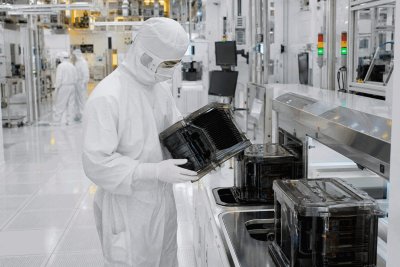
KLA's core business remains robust, driven by its critical role in semiconductor manufacturing. The company's inspection and process-control tools are essential for detecting microscopic defects in advanced chips, a capability that becomes increasingly important as AI chips grow more complex. This trend, known as process-control intensity, underpins the bull case for KLA as a key beneficiary of AI infrastructure spending.
In its fiscal third quarter, KLA reported revenue of $3.415 billion and GAAP net income of $1.20 billion, with GAAP diluted EPS of $9.12 and non-GAAP diluted EPS of $9.40. For the fiscal fourth quarter ending June 30, management guided revenue of $3.575 billion (plus or minus $200 million) and non-GAAP diluted EPS of $9.87 (plus or minus $1.00). Gross margins are expected to remain above 60%, reflecting pricing power for specialized chip equipment.
KLA also continues to return significant capital to shareholders. In fiscal Q3, capital returns totaled $874.8 million, with $3.15 billion returned over the past year. The board recently authorized an additional $7 billion share buyback program and increased the quarterly dividend. While buybacks can boost earnings per share by reducing the share count, they do not mitigate business-cycle risks.
Despite the positive momentum, valuation remains a concern. Fidelity reports a price-to-earnings ratio of approximately 68, indicating investors are paying a substantial premium for recent earnings. MarketScreener's average analyst target stands at $192.62, well below the current price, even though consensus remains positive. The stock fell nearly 9% after April's earnings when the outlook disappointed some investors, highlighting the risk of elevated expectations.
The next major catalyst for KLA is the fiscal fourth-quarter earnings report, expected after the June quarter ends. Investors will focus on whether revenue beats the $3.575 billion midpoint, if non-GAAP EPS exceeds $9.87, and management's commentary on AI, advanced packaging, and memory equipment demand. With the stock trading above several split-adjusted price targets, new buyers face heightened risk, though the long-term thesis remains intact if the AI cycle continues to broaden.