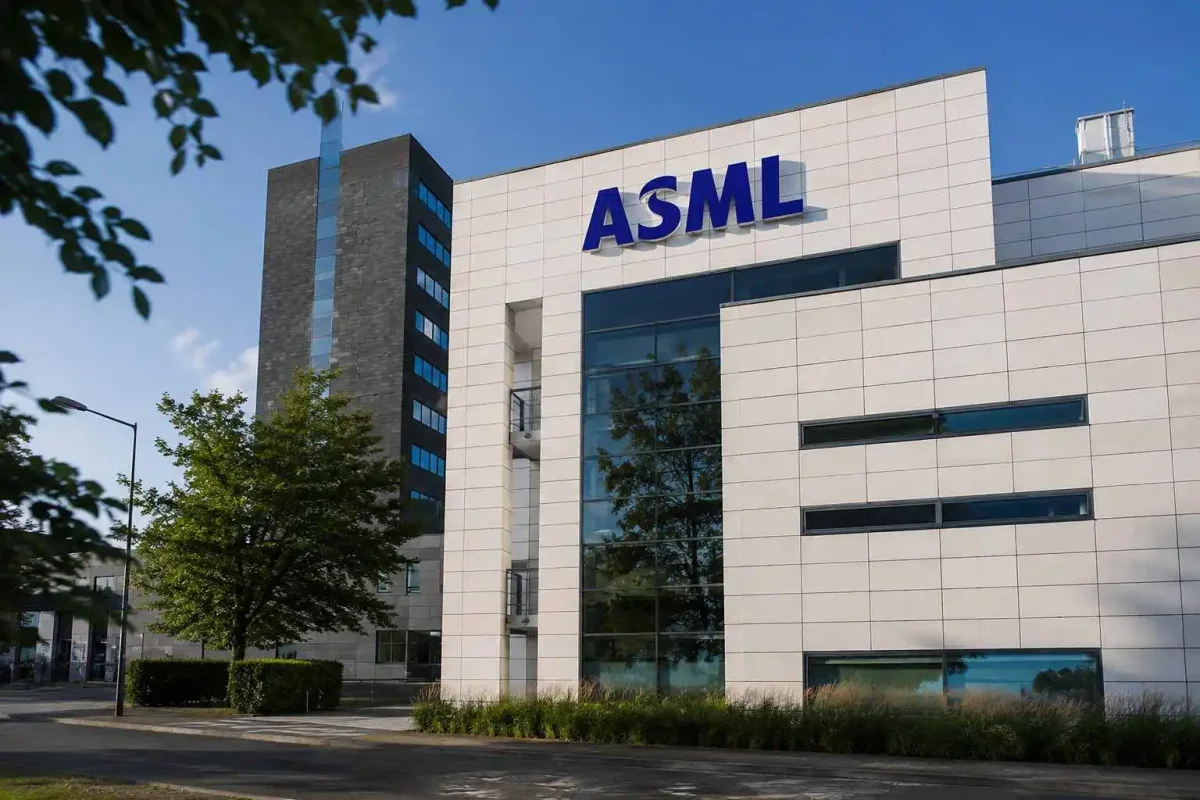
NEW YORK, July 27, 2026 – ASML Holding N.V. (NASDAQ:ASML) saw its U.S.-listed shares decline by 6.3% on Monday, sliding to $1,645.65, following a report that China has begun producing its own immersion deep-ultraviolet (DUV) lithography machines. The news raised fresh questions about the Dutch company’s competitive edge in the semiconductor equipment market.
According to the report, a state-backed Chinese manufacturer is expected to deliver approximately five immersion DUV systems this year and around 20 units by 2027. Although production volumes remain modest, the development signals a potential long-term challenge to ASML’s dominance in the lithography space.
The report noted that the Chinese-made machines still trail ASML’s systems in reliability and performance, and additional testing is needed before large-scale production can commence. Nonetheless, the stock market reaction suggests investors are weighing the possibility of a sustained breach in ASML’s competitive barriers in China.
Initial estimates indicate that ASML’s equity value fell by nearly $44 billion on Monday. For context, ASML forecasts its 2026 revenue to be between $49 billion and $51 billion, with roughly 20%—or about $10 billion—coming from China. The market cap decline was approximately 4.4 times that projected China revenue, implying that investors are pricing in potential losses in future pricing, service revenues, and market share.
The sell-off also impacted other semiconductor equipment stocks. Applied Materials (NASDAQ:AMAT) dropped 5.3%, Lam Research (NASDAQ:LRCX) fell 6.2%, and KLA Corp. (NASDAQ:KLAC) slipped 4.7%. The iShares Semiconductor ETF (NASDAQ:SOXX) was down 3.2%. On average, the three equipment peers declined by 5.4%, with ASML underperforming the group by roughly one percentage point.
The decline comes just 12 days after ASML reported robust second-quarter results. The company posted revenue of €9.33 billion, a gross margin of 54%, and net income of €2.92 billion. It sold 86 new lithography systems, up from 67 in the prior quarter. Management raised its full-year sales forecast to between €43 billion and €45 billion, with a gross margin of 54% to 56%. Third-quarter sales are projected at €11 billion to €12 billion.
CEO Christophe Fouquet described first-half order intake as “extremely strong,” and ASML plans to increase low-NA EUV and immersion-DUV capacity by 30% in 2027. Michael Roeg, an analyst at Degroof Petercam, called the July results “blow-out results across the board.” However, Monday’s decline highlights that China-related risks remain capable of overshadowing short-term execution.
The Chinese machines focus on immersion DUV technology, not extreme ultraviolet (EUV), where ASML remains the sole commercial source. By the end of the second quarter, nearly all of ASML’s increased EUV production capacity through 2027 had already been reserved. Still, China represents a significant DUV market, and ASML is already barred by export regulations from selling EUV and advanced DUV models there. The emergence of a credible domestic alternative could further pressure the legal equipment and service segments that remain accessible.
Risks remain on both sides. Chinese equipment could fall short in reliability, yield, or output tests, limiting its impact. Conversely, faster-than-expected technology progress or stricter service regulations could affect ASML’s China revenue sooner than anticipated. Investors will be watching tool uptime, customer responses, and the proportion of ASML’s sales to China for the next clues. For now, the market is pricing in a much larger question about competitive barriers than simply five machines.