Warsaw, November 17, 2026 – The upcoming LISA space observatory might open a new frontier in the search for exoplanets, potentially detecting worlds orbiting pairs of dead stars known as white dwarfs. Two studies published on November 10 explore how a planet would subtly alter the gravitational waves emitted by such binary systems and how infrared observations could confirm these findings. The research, highlighted in a NASA announcement, offers a forecast for future detections but does not report any newly discovered planets.
Understanding White Dwarf Binaries
White dwarfs are the dense, Earth-sized remnants of stars that have exhausted their nuclear fuel. While planets have been found around individual white dwarfs, none have yet been confirmed around a binary pair. Detecting such worlds would expand planet-hunting into a largely uncharted class of stellar systems, providing insights into planetary survival around evolved stars.
LISA: A Giant Gravitational Wave Detector
LISA, the Laser Interferometer Space Antenna, is a European Space Agency-led mission with NASA participation, targeted for launch in the mid-2030s. The observatory will consist of three spacecraft arranged in a triangle with sides of 2.5 million kilometers, trailing Earth in its orbit around the Sun. Laser links between the spacecraft will measure tiny changes in their separation caused by passing gravitational waves, allowing scientists to detect signals from distant cosmic events.
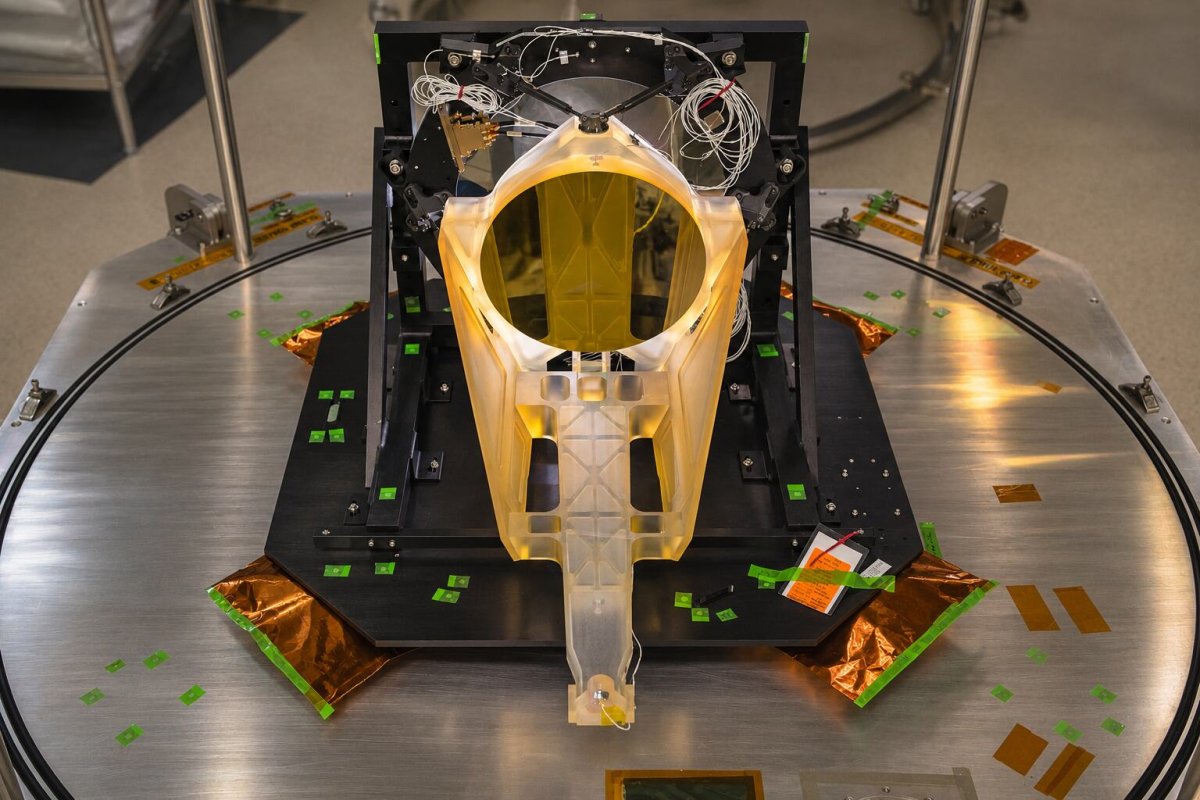
Each spacecraft will carry two telescopes, with NASA providing six in total. On October 8, NASA announced that L3Harris would build an additional engineering test unit before flight hardware production. The prototype, photographed at Goddard in 2024, features an amber glass-ceramic structure and a gold-coated mirror, essential for exchanging laser light across space.
Detecting Planets via Doppler Shifts
In a study led by Casey McGrath, the researchers propose that a planet orbiting a binary white dwarf system would cause a periodic tug on the pair, shifting the gravitational wave signal through the Doppler effect. This motion would redistribute some signal power into sidebands at additional frequencies, creating a unique pattern that reveals the planet's presence. The technique is most sensitive to massive planets with long orbital periods, and the study also accounts for the spacecraft's own motion, which must be subtracted from the data.
The concept dates back to 2008, but the new papers refine the detection physics and propose an independent verification method using the James Webb Space Telescope (Webb).
Complementary Roles of LISA and Webb
McGrath and colleagues modeled a system similar to the known binary ZTF J2243+5242, placed at an assumed distance of 150 parsecs (about 490 light-years) for a favorable case. Their simulations suggest that ten years of LISA observations could reveal planets as small as Jupiter's mass, while Webb's infrared observations would be sensitive to planets above about five Jupiter masses. Webb would look for excess infrared emission beyond what the two stars should produce, providing a cross-check on any gravitational wave candidate.
The ten-year mission duration assumes extended operations; ESA's baseline is four years with a possible six-year extension, but the study's optimistic scenario highlights the potential of long-term monitoring.
Optimistic Forecasts and Caveats
The authors emphasize that these are optimistic limits. Uncertain binary parameters could hide a planet's signal, and other stellar processes could mimic one. Therefore, independent observations would be crucial to confirm any detection. The studies are forecasts of what might be achievable, not announcements of actual discoveries.
Implications for Planet Formation and Evolution
Detecting planets around double white dwarfs would have profound implications for our understanding of planetary system evolution. Such systems have survived the violent late stages of stellar evolution, including possible common-envelope phases, which could reshape or destroy planets. Finding them would suggest that planets can endure extreme conditions, offering clues about the resilience of planetary systems and the potential for habitable worlds in unlikely places.
As LISA's launch approaches, the astronomical community eagerly anticipates the data that could turn these theoretical predictions into real discoveries.
