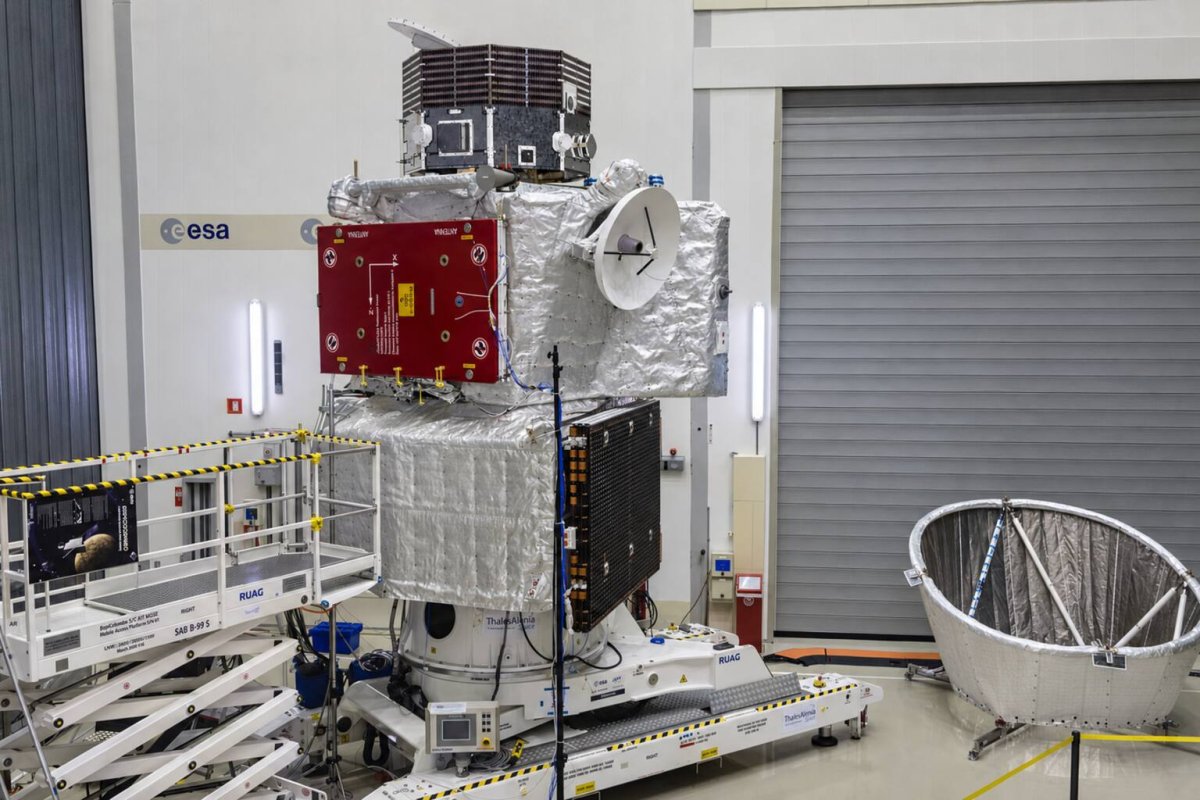
BepiColombo, the joint European-Japanese mission to Mercury, is on track for a critical orbit insertion on November 21, 2026. The spacecraft, which has been in transit since its launch in October 2018, will finally be captured by the innermost planet's gravity, marking a major milestone in a mission that has faced technical challenges and schedule revisions.
Mission Timeline and Key Milestones
According to the European Space Agency's (ESA) latest arrival update, the spacecraft will enter Mercury's orbit on November 21, with the two science orbiters—ESA's Mercury Planetary Orbiter (MPO) and JAXA's Mercury Magnetospheric Orbiter (Mio)—still attached. The separation of Mio is planned for December 9-10, followed by the release of Mio's protective sunshield on December 16. The MPO will continue adjusting its orbit through March 2027, with the start of the full science phase scheduled for April 2027.
The arrival sequence is the culmination of a complex journey that involved nine gravity assists—one from Earth, two from Venus, and six from Mercury—combined with electric propulsion. The mission's original timeline was revised in 2024 after a power-system issue on the transfer module limited the ion engines' output, delaying arrival from December 2025 to November 2026.
Scientific Objectives and Instruments
Once in orbit, the two orbiters will conduct a coordinated study of Mercury. The MPO, operating in a lower orbit (480-1,500 km altitude), will carry 11 science experiments, including a laser altimeter for terrain mapping, a thermal infrared spectrometer to analyze surface minerals and temperature, an X-ray spectrometer for elemental composition, and a magnetometer to investigate the planet's magnetic field and interior.
Mio, in a wider elliptical orbit (590-11,640 km altitude), will use its five instruments to study magnetic fields, plasma, sodium in the exosphere, and dust. The mission aims to answer fundamental questions about Mercury's magnetic field generation, its magnetosphere's comparison with Earth's, and the processes that shaped rocky planets near the Sun.
Operational Challenges and Preparations
The orbit insertion is demanding due to the Sun's gravitational pull, requiring 16 burns through March 2027. ESA has conducted extensive simulations, including contingency scenarios, with the final rehearsal completed on October 29. The operations will require closely coordinated activities between the two agencies' spacecraft, with the first major test being the Mio separation in December.
Market and Industry Impact
While this is primarily a scientific mission, it underscores the growing role of international collaboration in space exploration, which has implications for the aerospace and defense sectors. Companies involved in spacecraft manufacturing and launch services could see indirect benefits from continued government investment in planetary science. The mission's success could also pave the way for future public-private partnerships in deep-space exploration.
As BepiColombo approaches its destination, the global space community will be watching closely. The data collected over the coming years could reshape our understanding of Mercury and provide insights into the formation of terrestrial planets, with potential applications for future missions and commercial space endeavors.
The milestones are subject to change as operational conditions dictate, but ESA has expressed confidence in the current timeline. The science phase, set to begin in April 2027, promises to deliver groundbreaking findings from the planet closest to the Sun.