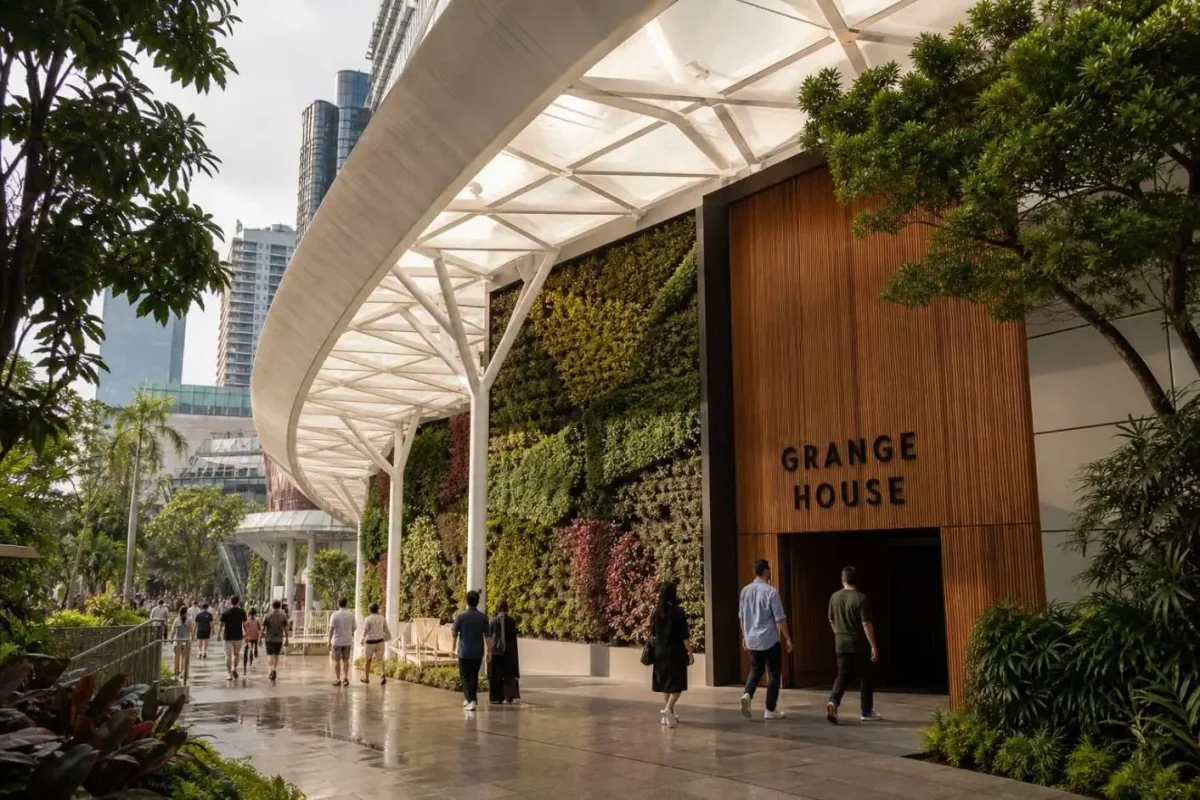
Live Nation Entertainment (NYSE:LYV) saw its shares decline 1.5% on Tuesday as investors weighed the company's strategic pivot toward higher-margin venue operations. The drop came after the live entertainment giant unveiled plans for Grange House, a 3,000-capacity venue slated to open on Singapore's Orchard Road by mid-2027.
Shares closed at $177.20, down $2.69 from the prior session, with 1.62 million shares changing hands. The modest pullback reflects a market digesting the implications of a venue that, while significant for the company's international footprint, represents a small piece of a $7.7 billion quarterly business.
Margin-Focused Strategy
The Grange House project underscores Live Nation's broader emphasis on ancillary revenue streams. While concert promotion remains the core business, the company is increasingly looking to hospitality, ticketing, sponsorship inventory, and food and beverage offerings to drive profitability. These segments typically generate higher economic returns than traditional concert promotion.
The venue will feature a landscaped terrace, a restaurant, and an all-day café, with public areas designed to be accessible outside of event nights. It will also host events organized by external promoters, marking a flexible approach to programming.
Financial Context
The company's most recent quarterly results highlight the importance of venue mix. Concerts revenue increased 8% year-over-year to $6.44 billion, but Concerts adjusted operating income (AOI) declined 14% to $309.6 million. In contrast, Ticketing AOI climbed 14% to $331.0 million, while Sponsorship AOI advanced 13% to $256.9 million.
These figures illustrate the financial benefits of generating revenue per visit on top of admission fees. The company's adjusted operating income is a key segment performance measure used by management to evaluate operational efficiency.
Capacity Scenarios
At the announced 3,000-person capacity, Grange House could host up to 300,000 attendees across 100 fully sold-out shows, or 600,000 across 200 shows. A sold-out run of 150 shows would allow for as many as 450,000 admissions. However, these figures are simple arithmetic based on capacity, not company projections or attendance guidance.
Ticket revenue will depend on event terms and actual occupancy, but spending per fan and sponsor interest could prove more significant factors in the venue's financial success.
International Expansion
Live Nation has been active in Singapore since 2006, according to managing director Edward Liu. The company's international expansion has been a key growth driver, with concert attendance in the first half of the year increasing 9% to 72.5 million. Nearly 90% of the six-million rise in fans came from overseas markets.
The Grange House project is backed by Singapore's tourism board, though financial details have not been disclosed. Venue president Stephanie Bax stated that designers prioritized "an exceptional experience for artists and fans."
Risks and Considerations
Live Nation has not revealed project expenses, lease terms, or a timeline for events. Costs incurred before the venue opens have already impacted Concerts AOI. Additionally, a $450 million expense tied to litigation reduced operating income for the first half of the year by 75%.
Investors are likely to focus on utilization rates, onsite spending, and sponsor agreements before attributing significant value to Grange House. The venue is ultimately a measure of margin rather than a numbers game on seats.