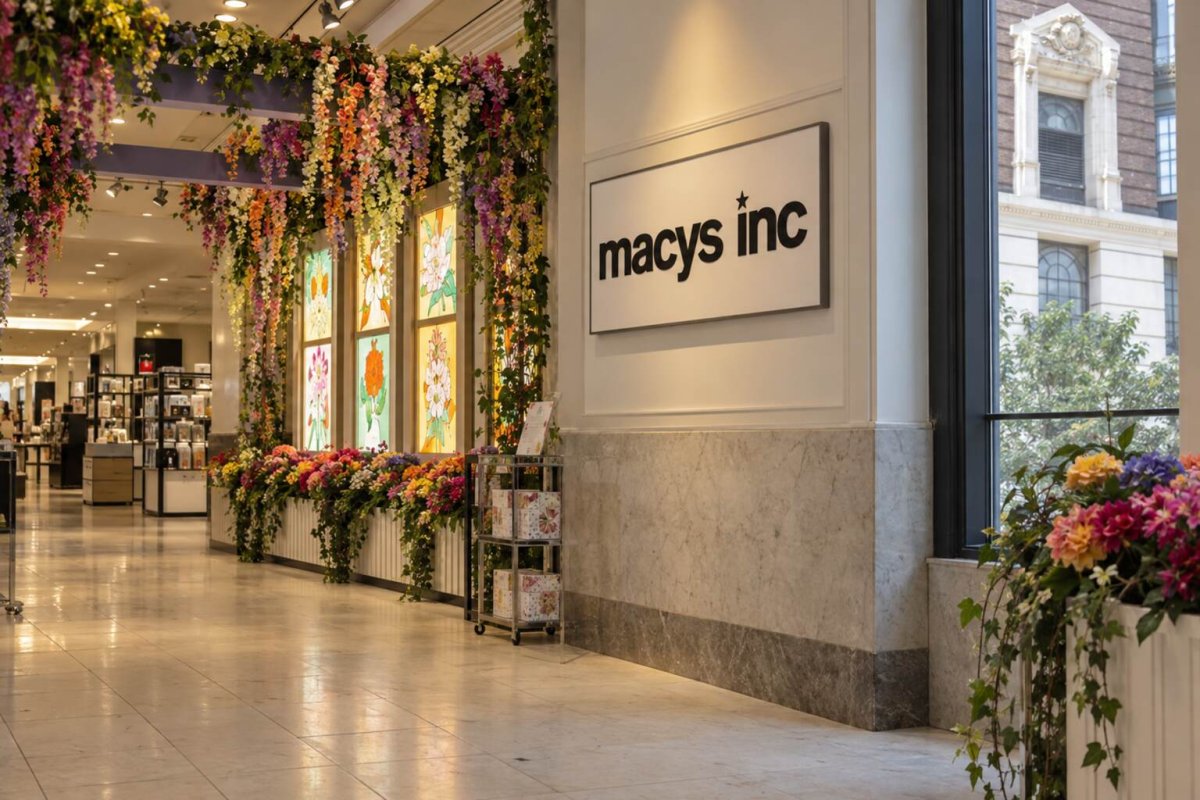
Macy's Inc. is set to report its fiscal second-quarter results before Thursday's opening bell, with the market's attention fixed less on the headline numbers and more on the underlying health of its core department store business. The retailer faces a credibility test as investors look for evidence that the namesake chain is gaining traction without eroding profitability.
Wall Street expects net sales of approximately $4.81 billion and adjusted earnings per share of $0.37, according to consensus estimates. These figures sit just above management's own guidance range of $4.75 billion to $4.80 billion in sales and $0.29 to $0.34 in adjusted EPS. The narrow gap means a so-called 'beat' may not be enough to satisfy investors, especially after the stock fell 4.2% on Wednesday to close at $21.51.
Key Metrics to Watch
Comparable sales growth is the first critical indicator. In the first quarter, Macy's posted a 3.0% group comp increase, but the performance was uneven across its portfolio: the flagship Macy's brand rose only 1.6%, while Bloomingdale's surged 10.2% and Bluemercury gained 6.4%. A second-quarter result near the flat end of guidance would signal a sharp deceleration, even if it extends the company's streak of positive comps to five consecutive quarters.
Profit quality is the tougher test. First-quarter gross margin slipped 30 basis points to 38.9%, which management attributed entirely to tariffs. Adjusted EBITDA fell 4.6% to $290 million, and the adjusted EBITDA margin contracted 40 basis points to 5.9%. The company's Q2 guidance implies a seasonal improvement to a 6.9%–7.2% adjusted EBITDA margin. Investors will scrutinize whether that improvement comes from better full-price selling and operational efficiency, or from non-core items like credit-card income or real-estate gains.
Inventory and Guidance
Inventory levels are an early warning sign. At the end of Q1, merchandise inventory was up 3.6% year-over-year, outpacing the 1.8% increase in net sales. While management said the mix was well-positioned for summer, another quarter of inventory growing faster than sales could raise the risk of markdowns in the crucial second half.
Macy's raised its full-year fiscal 2026 outlook in June, projecting net sales of $21.5 billion to $21.75 billion, comp growth of 0.5%–1.2%, and adjusted EPS of $2.00–$2.20. The guidance assumed tariffs and fuel costs remain at current levels. A simple reaffirmation may not suffice if Q2 lands near the bottom of the ranges; investors need to see a credible path to the annual comp target and a full-year gross margin of 38.4%–38.6%.
Balance Sheet and Buybacks
The company enters the report with a solid balance sheet: $1.29 billion in cash, $2.43 billion in long-term debt, and no significant maturities before 2030. Macy's also repurchased $50 million of shares in Q1 and has about $1.1 billion remaining under its authorization. Buybacks can support the stock, but they cannot substitute for a healthier core retail operation.
The bull case rests on the expansion of the 'Reimagine' store program, which aims to spread the better performance of its top locations across the broader Macy's fleet, while Bloomingdale's and Bluemercury continue to thrive. The bear case is that luxury has been carrying a slower namesake chain, and tariffs, fuel costs, and elevated inventory threaten the margin recovery.
Ultimately, the headline EPS of $0.37 is not the full test. Investors should focus on Macy's-nameplate comps, gross margin, the Reimagine-store gap, and inventory growth. If these improve together, the report can advance the turnaround thesis. If EPS beats only due to below-the-line items while core selling weakens, the market may see it as another quarter bought rather than built.