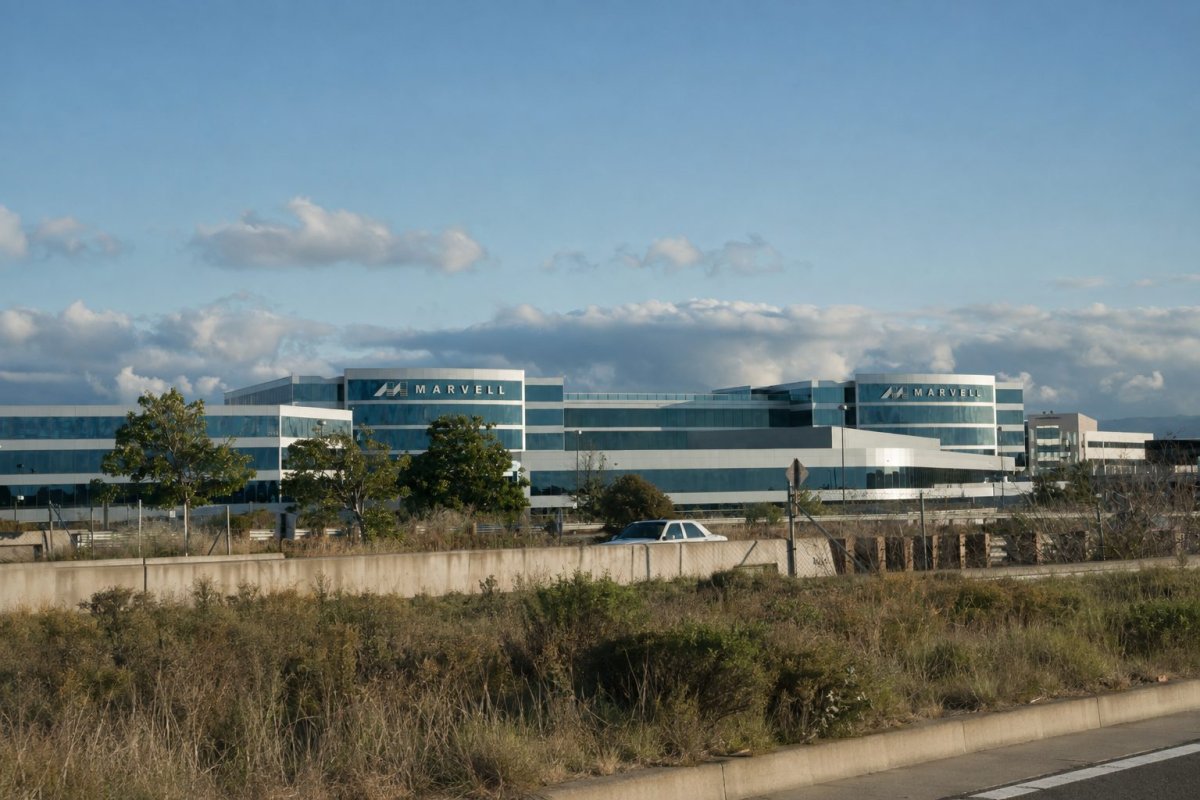
Marvell Technology (NASDAQ: MRVL) experienced its worst trading day in recent memory on Friday, with shares plummeting 10.3% to close at $216.62. The sharp sell-off erased roughly $22 billion in market capitalization, even as the company reported its highest-ever quarterly revenue. The market's reaction underscores a growing impatience among investors regarding the timeline for returns from Marvell's high-profile custom-chip partnership with Google.
The semiconductor firm delivered fiscal second-quarter revenue of $2.739 billion, a 37% year-over-year increase, driven largely by data-center sales that surged 46% to $2.172 billion—now representing 79% of total revenue. Non-GAAP earnings per share came in at $0.94, narrowly beating the analyst consensus of $0.93, according to FactSet. Despite these strong figures, the stock's decline highlights concerns beyond the headline numbers.
Margin Compression Raises Red Flags
While revenue growth remains robust, profitability metrics tell a more cautionary tale. The company's non-GAAP gross margin for the second quarter stood at 58.9%, but management's guidance for the third quarter points to a midpoint of 58.0%—a sequential decline of 90 basis points. This margin erosion, even amid surging AI-related demand, has become a focal point for investors who worry that the cost structure may not support sustained earnings growth.
Third-quarter revenue guidance of $3.15 billion implies sequential growth of approximately 15%, but the margin outlook suggests that scaling up production for custom AI chips may carry higher costs than previously anticipated. The company projects revenue growth of about 45% for fiscal 2027 and has raised its fiscal 2028 revenue target to roughly $18 billion, yet the market appears to be pricing in execution risks.
Google Deal: Big Promise, Delayed Payoff
Central to the sell-off is the timing of revenue from Marvell's custom-chip collaboration with Google. CEO Matt Murphy indicated that the impact of this partnership will become more significant starting in fiscal 2029, a timeline that some investors find too distant. The deal has the potential to generate as much as $120 billion in cumulative revenue by the end of fiscal 2033, but the wait may be testing shareholder patience.
This delay is particularly consequential for Marvell's valuation. The stock currently trades at a forward price-to-earnings multiple of 58.4 times, significantly higher than Broadcom's (NASDAQ: AVGO) 32.2 times. Investors are questioning whether the premium valuation is justified when the biggest growth catalyst is several years away.
Analyst Sentiment Remains Bullish
Despite the market's negative reaction, Wall Street analysts remain largely optimistic. According to FactSet data, Marvell holds 30 Buy ratings, seven Overweight ratings, and six Hold ratings, with no Sell recommendations. The median price target stands at $295, implying a 36% upside from Friday's closing price. However, the stock's performance suggests that the market is waiting for tangible evidence that the Google partnership will translate into bottom-line growth sooner rather than later.
Financial Health and Operational Metrics
Marvell ended the quarter with $3.93 billion in cash on hand. Operating cash flow totaled $605.5 million, representing 22.1% of revenue, while stock-based compensation amounted to $326.2 million. Trading volume on Friday reached 48.98 million shares, exceeding the 65-day average by 21%, indicating widespread selling pressure.
The company's heavy reliance on a few key customers, potential constraints in advanced chip supply, and the risk of delayed custom-silicon rollouts remain key vulnerabilities. If execution improves and margins stabilize, the stock could see a valuation rebound, but for now, investors are demanding more immediate returns from its AI investments.