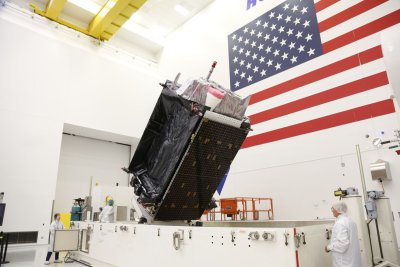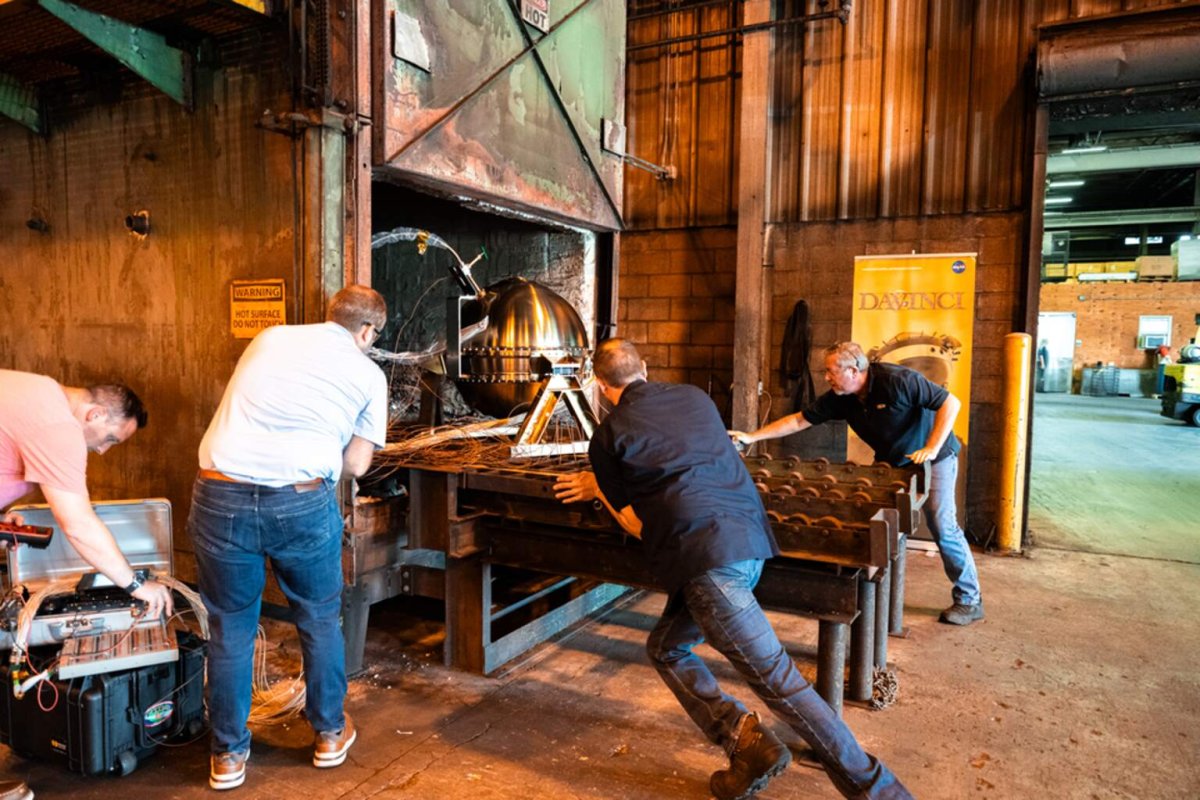
NASA has successfully completed a series of rigorous thermal tests on a full-scale engineering model of its DAVINCI Venus descent probe, clearing a significant technical hurdle for the ambitious mission. The test campaign, conducted from August 28 to September 10, subjected the probe's insulated pressure vessel to six simulated descents, each replicating the extreme heat profile it will encounter when plunging through Venus's thick atmosphere.
Engineers used a specialized industrial furnace in Bedford, Pennsylvania, to heat the test article to 465 degrees Celsius (869 degrees Fahrenheit) over roughly 55 to 60 minutes per cycle, matching the expected descent timeline. More than 100 thermal sensors monitored the probe's interior, including instrument simulators, to assess how the heat penetrated the titanium shell and its protective insulation. The successful completion of all six cycles demonstrates that the thermal design can withstand the rapid temperature rise repeatedly, a key requirement for mission reliability.
Venus presents a uniquely hostile environment, with surface temperatures averaging around 464 degrees Celsius and pressures about 92 times that of Earth's atmosphere, according to the European Space Agency. The DAVINCI probe must survive this while collecting atmospheric samples and transmitting data back to Earth. The rapid heating creates thermal gradients that stress materials differently, making the rate of temperature increase as critical as the peak temperature itself. The test's success indicates that the probe's seals, windows, and wiring feed-throughs can handle these stresses without failure.
However, NASA was careful to note that the test article was an engineering development unit, not the flight-ready probe. The campaign did not simulate the full pressure load, corrosive sulfuric acid clouds, or launch vibrations. These factors will be addressed in separate qualification tests. The current milestone primarily validates the thermal protection system's performance at full scale, a critical step in retiring risk for the mission.
The DAVINCI mission, a collaboration with Lockheed Martin, aims to analyze Venus's atmosphere during a controlled descent, measuring noble gases and stable isotopes to understand the planet's climate evolution. The probe is designed to return at least 60 gigabits of data, including images of the surface below the clouds. The success of this thermal test brings the project closer to the next major milestone: a decision to proceed with final design and fabrication.
Market analysts note that while DAVINCI is a science mission, its success is vital for NASA's broader Venus exploration program, which could have implications for future contracts and technology development. The mission's progress is being closely watched by the aerospace industry, with Lockheed Martin as the prime contractor. The company's stock (LMT) has been stable, but a successful mission could bolster its reputation in deep-space exploration.
The thermal test results, detailed in a NASA report dated September 24, provide confidence that the probe can protect its electronics during the hour-long descent. The probe's design balances the need for insulation with the requirement to admit atmospheric gases through dedicated inlets for chemical analysis, a complex engineering challenge that the tests help validate.
As NASA prepares for the design review, the DAVINCI team will continue to analyze the test data, refining thermal models and ensuring that the flight hardware will meet all mission requirements. The next phase will involve testing the actual flight probe under simulated Venus conditions, including full pressure and chemical exposure, before the scheduled launch in the late 2020s.