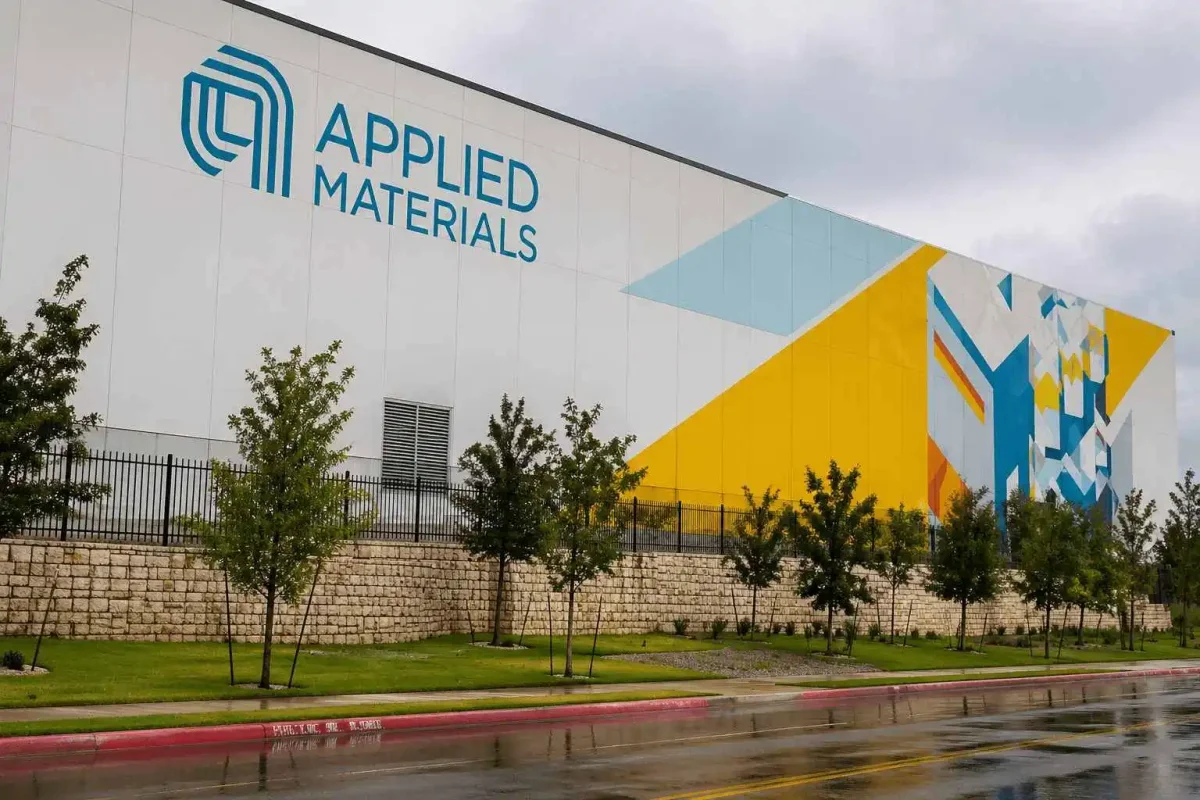
The U.S. Commerce Department has directed several semiconductor equipment manufacturers, including Applied Materials (AMAT), to cease shipments of specific chip-making tools to China's Hua Hong Semiconductor, according to a Reuters report. The directive also applies to Lam Research (LRCX) and KLA (KLAC), sources familiar with the matter told Reuters. Applied Materials did not immediately respond to a request for comment.
China Exposure Under Scrutiny
China remains a significant revenue driver for Applied Materials despite previous U.S. restrictions that have already curtailed sales to the region. In the quarter ending January 25, Applied Materials generated $2.10 billion from China, representing 30% of its total revenue, as disclosed in a regulatory filing. This latest regulatory action adds pressure on the company, with its fiscal second-quarter earnings call scheduled for May 14, just under three weeks away.
Shares of Applied Materials were trading around $382.32 early Wednesday, showing little change after a 5.8% decline on Tuesday triggered by the Reuters report. Lam Research slipped roughly 0.9%, while KLA also declined 0.9% in early U.S. trading, keeping chip-equipment stocks under pressure.
Targeting Advanced Chip Production
The U.S. action focuses on shipments linked to two Hua Hong facilities that American officials suspect may be engaged in producing some of China's most advanced semiconductors, Reuters reported. One of these sites, Huali Microelectronics, has been preparing for 7-nanometer manufacturing in Shanghai. In semiconductor manufacturing, smaller nanometer figures generally indicate more advanced, cutting-edge chip production.
China's foreign ministry responded to the report, with spokesperson Lin Jian urging the United States to take "concrete actions" to ensure global supply chains remain stable and unimpeded, though he did not specifically mention Applied Materials.
Industry and Policy Context
Chris McGuire, senior fellow for China and emerging technologies at the Council on Foreign Relations, described the Trump administration's move as "an overdue and welcome first step" in an interview with Reuters. However, he cautioned that unless the measure extends to all shipments from U.S. toolmakers—including those routed through foreign subsidiaries—its impact may be limited.
Applied Materials has previously warned investors that U.S. export rules could restrict its China sales and create opportunities for foreign or local Chinese competitors to fill the gap. In its filing, the company highlighted the difficulty and delays in securing licenses, noting that tighter regulations could disrupt shipments or support for certain customers.
Potential Workarounds and Uncertainty
According to Reuters, Hua Hong may seek to replace U.S. equipment with hardware from Chinese or other non-U.S. suppliers. It is also worth noting that the Commerce Department's "is-informed" letters are not guaranteed to evolve into broader, binding rules. As a result, the exact amount of revenue at risk and the duration of any disruption remain uncertain.
Recent Compliance Settlement
This development follows Applied Materials' recent resolution of another export-control matter. In February, the Commerce Department's Bureau of Industry and Security (BIS) announced that Applied Materials and its Korean affiliate would pay approximately $252 million for unlawfully shipping semiconductor manufacturing equipment to China. That penalty ranks as the second-largest ever imposed by BIS.
At the time, Applied Materials stated that the settlement resolved BIS claims related to specific China shipments from November 2020 through July 2022. The company also noted that the Justice Department and SEC had concluded related probes without further action, and reaffirmed its commitment to export-control and trade compliance.
AI Demand Provides Some Buffer
Despite these headwinds, Applied Materials' core business continues to benefit from AI-driven chip demand. The company reported first-quarter revenue of $7.01 billion and projected fiscal second-quarter sales of $7.65 billion, plus or minus $500 million. CEO Gary Dickerson has highlighted AI computing as a catalyst for spending on advanced logic, high-bandwidth memory, and packaging technologies.