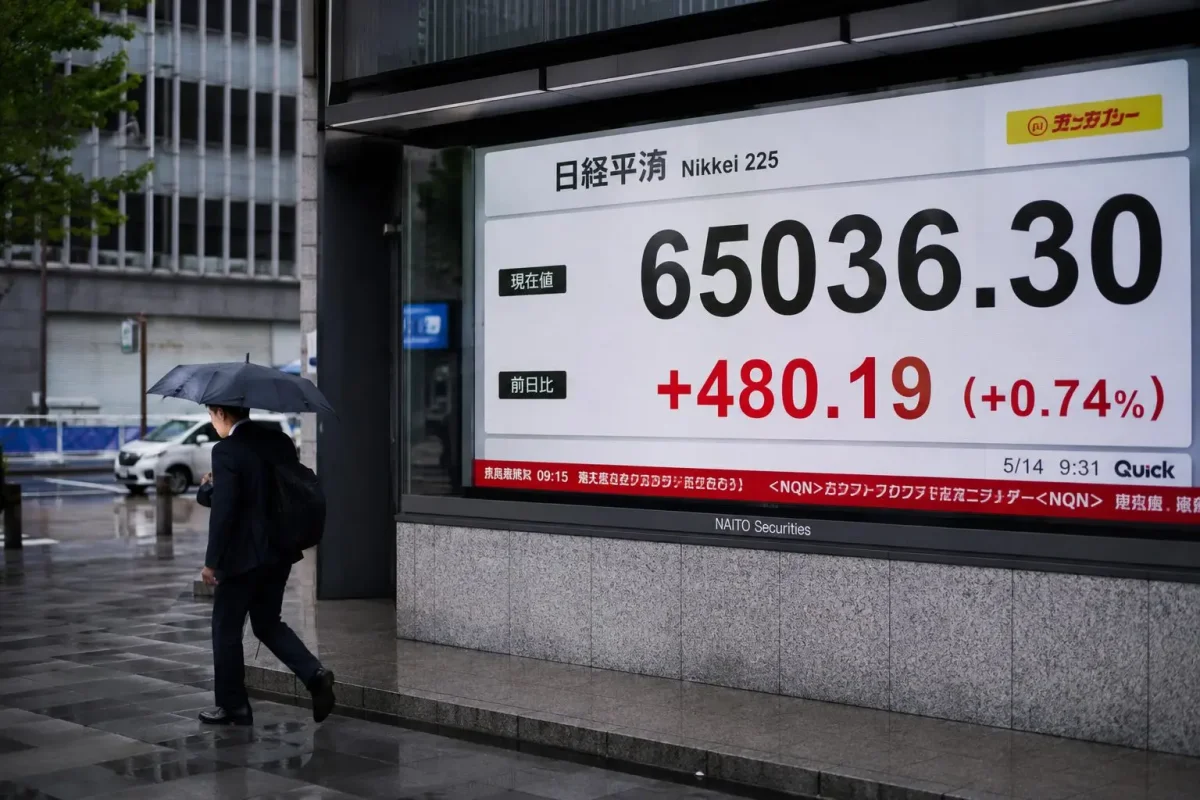
Asian equities rallied on Monday, with Japan's Nikkei 225 closing above the 65,000 mark for the first time, as renewed optimism over potential U.S.-Iran negotiations and a sharp decline in crude oil prices spurred risk appetite. The Nikkei surged 2.87% to 65,158.19, leading gains across the region. Taiwan's benchmark index also reached a record high, closing at 43,644, while Shanghai's composite index added 0.96%, Australia's All Ordinaries rose 0.43%, and India's Sensex climbed 1.41%.
The rally was fueled by hopes that Washington and Tehran might reach a memorandum of understanding, which could ease tensions in the Middle East and potentially reopen the Strait of Hormuz—a critical chokepoint for global oil and liquefied natural gas shipments. U.S. President Donald Trump indicated that the two sides had 'largely negotiated' a framework, though he cautioned against rushing into a final deal. Markets interpreted the comments as a positive signal, even without a concrete agreement.
Brent crude futures tumbled nearly 5% to below $100 per barrel, while West Texas Intermediate also declined by a similar margin. The drop in oil prices provided a significant tailwind for Asian economies that are heavy importers of energy, such as Japan and India. In Tokyo, investors snapped up AI and semiconductor stocks, which have been key drivers of the region's equity gains this year. Lasertec Corp. and Fujikura Ltd. both surged over 11%, while oil explorer Inpex Corp. fell 3.9% in sympathy with lower crude prices.
Maki Sawada, equity strategist at Nomura Securities, noted that lower oil prices, stronger Japanese government bonds, and a firmer yen all pointed to improved risk appetite. However, she cautioned that the 65,000 level for the Nikkei is a 'psychological milestone' that could trigger some profit-taking.
India's stock market also benefited from the decline in oil prices, with all 16 major sectors opening in positive territory. State-run fuel retailers such as BPCL, HPCL, and Indian Oil Corp. gained between 4% and 4.5%, while HDFC Bank, ICICI Bank, and Eicher Motors also moved higher. 'Easing concerns around Middle East tensions have improved the overall risk appetite among investors,' said Hitesh Tailor, research analyst at Choice Equity Broking. He added that this could help sustain bullish momentum in the near term, though analysts flagged potential resistance around the 24,000 level on the Nifty index, as traders await more concrete signs of a deal.
In currency markets, the U.S. dollar index slipped, while the yen strengthened to around 158.96 per dollar and the euro edged higher, as investors shifted away from safe-haven assets and returned to equities. Chris Weston at Pepperstone commented that markets care less about the precise deadline for a deal and more about the overall tone, which has been consistently pointing toward some form of resolution.
Despite the upbeat mood, risks remain. Both Washington and Tehran have backtracked on suggestions of a quick agreement, and the blockade of Iranian ships at the Strait of Hormuz remains in place until a deal is finalized. Kyle Rodda, senior financial market analyst at Capital.com, highlighted unresolved issues such as Iran's nuclear agenda, uranium enrichment, and the future of the strait, warning that any agreement could be little more than a temporary truce.
Interest rates also pose a risk. Markets have priced in a 25-basis-point rate hike from the Federal Reserve for January 2027, according to Reuters. Bruno Schneller, managing partner at Erlen Capital Management, said the Fed is in a difficult position as consumers feel the pinch from higher borrowing costs while inflation remains elevated.
Looking ahead, trading volumes are expected to be lighter this week, with U.S. exchanges closed Monday for Memorial Day and UK markets also on holiday. Investors will be watching for U.S. ADP jobs data due Tuesday, euro zone confidence figures on Thursday, and the reopening of Hong Kong markets on Tuesday to see if the Asian rally continues on catch-up trades.