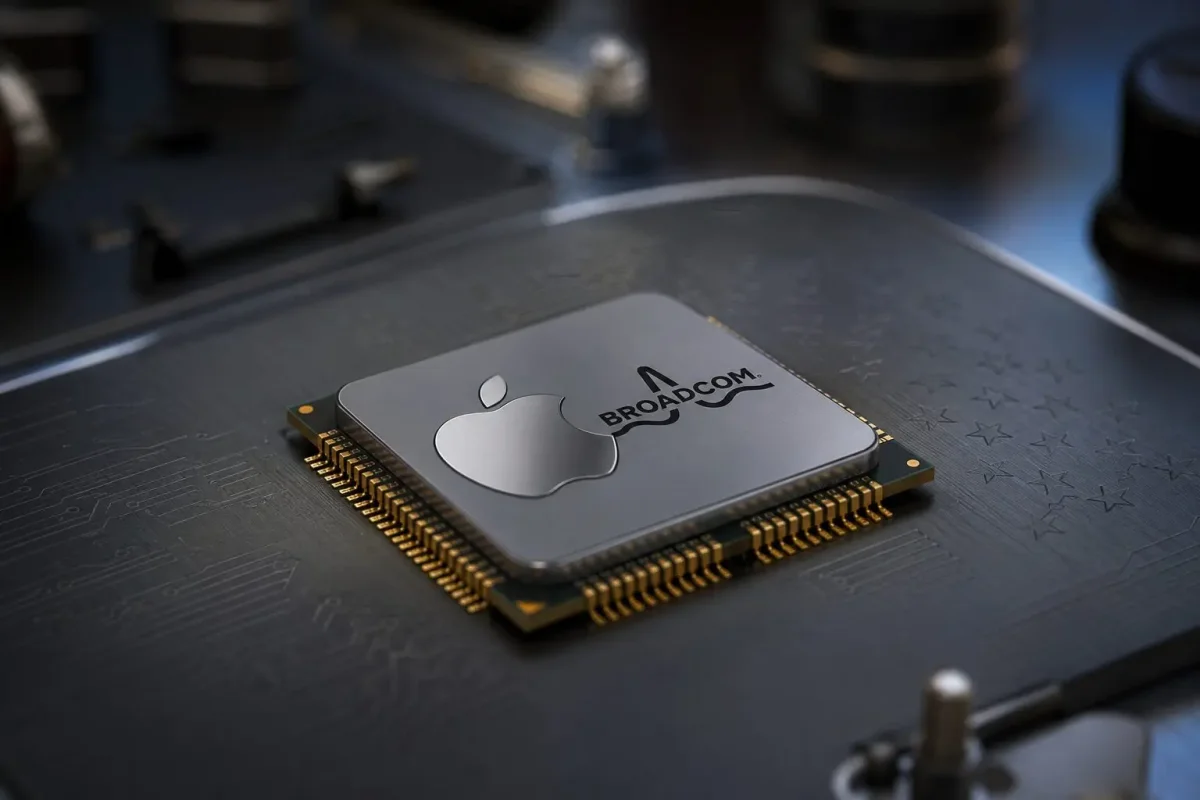
Cupertino, California — Apple Inc. (AAPL) announced a multiyear agreement with Broadcom Inc. (AVGO) valued at more than $30 billion, reinforcing their long-standing partnership and delivering a significant commitment to U.S. semiconductor manufacturing. The deal, which runs through 2031, is expected to yield over 15 billion chips produced in the United States and support hundreds of domestic jobs.
Under the terms, Broadcom will design and supply custom silicon—including radio-frequency components like FBAR filters—for a range of future Apple products. To meet production targets, Broadcom plans to invest $1.5 billion to expand and upgrade its facilities in Fort Collins, Colorado, which will focus on wireless technology and filter components that enhance signal handling in devices.
Market Reaction and Strategic Implications
Broadcom shares rose $6.61 to $395.30 in early trading, while Apple dipped $1.85 to $311.54. The broader semiconductor sector gained, lifting the S&P 500 and Nasdaq as chip stocks helped offset broader market concerns.
The extension reduces a key risk for Broadcom, which had faced speculation that Apple might accelerate its own chip development efforts. Apple currently accounts for roughly 20% of Broadcom's annual revenue, according to analysts cited by Reuters. "Locking in Broadcom through 2031 buys supply-chain certainty," said Emarketer analyst Jacob Bourne.
Apple continues to source its A-series iPhone processors and M-series Mac chips from Taiwan Semiconductor Manufacturing Co. (TSM), which has been strained by surging demand for AI chips from companies like Nvidia. Intel has emerged as a potential U.S.-based foundry for some Apple silicon, but analysts at Melius Research do not expect meaningful production at scale until at least late 2027.
Edge AI and Competitive Landscape
Melius Research analyst Ben Reitzes framed the Broadcom extension as part of a broader push toward edge AI—running artificial intelligence on devices rather than solely in data centers. "Apple silicon is arguably the best consumer edge inference platform in the world," Reitzes wrote, referring to the process by which AI models respond to user requests.
Jack Gold, founder of J.Gold Associates, noted that Broadcom may offer Apple faster turnaround and higher manufacturing priority as chip design cycles shorten. "The market is moving so fast," Gold told Supply Chain Dive. He warned that even a one-generation lag could risk losing competitive ground.
Supply Risks Remain
Despite the deal's benefits, supply chain vulnerabilities persist. Apple has cautioned that component shortages and rising costs could impact demand, revenue, and margins. Broadcom's own filing notes that forward-looking statements are subject to risks and uncertainties, and the Fort Collins expansion has yet to be completed. Additionally, AI data center demand continues to divert capacity from other chip segments.
Politically, the agreement gives Apple a win by expanding domestic chip production and responding to calls for reduced reliance on Asian manufacturing. For Broadcom, the pact secures a critical client for nearly a decade, ensuring revenue stability amid a rapidly evolving semiconductor landscape.