Oracle Corporation (NYSE: ORCL) saw its stock decline 4.62% on Wednesday, closing at $157.53 and marking its third consecutive session of losses. The drop came as the company's annual report revealed a sharp increase in capital spending that far outpaced revenue from its cloud infrastructure business, intensifying scrutiny of its financial strategy.
Capex far exceeds cloud revenue
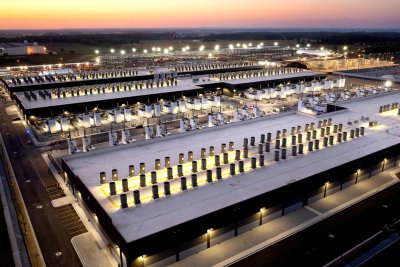
Oracle's fiscal 2026 capital expenditures reached $55.7 billion, more than triple the $18.1 billion generated from cloud infrastructure revenue. This translates to $3.08 in capital spending for every dollar of cloud infrastructure sales. Even when measured against total cloud revenue of $34.0 billion, the ratio stands at $1.64 of capex per dollar of cloud sales. The disparity highlights the enormous investment required to build out AI-focused data centers before the company can convert its massive backlog into profitable earnings.
Backlog and cash flow concerns
Oracle reported remaining performance obligations (RPO) of $638 billion as of May 31, up from $138 billion a year ago, driven by large cloud contracts. However, the company's free cash flow was negative $23.7 billion, underscoring the funding pressures despite the substantial backlog. The RPO, while indicating strong contracted demand, does not directly translate into free cash flow, leaving investors to question when the investments will yield returns.
Restructuring and headcount reduction
Oracle's cost-cutting efforts included a 13% reduction in headcount, or about 21,000 jobs, bringing its workforce to 141,000 for fiscal 2026. The company recorded $1.84 billion in restructuring and other charges, a 391% increase from the prior year. This equates to roughly $87,500 per laid-off worker, though the figure also covers other exit costs. Despite these cuts, the market remains unconvinced about the company's ability to balance spending with profitability.
Financing and future outlook
To fund its ambitious expansion, Oracle raised $43 billion in debt and $5 billion in equity during fiscal 2026. The company plans to raise an additional $40 billion through a combination of debt and equity in the next fiscal year, including a $20 billion at-the-market equity program that had not been tapped as of May 31. CFO Hilary Maxson indicated that gross margins are expected to decline in fiscal 2027 as data-center buildout accelerates, with Oracle's own capex projected at $70 billion, of which $20 billion to $25 billion is expected to be reimbursed by customers.
Demand remains strong
Despite the financial pressures, demand for Oracle's cloud services continues to grow. CEO Clay Magouyrk noted that first-quarter fiscal 2027 delivery was approaching one gigawatt, and the company highlighted $75 billion in customer-prepaid or customer-supplied hardware from large AI contracts in the second half of fiscal 2026. This arrangement reduces Oracle's need to raise additional capital. Analyst Jacob Bourne of eMarketer acknowledged that demand is real, with cloud infrastructure revenue and backlog growing rapidly, but warned that the funding question remains a significant challenge as capex exceeds estimates and free cash flow stays negative.