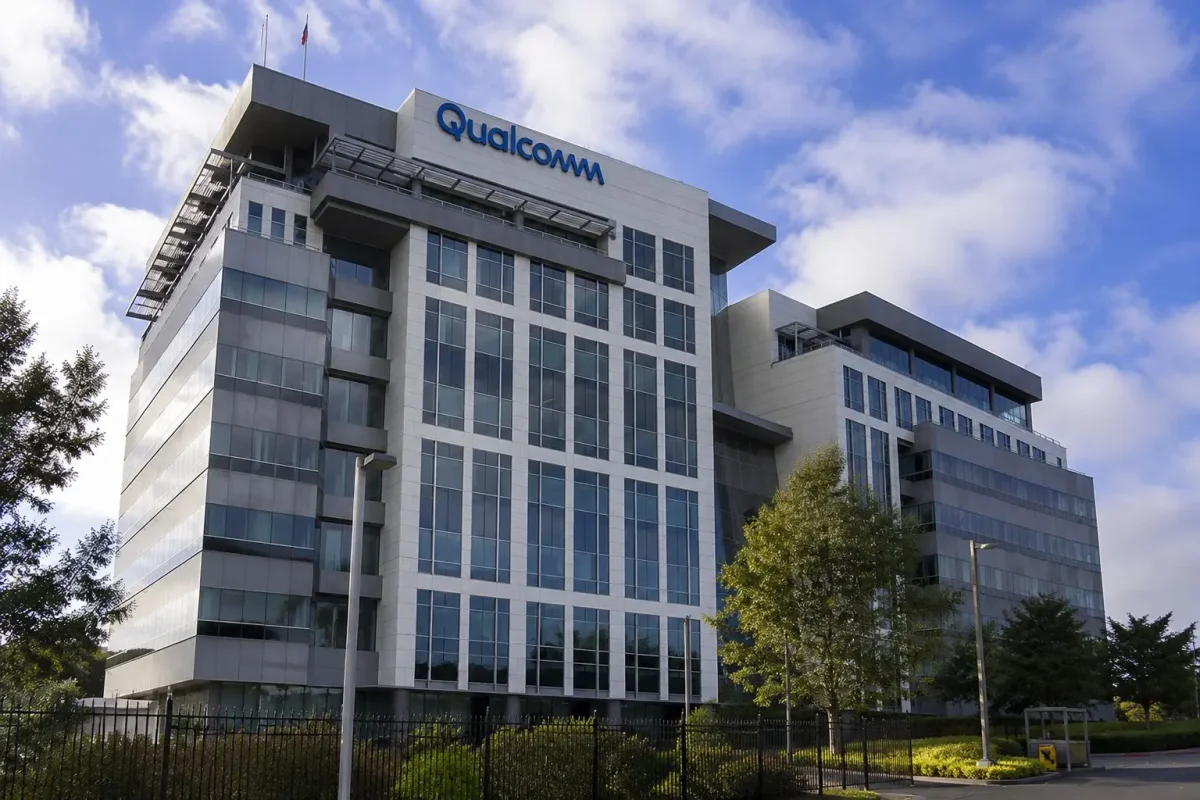
Qualcomm (NASDAQ:QCOM) shares declined 4.4% in regular trading to close at $155.68, and slipped nearly 5% in after-hours trade, as persistent weakness in the handset market overshadowed the company's diversification efforts. The stock's retreat came despite a major automotive win and a strategic acquisition aimed at bolstering its AI capabilities.
Quarterly Results Highlight Divergent Trends
For the fiscal third quarter of 2026, Qualcomm reported total revenue of $9.95 billion, down 4% year-over-year. Adjusted earnings came in at $2.21 per share, missing the LSEG consensus estimate by two cents. The company's QCT segment, which includes its core chip sales, saw revenue decline 5% to $8.504 billion. Handset revenue, which still accounts for 59.8% of QCT, fell 20% to $5.086 billion. However, growth in automotive and Internet of Things (IoT) segments partially offset the decline. Automotive revenue surged 61% to $1.588 billion, while IoT revenue rose 9% to $1.830 billion. Combined, these segments contributed $753 million in growth, covering approximately 61% of the $1.242 billion drop in handset revenue.
BMW Partnership Signals Automotive Ambitions
Qualcomm announced that BMW (ETR:BMW) has selected it as the primary provider of compute silicon for upcoming vehicle platforms. The multi-year deal covers digital cockpit technology and advanced driver-assistance systems, utilizing Qualcomm's Snapdragon Cockpit and Snapdragon Ride chips, along with AI accelerators. No financial terms were disclosed. Nakul Duggal, Qualcomm's head of automotive, said the partnership allows the two companies to 'define the future of mobility.' This win positions Qualcomm to compete more directly with Nvidia (NASDAQ:NVDA) and Mobileye Global (NASDAQ:MBLY) in the automotive compute market.
Modular Acquisition Strengthens AI Software
Qualcomm also finalized its acquisition of Modular, a company specializing in AI software infrastructure. The all-stock deal, announced in June, was valued at $3.92 billion. Modular's platform supports AI workloads across multiple computing architectures, aligning with Qualcomm's edge-to-cloud strategy. The Mojo, MAX, and Modular Cloud offerings will continue as distinct brands. This acquisition bolsters Qualcomm's ability to provide AI solutions that work across different hardware, a key differentiator in the data center and edge computing markets.
Outlook and Guidance Disappoint
Qualcomm's forward guidance fell short of analyst expectations. For the fiscal fourth quarter, the company expects adjusted earnings in the range of $2.05 to $2.25 per share, with the midpoint of $2.15 roughly 9% below the consensus estimate of $2.36. Revenue is projected between $9.7 billion and $10.5 billion, surrounding the consensus of $10.02 billion. Handset revenue, particularly from Apple (NASDAQ:AAPL), is expected to decline more quickly than previously anticipated. CEO Cristiano Amon noted, 'We kind of replaced Apple with the data center,' highlighting the company's pivot toward non-handset revenue.
Long-Term Diversification Strategy
Qualcomm's long-term goal is to reach $40 billion in non-handset revenue by fiscal 2029, with non-handset revenue projected to grow by over 60% in fiscal 2027. This ambition relies on achieving targets in automotive, IoT, and data-center divisions. However, risks remain, including rising costs for wafers, packaging, and memory, which could weigh on margins. Additionally, the BMW contract value is undisclosed, Modular integration is unproven, and handset customer concentration is still significant.
In after-hours trading, Qualcomm shares continued to slide, reflecting investor disappointment with the near-term profit outlook despite the strategic progress in diversification.