New York, June 13, 2026, 06:56 (EDT)
Quantum computing shares ended the trading week on a mixed note as the initial enthusiasm from government funding announcements began to dissipate. The sector, which had enjoyed a significant spring rally, now faces a more cautious investor outlook.
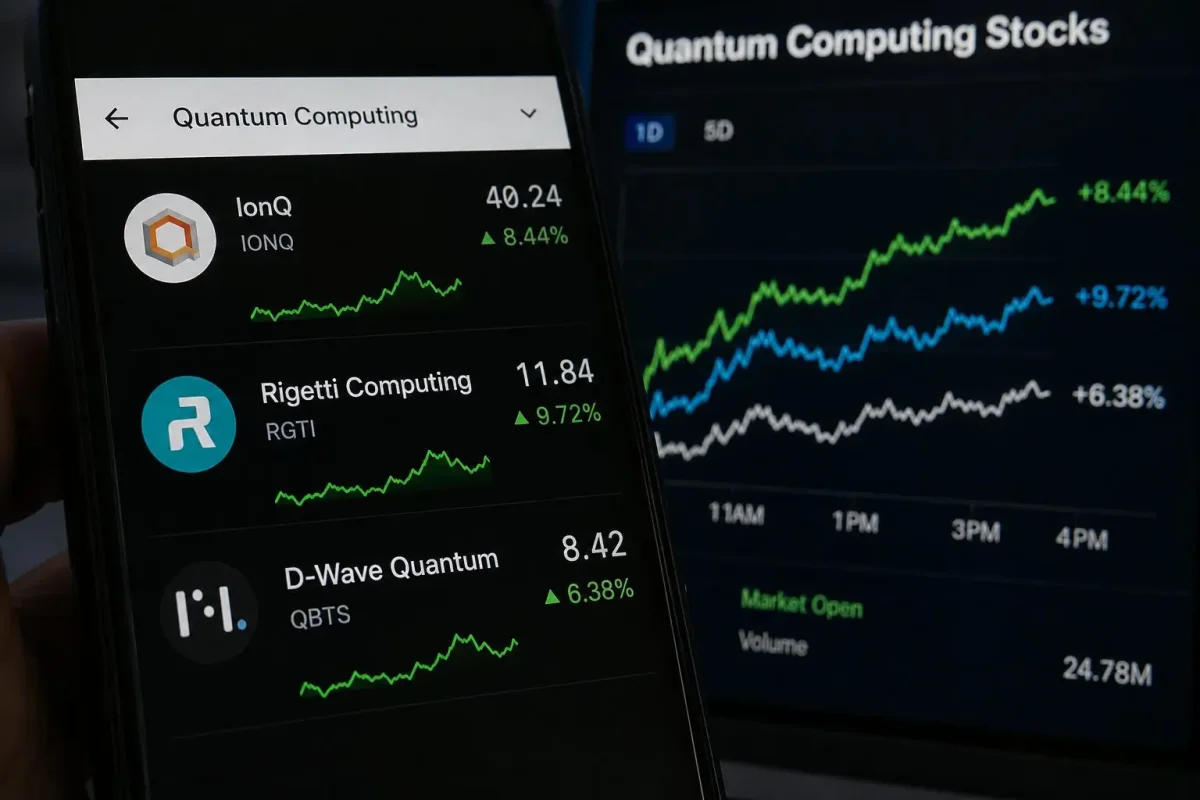
IonQ (IONQ) closed at $57.85, down 0.3%. Rigetti Computing (RGTI) bucked the trend slightly, gaining 1.7% to finish at $20.98. D-Wave Quantum (QBTS) slipped 2.0% to $23.37, while Quantum Computing Inc. (QUBT) edged up 0.2% to $9.93. Despite this week's weakness, The Motley Fool noted that all three major players remain at least 50% above their late-March levels.
The recent rally was fueled not by earnings but by a major policy shift. On May 21, the U.S. Department of Commerce signed nine letters of intent for $2.013 billion in planned CHIPS and Science Act incentives targeting quantum companies. IBM is set to receive $1 billion, GlobalFoundries $375 million, D-Wave $100 million, and Rigetti up to $100 million. These funds aim to advance utility-scale, fault-tolerant quantum computers, which rely on error-prone qubits but are essential for scalable systems. Commerce Secretary Howard Lutnick called the investments the start of "a new era of American innovation."
International momentum also continued this week. Barron's reported on Friday that governments worldwide are increasing quantum funding. In the U.K., Science Minister Patrick Vallance launched a Quantum Growth Alliance, enlisting major companies including HSBC, Barclays, Standard Chartered, GSK, BP, Rolls-Royce, BAE Systems, BT, Vodafone, and QinetiQ. Such government and corporate backing could help address a key question for the sector: who will finance systems before larger machines are commercially ready?
Valuation concerns and insider selling are contributing to the pullback. D-Wave CFO John M. Markovich sold 51,049 shares on June 8 and June 9, netting approximately $1.34 million. This followed a larger sale of 328,752 shares for roughly $9.1 million on May 22. While insider sales can be for tax or diversification reasons, they tend to weigh more heavily on speculative stocks when valuations are already stretched.
D-Wave's financials present a mixed picture. First-quarter revenue was $2.9 million, down 81% year-over-year due to a large system sale in the prior-year period. However, bookings surged to $33.4 million, and remaining performance obligations rose to $42.4 million. CEO Alan Baratz highlighted "expanding commercial adoption." The strong order pipeline contrasts with choppy revenue and significant losses.
IonQ posted first-quarter revenue of $64.7 million, the highest among pure-play peers, and raised its full-year guidance to $260-$270 million, with $470 million in remaining performance obligations. Rigetti reported Q1 revenue of $4.4 million and an operating loss of $26.0 million, but holds $569.0 million in cash. Its 108-qubit Cepheus-1-108Q system is now generally available. Quantum Computing Inc. had about $3.7 million in Q1 revenue, a net loss of $4.1 million, and $1.4 billion in cash and investments following recent acquisitions.
Despite the support from federal funding, customer deals, and improved cash positions, valuations remain high. Price-to-sales ratios are elevated: The Motley Fool estimates IonQ at about 95.7, D-Wave at 645.4, and Rigetti at 632.2, with profits still elusive. Market capitalizations stand at roughly $21.5 billion for IonQ, $8.6 billion for D-Wave, $7.0 billion for Rigetti, and $2.2 billion for Quantum Computing Inc.
The sector's next major catalyst is the conversion of Commerce Department letters of intent into milestone-tied funding. D-Wave's Qubits Europe event on June 18 in London is also closely watched, where the company plans to discuss its technology roadmap, progress in annealing and gate-models, software, hybrid quantum work, and quantum AI. For shares to sustain their gains, investors will need to see bookings translate into revenue and technical milestones met. Delays, dilution, weak orders, or a broader downturn in speculative tech could pressure stocks further.