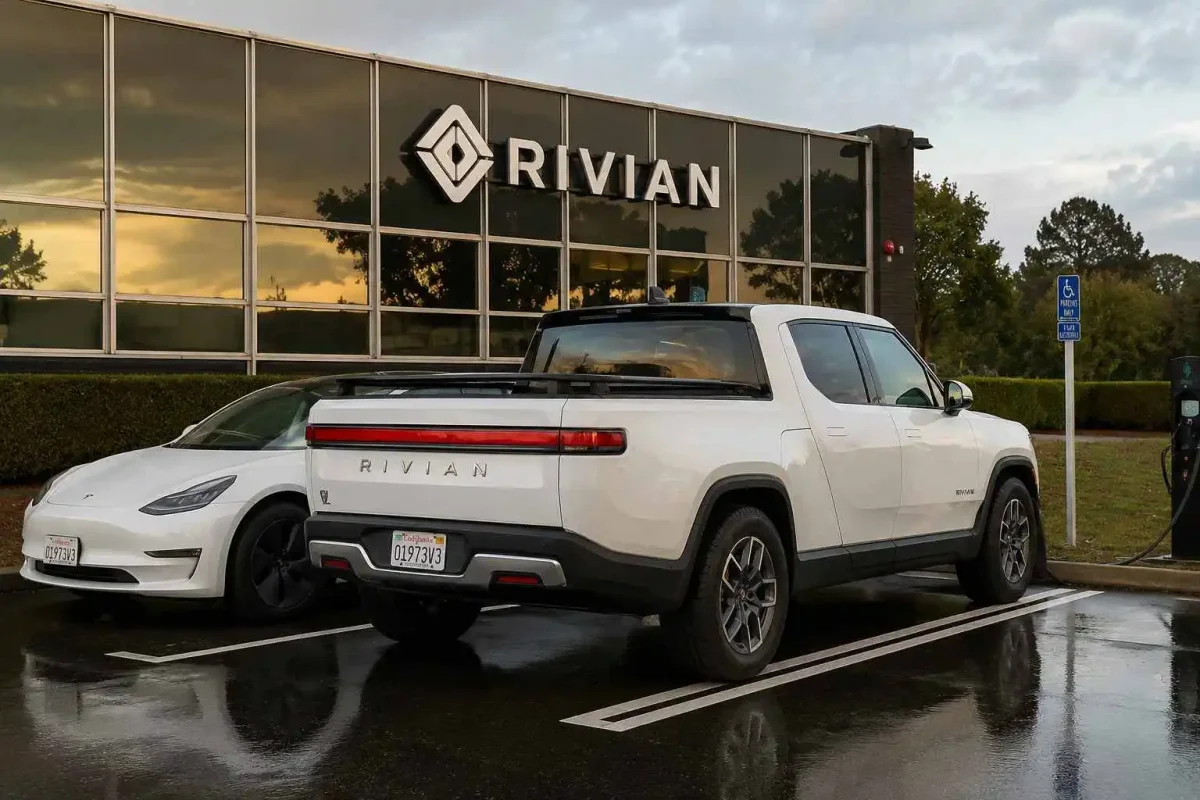
Rivian Automotive (NASDAQ: RIVN) shares ended the trading week at $15.84, marking a 9.2% decline over the period. The stock is now trading only 2.2% above its most recent offering price of $15.50, a tight margin that leaves little room for error as the electric vehicle maker prepares to report second-quarter results on July 30 after the market close.
The company's share price has been under pressure following a $1.32 billion capital raise through the issuance of 86.25 million shares at $15.50 apiece, including the full exercise of underwriters' option. The offering, which closed recently, has diluted existing shareholders and weighed on the stock's performance.
Production Targets and R2 Ramp-Up
At the midpoint of its full-year guidance, Rivian needs to deliver 44,941 vehicles in the second half of 2026—nearly double the 22,559 units delivered in the first half. This translates to an average of 22,471 vehicles per quarter in the second half, which is 84% higher than the second-quarter total of 12,194 vehicles delivered. The company exceeded its prior second-quarter delivery forecast of 9,000 to 11,000 vehicles and raised its full-year outlook to 65,000–70,000 units.
Deliveries of the highly anticipated R2 model commenced in June, and CEO RJ Scaringe stated in April that the R2 has the potential to "dramatically expand our market opportunity." The upcoming earnings report will provide crucial insights into the pace of R2 production scaling and its impact on overall delivery numbers.
Financial Health and Cash Position
Rivian's preliminary cash balance for June stood at $5.3 billion. After accounting for the net proceeds of approximately $1.32 billion from the recent share offering, pro-forma cash totals $6.62 billion, excluding July expenditures. The company estimates this represents roughly 6.2 quarters' worth of free-cash-flow shortfalls, though management cautions this is not a projection of runway.
In the first quarter, Rivian reported negative free cash flow of $1.075 billion. Automotive gross profit was a loss of $62 million, but the company achieved consolidated gross profit of $119 million thanks to $181 million in gross profit from software and services. For the second quarter, Rivian has issued a preliminary revenue projection of $1.55 billion to $1.65 billion, up from $1.30 billion in the same period last year, driven by higher deliveries, software-development services, and regulatory credits.
Market Context and Risks
On Friday, Rivian's 3.8% decline outpaced losses among its closest U.S.-listed EV competitors. Tesla (NASDAQ: TSLA) fell 2.1% to $313.03, while Lucid Group (NASDAQ: LCID) dropped 2.4% to $6.30. The broader market weakness in the EV sector reflects ongoing concerns about demand and profitability.
Investors will focus on several key areas during the earnings call: R2 production ramp, automotive margins, cash consumption, and the full-year outlook. The company has stated that scaling the R2 and implementing cost reductions are essential for eventual profitability. Risks remain elevated, including softer demand, supply constraints, or additional share sales that could weigh on investor returns.
The $15.50 offering price now serves as a firm benchmark in the market. Achieving a higher premium likely depends on simultaneous improvement in both R2 volume and unit economics. With the stock trading just cents above the offer price, the upcoming earnings report will be pivotal in determining whether Rivian can regain investor confidence and justify a higher valuation.