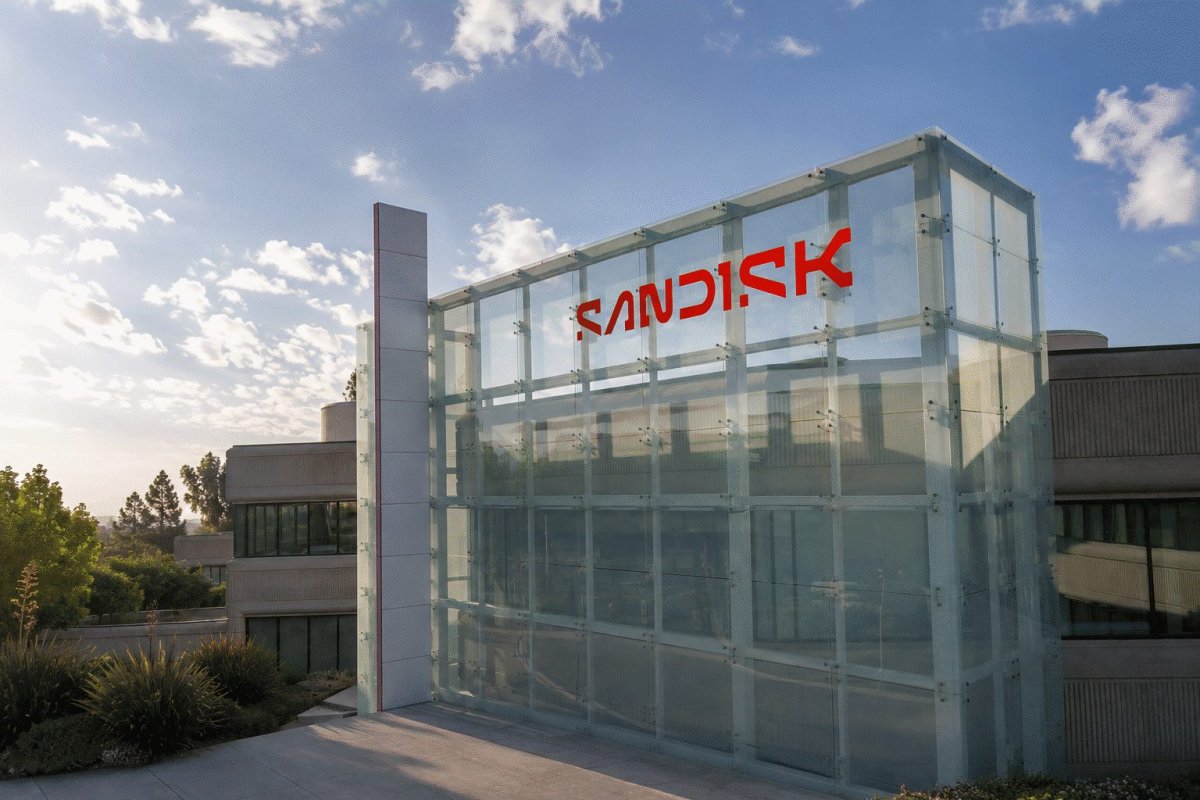
Sandisk Corporation (NASDAQ:SNDK) received a fresh Buy rating from Argus Research on Monday, as analyst Jim Kelleher set a 12-month price target of $1,600. The upgrade comes after the stock retreated 47% from its June peak, offering investors a potential entry point into a memory-chip leader that has faced recent volatility. Shares closed Monday at $1,254.16, up 3.5% on the day.
The new target implies a 27.6% upside from Monday's close, but it still sits 31.5% below the late-June record of $2,335. That gap underscores the market's cautious stance: Wall Street is not simply buying the dip. Instead, investors are weighing whether Sandisk's new long-term customer contracts can bring enough stability to a notoriously cyclical memory business to justify a higher valuation multiple.
Kelleher wrote in his note, "We believe that point has arrived, with the shares at close to half of their peak level." The timing of the upgrade is significant, coming just days after Sandisk reported fiscal fourth-quarter earnings that beat estimates but disappointed on guidance. The company posted revenue of $8.97 billion, up 372% year-over-year, and adjusted earnings per share of $39.25, beating consensus by 12.3%. Datacenter revenue reached $2.98 billion, a key growth driver.
However, management's revenue outlook for the next quarter came in slightly below Wall Street expectations. The fiscal Q1 2027 revenue midpoint of $10.55 billion is 2.5% below the consensus figure, and the adjusted EPS midpoint of $45 is 14.6% higher than the prior quarter but slightly below the $44.72 consensus. The gross margin midpoint of 84% is 0.6 percentage points lower than the fiscal Q4 actual of 84.6%. These small gaps suggest the market had priced in exceptional execution, and the stock sold off after the earnings release.
Management argues that the margin trade-off buys predictability. Sandisk has signed eight long-term agreements with six customers, with a combined stated value of $93.9 billion and an average contract duration of four years. These agreements cover about 50% of fiscal 2027 output and roughly two-thirds of fiscal 2028 output. CEO David Goeckeler told Reuters that this shift was a major strategic change from three quarters earlier, emphasizing the company's focus on securing stable demand.
The market remains divided on Sandisk's prospects. Analyst targets are unusually dispersed: Argus and Raymond James have acted after earnings, with Raymond James raising its target to $2,000. Other firms, including Bank of America ($2,500), Bernstein ($3,000), and Cantor Fitzgerald ($2,900), have targets that predate the earnings report. This wide range shows little consensus on sustainable earnings, reflecting the uncertainty around NAND pricing and contract dynamics.
Peer stocks also felt the pressure last week. Western Digital (NASDAQ:WDC) dropped 19.1% in early trading Thursday, while Micron Technology (NASDAQ:MU) fell 7%. Sandisk was down 13.3% at the time, highlighting sector-wide concerns about memory pricing and demand. ClearBridge Investments portfolio manager Divya Mathur noted that "the recent volatility in semiconductor stocks appears disconnected from any material change in long-term fundamentals."
Risks remain: NAND price growth could slow faster than expected, and customer commitments may limit upside if spot prices rise. The stock's 428% year-to-date gain leaves little room for weak guidance. The next major catalyst is Sandisk's Investor Day on Thursday at 09:00 EDT, where CEO David Goeckeler, CFO Luis Visoso, and other executives will address the business outlook. Investors will be looking for evidence that contract-backed stability can offset the guided margin dip.