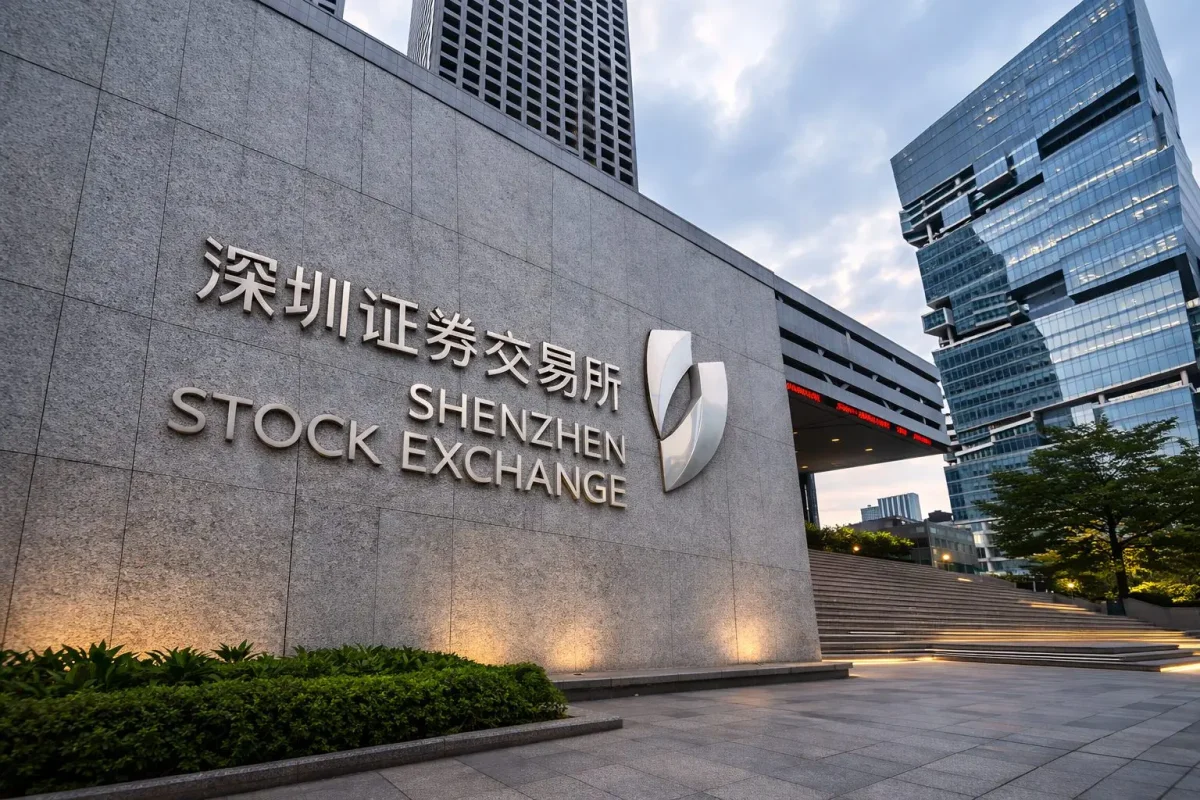
Chinese financial authorities have introduced revised listing regulations for the ChiNext board on the Shenzhen Stock Exchange, aiming to enhance support for technology and innovation-focused companies. The announcement, made on Friday, March 6, 2026, represents a strategic effort to channel more investment into high-growth sectors, mirroring aspects of the successful framework used by Shanghai's STAR Market while introducing more tailored criteria.
Market Performance Contrasts with Policy Support
Despite the policy announcement and a modest intraday rebound on Friday, equity markets in mainland China closed the week lower. The Shenzhen Component Index managed a gain of 0.59% on March 6, finishing at 14,172.63, while the ChiNext Index rose 0.38% to 3,229.30. However, both benchmarks recorded significant weekly declines, falling 2.2% and 2.4%, respectively, from the previous Friday's close. The broader Shanghai Composite Index also retreated, sliding approximately 0.9% over the same period from February 27 to March 6.
Market activity showed signs of caution, with combined turnover for the Shanghai and Shenzhen exchanges slipping to 2.2 trillion yuan on Friday, down from 2.39 trillion yuan the prior session. Sector performance was mixed, with power-grid equipment manufacturers and computing capacity rental firms among the gainers, while oil and gas companies lagged.
Broader Economic and Policy Context
The regulatory push occurs against a complex macroeconomic backdrop. Officials recently confirmed a 2026 economic growth target range of 4.5% to 5%, slightly below the previous year's 5% goal. Concurrently, the government has pledged increased infrastructure and public service spending, alongside the establishment of a 100-billion-yuan fiscal-financial coordination fund designed to stimulate consumption and private investment.
Securities regulator chairman Wu Qing highlighted that the mainland's A-share market capitalization has now surpassed 110 trillion yuan. He projected that exchange-based stock and bond financing will reach 64 trillion yuan by 2025, with direct financing—capital raised via shares and bonds rather than bank loans—accounting for 31.97% of the total.
Regional Initiatives and Funding Trends
Additional supportive measures were unveiled at the local level. Authorities in Guangdong province announced plans to accelerate the adoption of artificial intelligence applications across the region. Shenzhen Mayor Qin Weizhong noted that the city's AI, robotics, and semiconductor sectors achieved double-digit growth last year. Furthermore, Beijing plans a 300 billion yuan capital injection into state banks this year to facilitate deeper reforms of state-owned financial firms and steer more funding toward technology companies.
Despite this supportive environment, capital-raising activity displayed a note of restraint. Some Shenzhen-listed companies seeking secondary listings in Hong Kong opted for conservative pricing. For instance, Estun Automation priced its Hong Kong offering at the lowest possible level, a decision influenced by market volatility. Similarly, Shenzhen Zhaowei Machinery & Electronics set its Hong Kong share price just below the top of its indicated range. Data from LSEG indicates that initial public offerings and secondary listings in Hong Kong are off to their fastest start since 2021, explaining the continued appeal of the Hong Kong market for Shenzhen-based firms seeking capital.
Analyst Perspectives and External Headwinds
Market observers acknowledge the clear policy direction but note significant external challenges. "The policy signal is loud and clear," stated Liu Chenjie, chief economist at Upright Asset Management in Shenzhen. Marco Sun, chief financial market analyst at MUFG (China), expects the investment focus to remain on "new economy" sectors.
However, global market jitters, partly linked to geopolitical tensions, have prompted a shift toward safer assets. Yuan Yuwei, a fund manager at Trinity Synergy Investments, suggested that the official economic outlook "has not taken into account the Iran conflict," highlighting a potential disconnect between domestic policy and international risk factors.
Looking ahead, Beijing has outlined plans to strengthen market-stabilizing mechanisms from 2026 to 2030, intensify scrutiny of high-frequency quantitative trading, and launch a national mergers-and-acquisitions fund. These longer-term initiatives are being rolled out as Shenzhen investors navigate weaker growth prospects and external headwinds, factors that contributed to last week's market unease despite a flurry of new supportive policies.