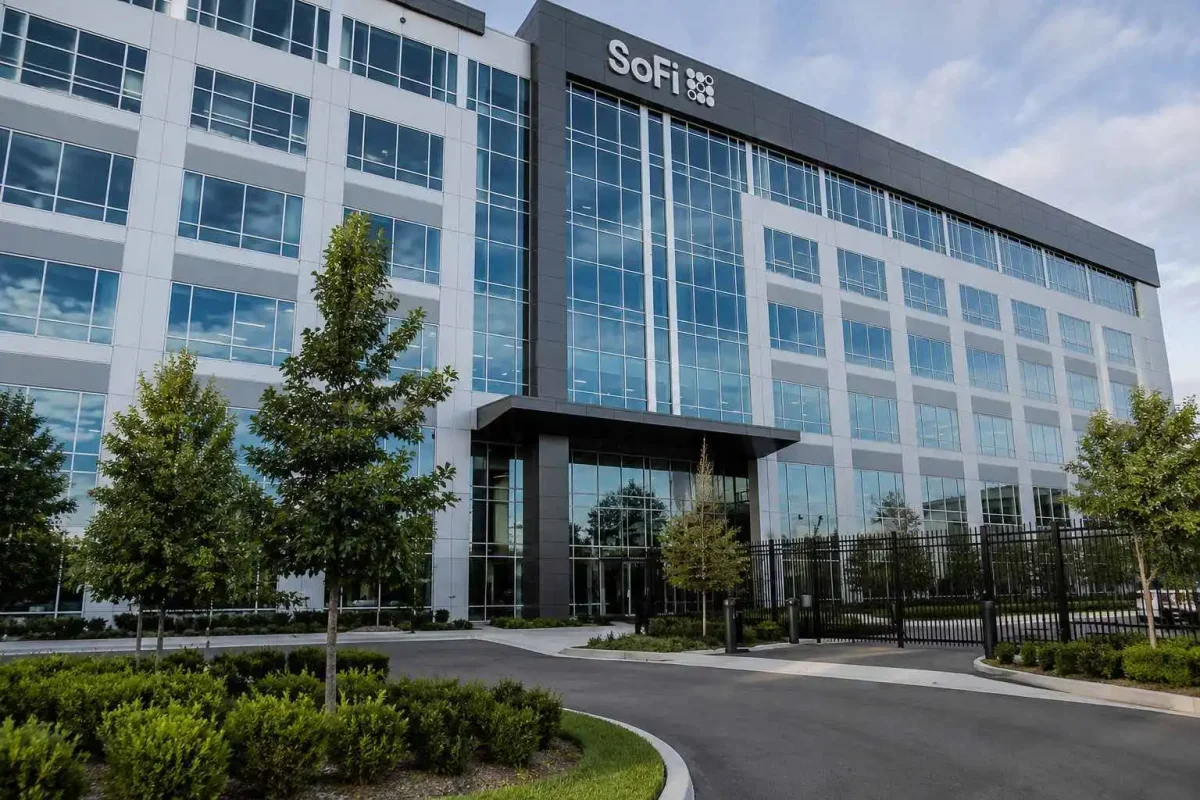
SoFi Technologies (NASDAQ:SOFI) is navigating a significant margin hurdle as it heads into the second half of 2026, with adjusted net-income margins projected to land between 20.9% and 21.4%. This challenge has become a focal point for investors, who are closely watching the company's upcoming earnings report for signs of a clear pathway to profitability.
Shares of SoFi were trading near $16.65 at midday on Friday, reflecting a relatively flat session. The stock's current valuation implies a multiple of approximately 27.8 times management's adjusted earnings per share guidance of $0.60 for the full year. This premium underscores the market's expectation for a significant margin improvement, even as the company confronts a steep second-half requirement.
Earnings and Revenue Projections
Wall Street analysts expect SoFi to report second-quarter earnings per share of $0.11 on revenue of roughly $1.11 billion. The company has guided for revenue growth of 30% year-over-year and an adjusted net-income margin between 12% and 13% for the second quarter. However, the full-year target of $825 million in adjusted net income—paired with $4.655 billion in adjusted net revenue—implies that nearly two-thirds of the year's profit must be generated in the second half, which accounts for only about 53% of annual revenue.
To hit these targets, SoFi needs to average roughly $1.226 billion in quarterly revenue during the second half, a figure just 10% above the Q2 estimate. More critically, profit must average between $257 million and $262 million per quarter, representing a sharp 54% to 57% increase from the first quarter's $166.7 million. Analysts caution that a typical revenue beat may not be sufficient to bridge this gap.
Operational Strengths and Credit Trends
Despite the margin pressure, SoFi's underlying business fundamentals remain solid. Net interest income climbed 39% year-over-year in the first quarter to $693 million, while fee-based revenue grew 23% to $386.8 million. The company reported deposits of $40.2 billion, which provided an annualized interest expense savings of $621.8 million compared with warehouse facilities—a structural advantage that could support margin expansion.
Credit quality has also shown improvement. Annualized net charge-offs for personal loans declined by 28 basis points. CEO Anthony Noto emphasized the strength of the consumer base in a recent statement, although elevated loan growth—with $12.2 billion in originations during Q1, of which personal loans represented 68%—keeps credit exposure a key risk factor.
Technology Platform and Market Sentiment
SoFi's Technology Platform segment faced headwinds in the first quarter, with revenue falling 27% to $75.1 million and the number of accounts declining 16% year-over-year. However, sequential account growth of four million from the prior quarter offers a glimmer of recovery. Analysts will be watching for signs of stabilization in this segment.
Market sentiment has been cautious since SoFi's first-quarter report, which triggered a 12% stock decline despite a 41% jump in adjusted revenue. The company's leadership reaffirmed its full-year outlook, but the market is seeking either an upward revision or a concrete plan to achieve the 21% margin target. Truist Securities analyst Matthew Coad recently raised his price target to $18 from $17 while maintaining a Hold rating, noting that Q2 guidance fell short of expectations, particularly on adjusted net income.
SoFi is scheduled to report second-quarter results on July 29 at 7 a.m. Eastern Time, followed by a conference call at 8 a.m. Investors will be listening intently for management's strategy to navigate the margin challenge and deliver on its ambitious profit targets. Risks include potential softening in consumer strength leading to higher personal-loan losses, rising deposit costs, or further deterioration in the Technology Platform segment, any of which could delay the margin recovery.