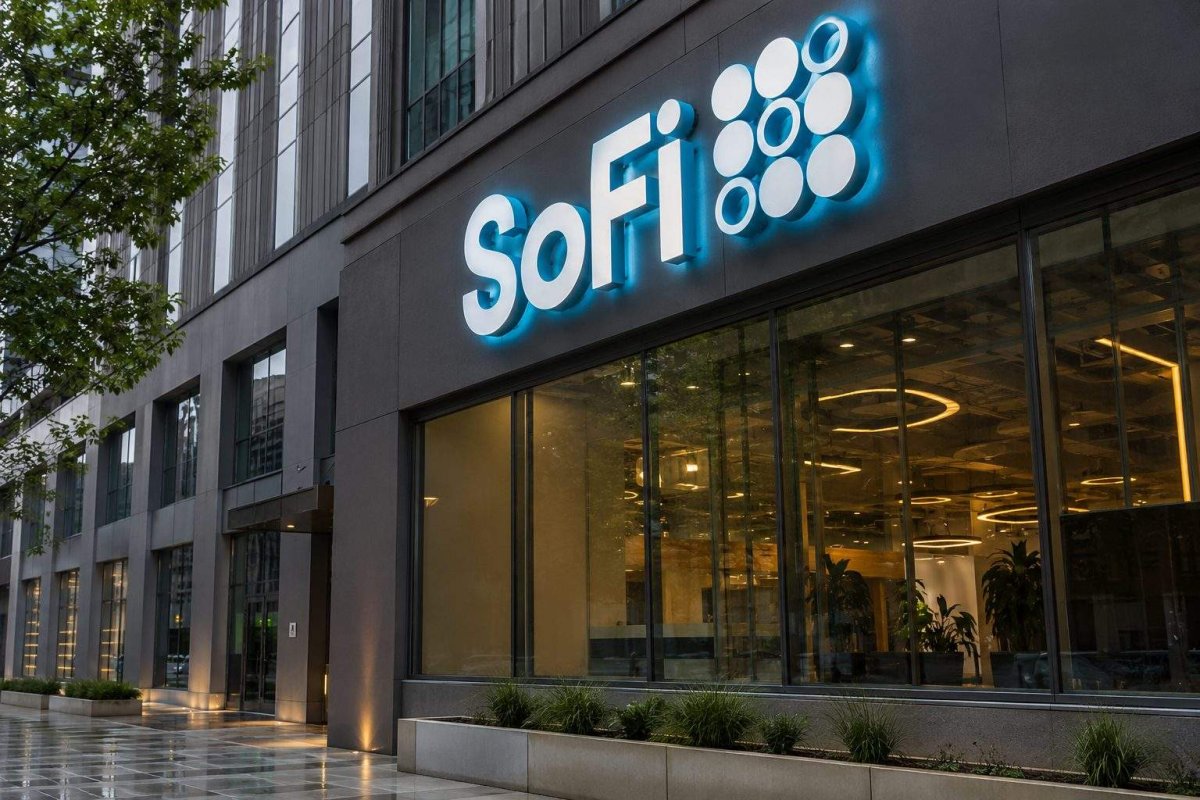
SoFi Technologies, Inc. (NASDAQ:SOFI) saw its shares decline 2.0% to $17.40 in regular U.S. trading on Wednesday, July 8, 2026, following the launch of its new exchange-traded fund. The decline came amid broader market weakness, with the Dow Jones Industrial Average losing 1.5%, the S&P 500 slipping 0.9%, and the Nasdaq Composite falling 0.9%.
New ETF Debuts Amid Market Volatility
The fintech company launched the SoFi Social 50 Income ETF (NYSEARCA:SFYI) on July 7. The fund is an options-income ETF that tracks the top 50 U.S.-listed stocks most widely held in SoFi Invest self-directed accounts, then applies an active options strategy to generate monthly income and growth. Brian Walsh, SoFi's head of advice and planning, described the current environment as characterized by an "uncertain interest rate environment and economic volatility."
Despite the new product, market reaction was muted. SoFi is trading more like a high-multiple lender with a fintech angle than an ETF sponsor. The stock's performance closely mirrored that of the Financial Select Sector SPDR Fund (NYSEARCA:XLF), which lost 1.5%, while the Invesco QQQ Trust Series 1 (NASDAQ:QQQ) was off 0.2%.
Q2 Earnings on the Horizon
Investor attention is firmly fixed on SoFi's second-quarter results, scheduled for release before the market opens on July 29, with a conference call at 8 a.m. ET. Management has guided for adjusted net revenue growth of approximately 30%, with an adjusted EBITDA margin of about 30% and adjusted net income margin between 12% and 13%. For the full year 2026, the company expects adjusted revenue near $4.655 billion, adjusted EBITDA close to $1.6 billion, and adjusted EPS around 60 cents.
In the first quarter, SoFi reported adjusted revenue of $1.1 billion, up 41% year-over-year, with net interest income of $693 million (up 39%) and fee-based revenue of $386.8 million (up 23%). Loan originations hit a record $12.2 billion, and total members grew 35% year-over-year to 14.7 million.
Valuation and Credit Concerns
SoFi currently trades at 38.7 times earnings, leaving little margin for error. The company's guidance for 30% revenue growth in Q2, while rapid for a bank, represents a deceleration from the 41% growth seen in Q1. Investors are watching to see if loan demand has merely been pulled forward and whether fee income can support the stock's elevated valuation.
The technology platform segment remains a drag, with Q1 tech-platform net revenue declining 27% year-over-year to $75.1 million, following the departure of a major client before December 31, 2025. In contrast, the lending segment saw adjusted revenue jump 53% to $629.3 million, underscoring the company's reliance on credit and interest rate dynamics.
Credit quality is a key swing factor. SoFi reported annualized charge-offs on personal loans fell 28 basis points year-over-year to 3.03%. However, recent loan vintages from Q4 2022 through Q2 2025 showed net cumulative losses of 4.64%, with 36% of the original principal still unpaid. Rising oil prices and higher yields could pressure these metrics in Q2.
Peer Comparison and Market Context
Among peers, SoFi's performance was mixed. Affirm Holdings (NASDAQ:AFRM) fell 3.8%, Dave Inc. (NASDAQ:DAVE) dropped 3.3%, Robinhood Markets (NASDAQ:HOOD) slipped 1.6%, and Upstart Holdings (NASDAQ:UPST) lost 5.2%. Ally Financial (NYSE:ALLY) declined 2.5%. SoFi's P/E of 38.7 places it between growth-focused fintechs like Affirm (71.8 P/E) and traditional financials like Ally (10.7 P/E), reflecting its hybrid nature.
The broader market decline was fueled by geopolitical tensions after President Donald Trump declared the interim Iran deal "over," sending Brent crude oil prices surging 7% and stoking inflation and interest rate concerns.
Outlook
While the new ETF could boost member engagement, it does not address the core questions for the upcoming earnings report. Investors want to see whether SoFi can sustain 30% growth without overextending its balance sheet lending, and whether the tech platform segment can stop weighing on results while credit performance remains within the company's own targets.