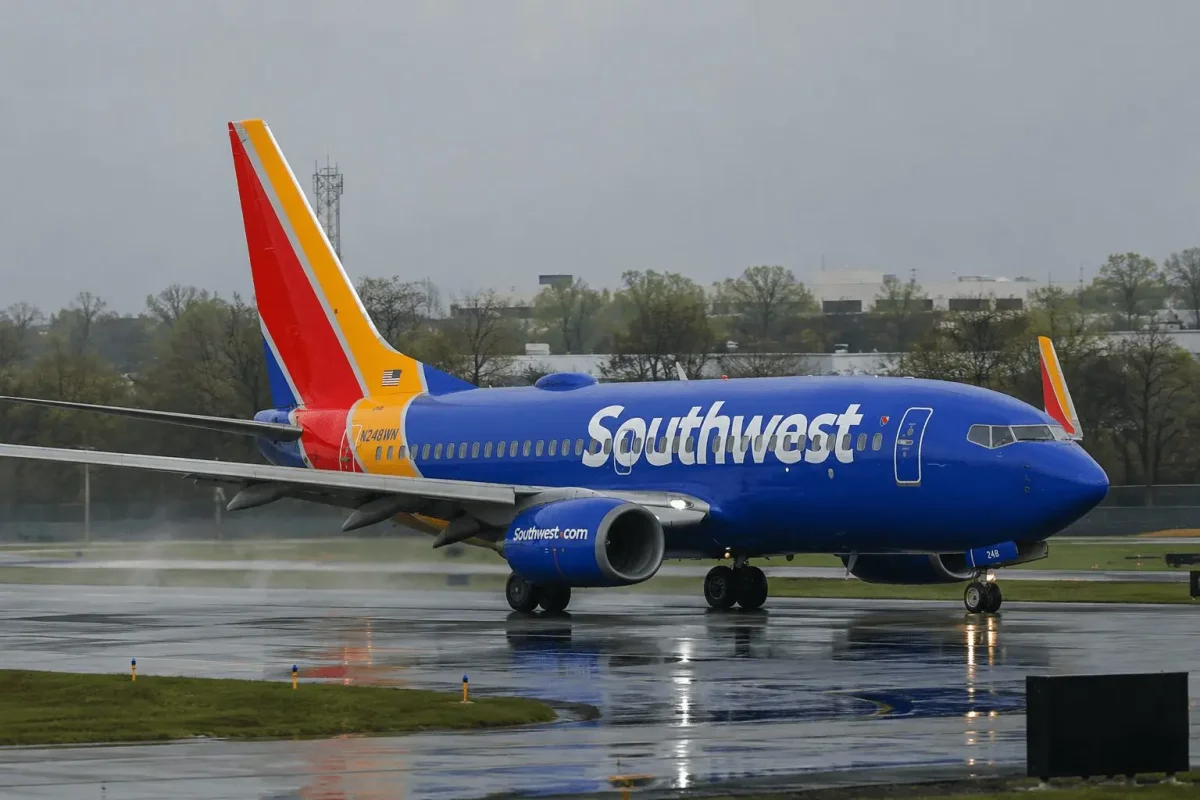
Southwest Airlines (NYSE:LUV) delivered a robust 20.1% increase in adjusted unit revenue during the second quarter, driven by a near-21% rise in average fares, even as capacity expanded by a mere 0.2%. However, the carrier's decision to remain completely unhedged on fuel costs from 2025 onward is drawing increased scrutiny from investors, especially as oil prices remain volatile.
The Dallas-based airline reported adjusted earnings per share (EPS) of $0.94 for the second quarter, surpassing analyst expectations, with the adjusted operating margin improving by 3.3 percentage points to 6.7%. CEO Bob Jordan touted the results as evidence of the company's earnings power, noting that the commercial reset is delivering tangible results.
Despite the strong operational performance, Southwest's stock closed at $45.08 on Friday, down 6.2% for the week, as the market focused on the company's cautious outlook. Management guided third-quarter adjusted EPS in a range of $0.50 to $0.75, well below the $0.82 consensus estimate. For the full year 2026, the airline lowered its adjusted EPS forecast to $3.25-$4.25, from a prior minimum of $4.00, though the new lower end still exceeds the analyst consensus of $3.17.
The primary concern is fuel exposure. Southwest estimates that a $0.10 increase in fuel prices could reduce third-quarter EPS by approximately $0.08, based on the second-quarter adjusted tax rate and diluted share count. With quarterly fuel consumption projected at about 532 million gallons, each one-cent move in fuel prices translates to a $5.3 million pre-tax impact. The airline's fuel hedges are set to expire by the end of 2024, leaving it fully exposed to spot prices thereafter.
Fuel costs consumed a significant portion of the revenue gains. Adjusted revenue rose by $1.47 billion year-over-year, while fuel expenses increased by $889 million, representing roughly 60% of the total increase. This dynamic highlights the vulnerability of the airline's improved unit revenue to rising energy costs.
Southwest's valuation offers limited buffer against fuel price swings. At Friday's close, the stock traded at 12.0 times the midpoint of its 2026 adjusted EPS guidance, nearly in line with Delta Air Lines (NYSE:DAL) at 12.2 times and United Airlines (NASDAQ:UAL) at 11.8 times. Despite Southwest's superior unit revenue growth, the lack of a valuation discount suggests the market is pricing in the fuel risk.
Looking ahead, the company's next major catalyst is Boeing's (NYSE:BA) second-quarter earnings report on Tuesday. Southwest expects to take delivery of 64 Boeing 737-8 jets this year while retiring about 60 older aircraft. Any adjustments to Boeing's delivery schedule could impact Southwest's capital expenditure plans and operational efficiency.
Investors are also watching for signs of fare resistance among travelers, which could offset revenue improvements. Additionally, the removal of six seats per 737-700 aircraft is expected to increase nonfuel unit costs by 1.1 percentage points in the third quarter. On the positive side, any decline in fuel prices would provide an immediate boost to profits. The next earnings call is scheduled for October 22.