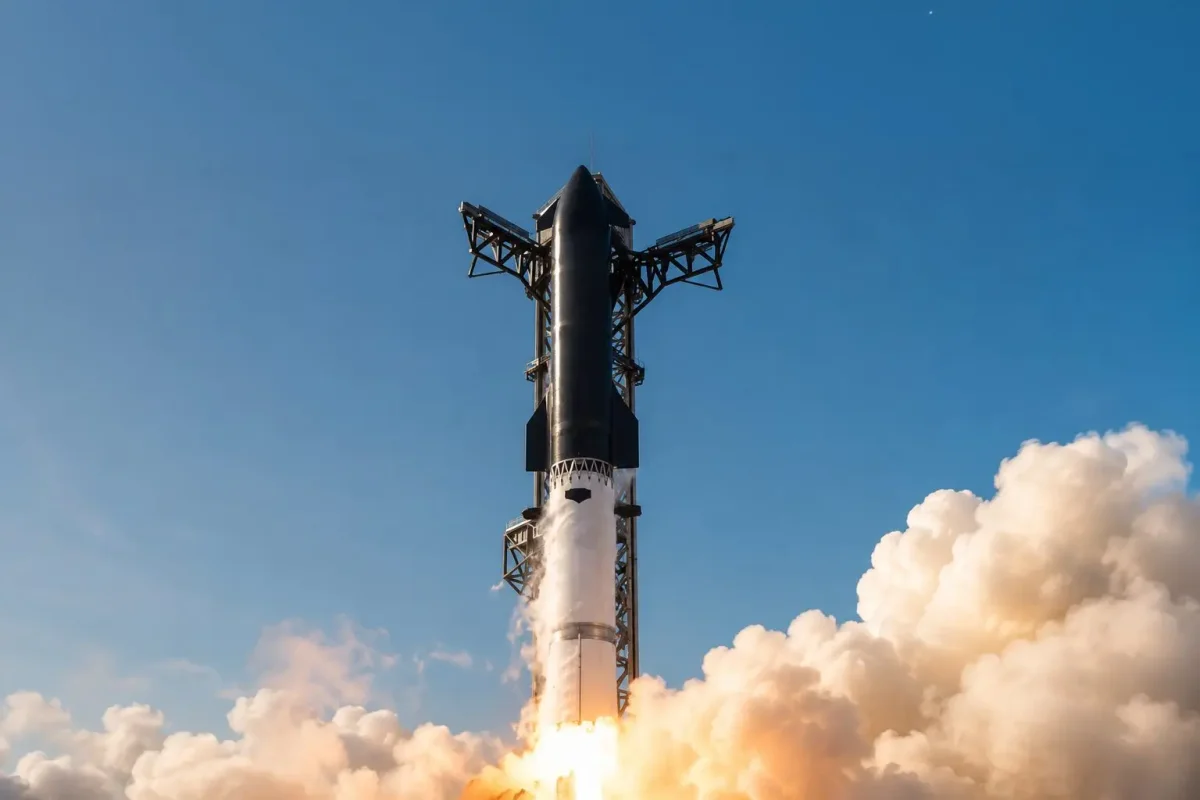
SpaceX's (NASDAQ:SPCX) Starship program achieved a critical engineering milestone during Flight 13, successfully testing its heat shield tiles under intentionally elevated acceleration and dynamic pressure. However, the achievement failed to impress investors, as the company's stock plunged to an all-time low during Monday's trading session.
The test flight, which took place on July 27, 2026, subjected the thermal protection system to conditions beyond normal operational parameters. SpaceX designed the experiment to evaluate tile attachment performance under stress, a key requirement for enabling heavier payloads to orbit. The company's CEO, Elon Musk, confirmed the test was successful, stating that Starship experienced "much higher acceleration" during reentry.
Despite the positive engineering outcome, the market reacted negatively. SpaceX shares closed at $113.50, a decline of 1.36% from the previous session. During the day, the stock touched a new low of $108.66, bringing its market capitalization to approximately $1.49 trillion. The stock now trades 15.9% below its initial public offering price of $135 and 49.7% below its June high of $225.64.
The disconnect between technical progress and stock performance highlights investor skepticism about the company's path to profitability. While the heat shield test addressed a significant engineering risk, SpaceX has yet to demonstrate rapid reusability—a cornerstone of its economic model. Analysts note that the company needs to prove it can consistently recover and refurbish Starship hardware for multiple flights with minimal turnaround time.
During Flight 13, the upper stage released 20 Starlink V3 satellites, all of which successfully established contact before their planned atmospheric disposal. The vehicle also performed a Raptor engine relight in space, executed a banking maneuver, and completed a controlled landing burn above the Indian Ocean. The spacecraft remained intact and transmitted telemetry throughout reentry, providing what SpaceX described as "critical views of an intact heatshield for the first time."
The Super Heavy booster, however, experienced a harder-than-expected splashdown due to a reignition failure in some of its landing engines. SpaceX spokesperson Dan Huot acknowledged the issue during the webcast, noting that the company had aimed for a gentler descent. This incident underscores the challenges still facing the full-stack reuse model.
Morgan Stanley (NYSE:MS) assigned Flight 13 an "A-" grade, maintaining an Overweight rating and a $300 price target. The bank highlighted the satellite deployment, engine relight, and successful splashdown as key achievements, but noted that the next major catalyst would be the first upper-stage tower catch, which Musk indicated is planned for Flight 14.
In contrast, competitor Rocket Lab (NASDAQ:RKLB) saw its shares rise 4.74% following news of a $266 million contract with the U.S. Space Force for 12 suborbital launches, with options for six more. The contract win provided a clear revenue signal that investors found more compelling than SpaceX's engineering milestones.
SpaceX is expected to report its second-quarter results on August 4, 2026. Analysts will be closely watching for details on launch frequency, revenue growth, and progress toward reusability metrics. The company's ability to translate technical successes into financial performance remains a key question for the market.