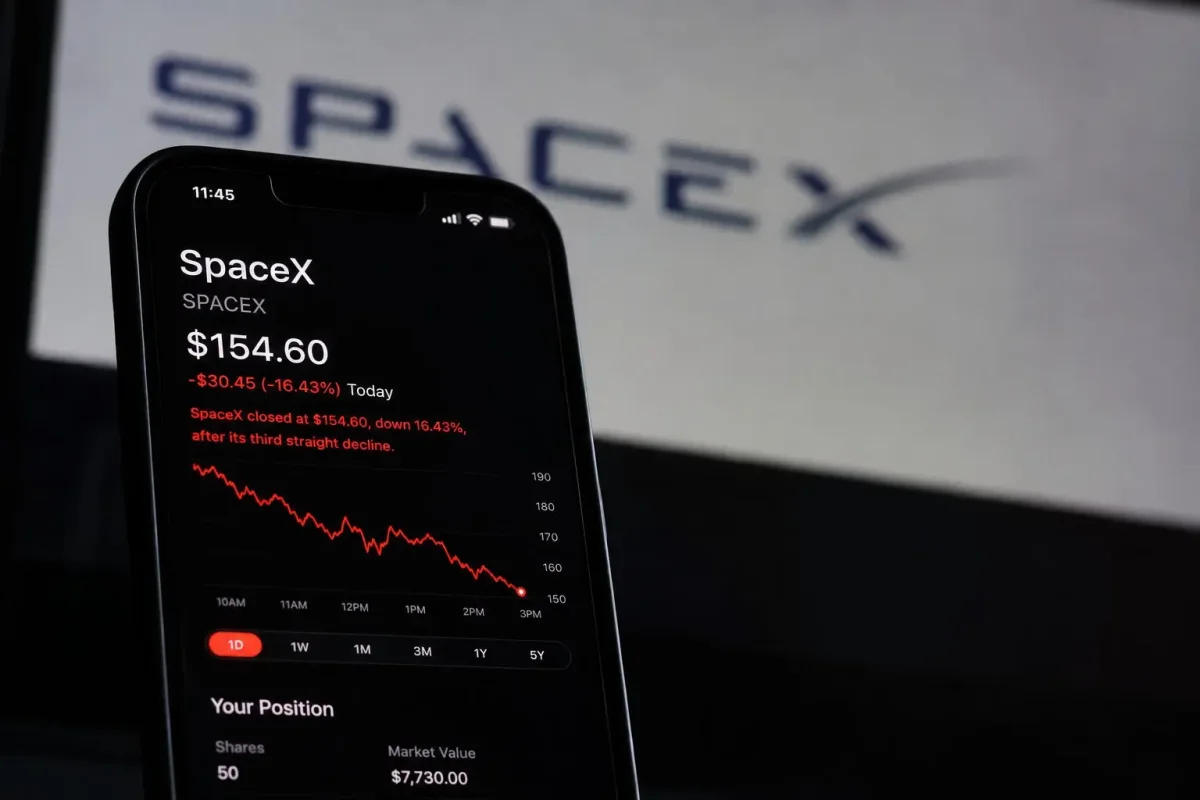
SpaceX experienced a sharp decline on Monday, with its stock price falling 16.4% to $154.60, as the company announced its first-ever bond sale. The move erased approximately $400 billion from the company's market capitalization, raising fresh concerns about the costs associated with expanding into artificial intelligence.
The sell-off extended a three-day losing streak, bringing the stock down about 23% since its debut. Despite the recent drop, the shares remain 14.5% above the initial public offering price of $135, and the company's market cap still hovers above $2 trillion.
Bond Sale Details
SpaceX initiated a bond offering of at least $20 billion, intended to refinance a bridge loan used for the acquisition of Elon Musk's xAI in February. The company has not yet disclosed the final size, interest rate, or coupon of the proposed notes. By opting for debt rather than equity, SpaceX is avoiding further dilution of existing shareholders, a decision that analysts view as prioritizing investor interests.
"This debt choice over additional equity clearly prioritizes avoiding further shareholder dilution," said Adam Sarhan, CEO of 50 Park Investments.
Financial Performance and AI Contracts
The company reported $100.8 billion in cash and equivalents as of June 19, bolstered by proceeds from its record $85.7 billion IPO just 10 days earlier. However, the bond plan underscores the enormous capital requirements for future expansion. SpaceX posted $18.67 billion in revenue for the year, a 33% increase, with Starlink accounting for roughly 60% of sales. But after absorbing the loss-making xAI unit, the company swung to a net loss of $4.94 billion, compared to a profit of $791 million in 2024.
On Monday, SpaceX secured a new AI client, Reflection AI, which agreed to pay $150 million per month for compute capacity at the Colossus 2 data center starting in July. The contract could be worth up to $6.3 billion by 2029, but either party can terminate after three months with 90 days' notice.
Market Impact
The broader market also felt the pressure, with the Nasdaq Composite sliding more than 1.3% as the selloff spread beyond space stocks. Other space-related companies, such as Rocket Lab and AST SpaceMobile, saw their shares decline by 6.5% and 9.3%, respectively. Big tech names also dropped as investors grew wary of heavy AI infrastructure spending. David Wagner, portfolio manager at Aptus Capital Advisors, described the move as a "broader sector pullback" driven by nervousness over AI investment costs.
Credit Ratings and Outlook
In credit markets, the bond offering received a boost from major rating agencies. Moody's, Fitch, and S&P Global Ratings all assigned investment-grade ratings to SpaceX with a stable outlook, indicating the company can meet its obligations despite moderate credit risk. However, S&P flagged uncertainty around the AI unit, citing ongoing funding needs and intense competition.
Industry Implications
SpaceX's IPO has reshaped valuation expectations in the space sector. "Everyone is aiming for higher valuations after the SpaceX IPO," noted OHB CEO Marco Fuchs, as the German satellite firm launched its own share sale. Risks remain significant, including higher interest payments, potential AI contract cancellations, substantial Starship spending requirements, and Elon Musk's majority voting control. New York University finance professor Aswath Damodaran valued SpaceX at roughly $100 per share before the listing and described the company's prospects as "bigger, but also more volatile."
The market now awaits the final terms of the bond offering, which will test whether credit investors share the caution seen in equity markets or view Monday's drop as a temporary cooling after a rapid IPO run-up.