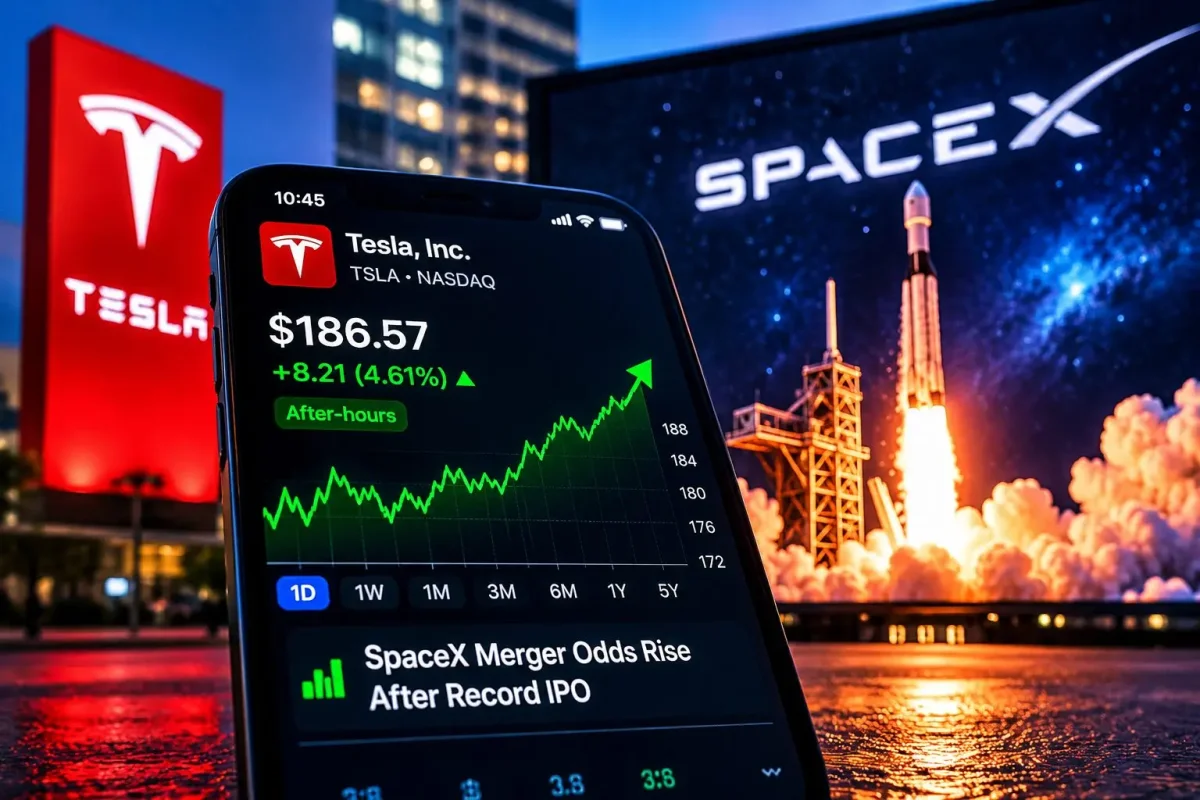
Traders on the Kalshi prediction market are now assigning a 54% probability to a merger between Tesla and SpaceX before May 1, 2027. This elevated expectation follows SpaceX's record-breaking initial public offering, which raised $75 billion and sent the company's market capitalization past $2 trillion on its first day of trading.
Shorter-term contracts indicate the market expects any potential deal to occur closer to the 2027 deadline. The odds of a merger before March 1, 2027 stand at 36%, rising to 40% before April 1 and hitting 54% before May 1. Kalshi has stipulated that a definitive, binding agreement announced in official company statements is required for settlement—mere rumors or preliminary discussions will not suffice.
SpaceX shares surged in their Nasdaq debut, opening at $150, well above the $135 IPO price, and jumped over 20% before settling near $167.40. Tesla was trading around $396.47, giving it a market cap of approximately $1.4 trillion. The IPO was the largest in history, marking the first time SpaceX shares were available to public investors.
SpaceX President Gwynne Shotwell did not dismiss the possibility of a tie-up with Tesla in a recent CNBC interview. “That might make Elon’s life a little easier, actually,” she said, citing synergies between the two companies. However, she emphasized that her immediate focus remains on SpaceX operations and expansion, not a merger deal.
The potential merger scenario presents a clear binary outcome for Tesla shareholders. A value-enhancing deal or strong second-quarter delivery numbers could drive shares higher. Conversely, disappointing deliveries, fading merger hopes, or unfavorable exchange ratios could weigh on the stock. Tesla currently trades at approximately 364 times earnings, leaving little room for disappointment.
Bulls argue that combining Tesla’s factories, batteries, robotaxis, and humanoid robots with SpaceX’s rockets, Starlink satellites, and artificial intelligence initiatives could create immense value. Wedbush analyst Dan Ives described a potential merger as the “holy grail” for Musk’s AI ambitions, noting that the two companies already collaborate on projects like the Terafab chip. Tesla’s earlier investment in xAI was converted into a SpaceX stake when SpaceX merged with xAI in February.
Bears, however, point to significant valuation and governance risks. SpaceX reported $18.7 billion in revenue for 2025 but lost nearly $5 billion, according to Reuters. The company’s price-to-revenue ratio stands near 94, far above Morningstar analysts’ valuation estimate of approximately $780 billion. This discrepancy raises the risk that Tesla shareholders could end up holding an overpriced asset in any merger.
Investors are now focused on Tesla’s second-quarter delivery and production numbers, expected after the June quarter ends. In Q1, Tesla produced 408,386 vehicles and delivered 358,023, while deploying 8.8 GWh of energy storage. The company has cautioned that these metrics alone do not capture the full picture, as pricing, costs, and other factors also drive results.
Tesla’s stock remains highly speculative at current levels. Bulls are betting on future AI, robotaxi, and robotics potential, as well as a possible SpaceX deal, rather than near-term auto sales. Bears warn that a merger may never happen, could occur on unfavorable terms, or might distract both companies from their core businesses. Traders are likely to react sharply to any concrete developments on the merger front or to Q2 delivery numbers.