Uber Technologies (NYSE:UBER) saw its market capitalization surge by nearly $8 billion in a single trading session following the announcement of its new autonomous vehicle unit. The stock initially climbed 5% on the news before closing at $75.69, down 0.7% from the previous day's close. This single-day gain underscores investor enthusiasm for Uber's foray into self-driving technology.
The $8 billion increase is significant when compared to Uber's financial performance. It is approximately 3.5 times the company's first-quarter free cash flow of $2.286 billion and nearly 2.9 times the midpoint of its second-quarter adjusted EBITDA guidance of $2.75 billion. This highlights the market's willingness to bet on future growth over current cash generation.
Financial Context and Segment Performance
Uber's first-quarter results showed strong underlying business momentum. Trips increased 20% year-over-year to 3.6 billion, while gross bookings rose 25% to $53.7 billion. Revenue grew 14% to $13.2 billion. CEO Dara Khosrowshahi noted that Uber One membership reached 50 million, now accounting for half of Mobility and Delivery gross bookings. CFO Balaji Krishnamurthy emphasized that earnings are "scaling at more than twice our topline."
Segment performance reveals key insights. Mobility gross bookings reached $26.394 billion, up 25%, with operating income of $2.029 billion. Delivery generated $25.992 billion in gross bookings, up 28%, but operating income was only $961 million—less than half of Mobility's. Freight contributed $1.334 billion in bookings, up 6%, but posted an operating loss of $30 million.
Autonomous Vehicle Strategy
In February, Uber launched Uber Autonomous Solutions, a unit designed to provide partner services including demand, mapping, rider support, and fleet operations. However, Khosrowshahi cautioned that "meaningful commercialization will take much longer," suggesting the new unit's profit impact may be gradual. Sarfraz Maredia, head of global autonomous mobility and delivery, advised teams to focus on "building software," with Uber taking on some operational responsibilities.
The capital commitment to autonomy extends beyond internal development. Reuters reported in March that Uber plans to invest up to $1.25 billion in Rivian (NASDAQ:RIVN), with an initial $300 million investment. The deal is linked to 10,000 autonomous R2 SUVs starting in 2028, with an option for an additional 40,000 from 2030. BNP Paribas analyst James Picariello said the investment was "widely expected" and should fund additional R&D.
Competitive Landscape
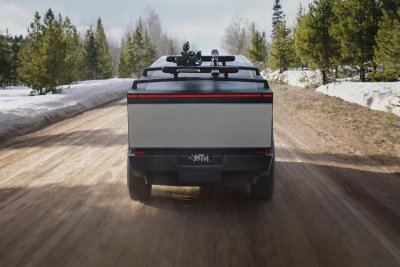
Uber's robotaxi push comes amid heightened investor interest in autonomous ride services. On Monday, Alphabet (NASDAQ:GOOG) shares rose 4.6%, Tesla (NASDAQ:TSLA) jumped 5.4%, and Lyft (NASDAQ:LYFT) gained 1.8%. Reuters reported that Alphabet's Waymo operates approximately 2,500 robotaxis in select U.S. cities, while Tesla has launched a small robotaxi service in Austin, Texas. These moves reflect growing investor demand for autonomous vehicle exposure.
Analyst Sentiment and Guidance
Despite a 14.7% year-to-date decline through June 21—compared to a 26.7% gain for the S&P 500—analysts remain bullish. Lawrence Rothman, CFA, at Motley Fool recommended buying Uber shares on June 25, citing autonomous vehicle challenges as a buying opportunity. On June 26, Cavenagh Research at Seeking Alpha rated Uber a "Strong Buy," highlighting over 20% top-line growth, strong cash flow, and share buybacks.
Uber's second-quarter guidance includes gross bookings between $56.25 billion and $57.75 billion, non-GAAP EPS of $0.78 to $0.82, and adjusted EBITDA ranging from $2.70 billion to $2.80 billion. As the company navigates the transition to autonomous mobility, investors will closely monitor both near-term financial performance and long-term strategic execution.