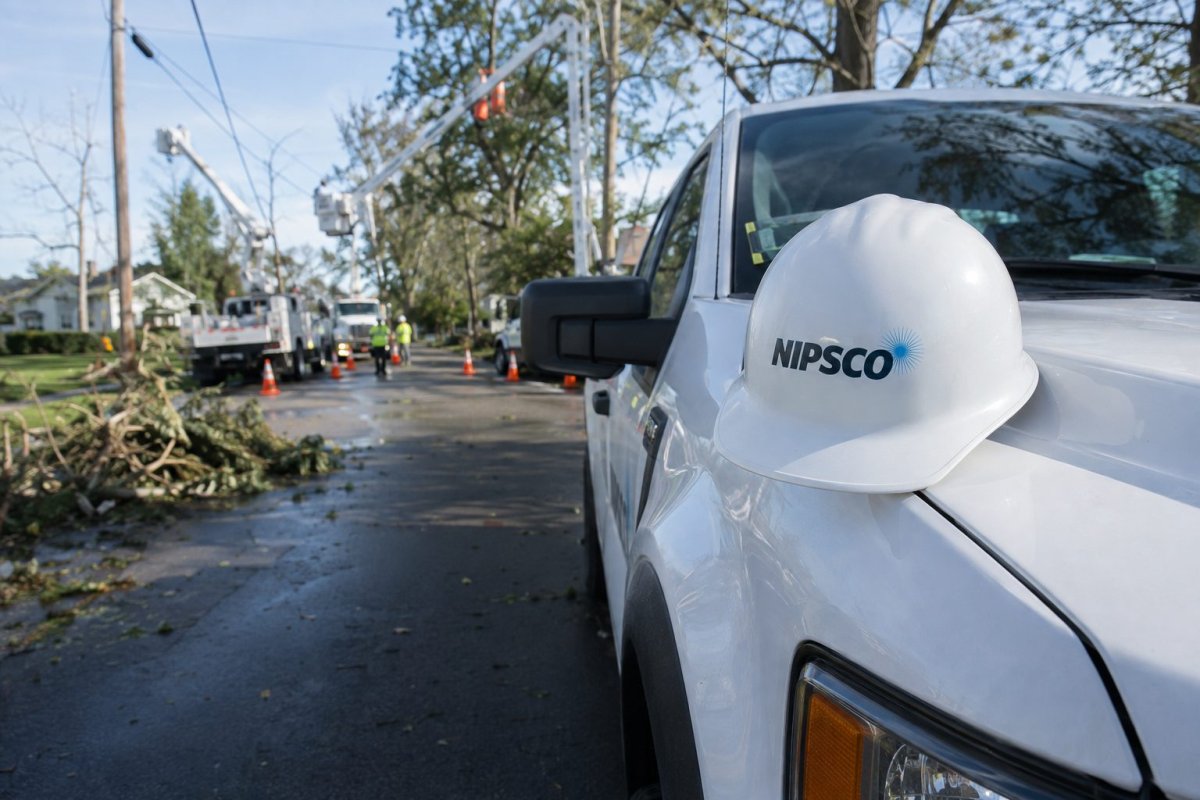
Severe storms sweeping through the Midwest have knocked out electricity for approximately 273,900 customers served by NiSource Inc.'s (NYSE: NI) NIPSCO utility subsidiary, representing nearly 59% of its 468,000 electric customer base. The utility has launched a large-scale restoration effort, but investors are already weighing the financial impact of the widespread outages.
The storm, which struck on August 11, 2026, caused outages across the region, with NIPSCO accounting for about 92% of Indiana's total outages and roughly 38% of the Midwest's 729,000 affected customers, according to data reported by Reuters. Restoration efforts are expected to extend over multiple days in some areas, as crews assess damage to poles, lines, and trees.
NiSource shares, which closed at $42.01 on Tuesday, are trading approximately 14.6% below their 52-week high of $49.21 set on June 29. The stock saw elevated trading volume last week, with 13.6 million shares changing hands on August 5 following the company's quarterly earnings release, compared to a 50-day average of 4.4 million shares.
The outage comes at a critical time for NiSource, which has been positioning itself as a key player in the data center boom. The company has signed agreements to supply power to facilities for Alphabet (NASDAQ: GOOGL) and Amazon (NASDAQ: AMZN), projecting around $1.4 billion in value for existing customers. These large-load customers are expected to fund associated generation and transmission costs, but the current grid stress highlights the importance of reliability.
Financial Guidance and Analyst Outlook
NiSource reaffirmed its 2026 adjusted earnings guidance of $2.02 to $2.07 per share in May, along with a 9%-10% adjusted EPS growth target for 2026-2033. CEO Lloyd Yates said at the time, "We are off to a strong start in 2026, continuing to execute on our strategy." However, the company has not yet provided an estimate for storm restoration costs or updated its guidance in response to the event.
Analysts remain cautiously optimistic. RBC Capital Markets initiated coverage with a Buy rating and a $52 price target on July 1, while Wells Fargo reiterated a Buy rating with a $52 target on June 29. Barclays, Evercore ISI, and Citigroup have also maintained their ratings, with targets ranging from $47 to $52. Based on Tuesday's close, these targets imply a potential upside of 12% to 24%, though they do not account for storm-related impacts.
Market Context and Peer Outages
Other major utilities, including Exelon (NASDAQ: EXC), Duke Energy (NYSE: DUK), and American Electric Power (NASDAQ: AEP), also reported outages from the storm, but NIPSCO's numbers were the highest among listed utilities. The widespread nature of the disruption could have broader implications for the sector, as investors focus on grid resilience and the costs associated with extreme weather events.
NiSource serves approximately 500,000 electric customers and 3.3 million gas customers across six states. The outage affecting over half of its electric base underscores the operational challenges facing the utility as it balances growth initiatives with the need for reliable infrastructure.
Investors will be watching for updates from NIPSCO on restoration progress and any changes to the multi-day timeline. A rapid decline in outages would reduce uncertainty, while extended disruptions could renew scrutiny on cost recovery mechanisms and grid investments.