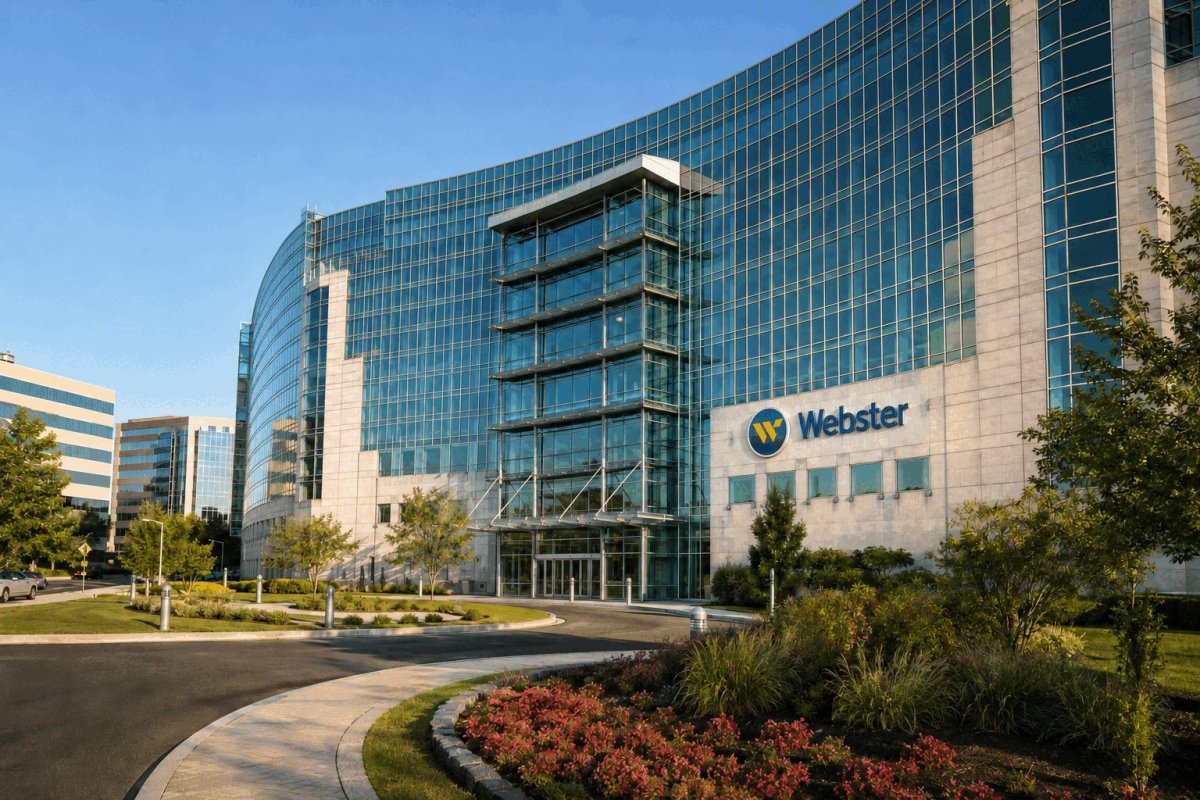
Webster Financial Corporation (NYSE:WBS) concluded its public trading life on August 19, closing at $77.57, a 1.8% decline from the previous Friday. The session saw an extraordinary 91.3 million shares change hands, a volume 15.4 times the company's three-month daily average of 5.93 million shares. This surge was directly tied to the completion of Banco Santander's acquisition, not typical market dynamics.
The acquisition was finalized on August 20, and Webster's common shares were delisted from the New York Stock Exchange. The transaction valued each former Webster share at $78.73, based on Santander's closing price on Friday, August 21. This consideration consisted of $48.75 in cash plus 2.0548 Santander American Depositary Shares (ADSs).
At the time of Webster's final close, the package was worth approximately $77.87, based on Santander's ADS price of $14.17. This represented a slight premium of 0.4% over Webster's closing price. By Friday, Santander's ADS had risen to $14.59, pushing the equivalent value to $78.73 per share. This marked a gain of about $1.16 per share for former Webster shareholders compared to the final WBS price, before accounting for taxes or fees.
Volume and Trading Context
The final week of trading saw escalating volume as the deal's completion approached. On August 14, Webster shares traded 10.39 million shares, followed by 7.22 million on August 17 and 28.45 million on August 18. The climax came on August 19 with 91.32 million shares, a clear indication of arbitrage activity and institutional repositioning ahead of the merger's close.
This volume spike was not a reflection of new investment interest but rather the mechanics of the acquisition. The difference is important for screens that continue to classify WBS as an active stock. The quote has become outdated as no trading occurred in Webster common stock on Thursday or Friday after the delisting.
Deal Valuation and Market Response
The transaction's completion shifts investor focus to Santander. The Spanish lender created 329.85 million new shares for the deal, representing 2.20% of its expanded share capital. Santander now has 15.02 billion shares in circulation. The new shares are set to begin trading in London on August 26.
Santander projects that the merged U.S. business will have assets totaling approximately $327 billion, with $185 billion in loans and $172 billion in deposits. The company aims for annual pre-tax cost savings of around $800 million by the end of 2028. Santander anticipates earnings-per-share gains of 7% to 8% and expects to achieve an 18% return on tangible equity in its U.S. operations that same year.
During the final week, Santander's ADS fell 1.2%, a smaller decline compared to some regional banks. This performance does not indicate a merger advantage but rather that Santander's U.S. ADSs avoided significant additional downward pressure. In comparison, BankUnited (NYSE:BKU) fell 4.16%, Citizens Financial (NYSE:CFG) dropped 6.52%, and Fifth Third (NASDAQ:FITB) declined 5.58% over the same period.
Analyst Perspectives and Risks
Analyst targets released before the close are now historical, reflecting the arbitrage phase. Barclays had an Equal Weight rating with a $78.00 target, RBC Capital had Sector Perform at $76.00, Keefe, Bruyette & Woods had Outperform at $77.50, Truist Securities had Hold at $72.00, and UBS had Neutral at $69.00. These are no longer applicable to a listed WBS security.
Santander Executive Chair Ana Botín praised the deal, stating, "Santander US and Webster are a perfect match," following the Federal Reserve's approval. However, integration challenges remain. The projected $800 million in savings represents roughly 19% of the merged cost base. Delays in systems integration, client losses, or more significant back-office reductions could increase costs and diminish anticipated returns.
With assets now surpassing $250 billion, Santander will fall under a stricter U.S. supervisory category. Key ongoing markers will include deposit retention, conversion timelines, and progress toward the 2028 savings objectives. The market will watch Santander's performance closely as it absorbs Webster's operations.