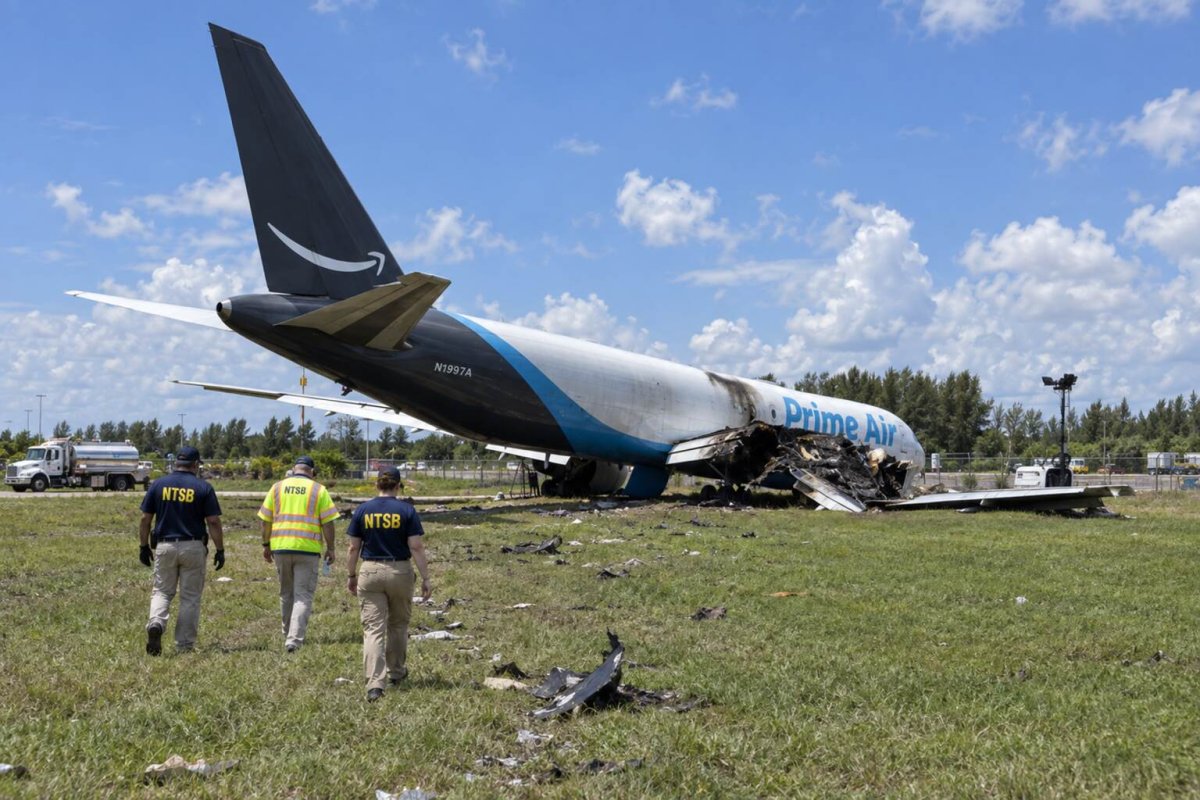
Amazon's air cargo operations came under renewed scrutiny this week following a fatal crash in Miami that killed five people. The incident, involving a Boeing 767-33A operated by 21 Air under the Amazon Air brand, has transitioned from an operational emergency to a broader investor question about contractor oversight and potential legal liabilities. Shares of Amazon (AMZN) traded at $252.225 at 3:17 p.m. ET Wednesday, down 1.85%, though the decline cannot be solely attributed to the accident, as the company also recently priced a new sterling bond sale.
What We Know So Far
The National Transportation Safety Board (NTSB) has identified the aircraft as 21 Air Flight 7598, a scheduled cargo flight from San Juan to Miami operating under Part 121 rules. It overran Runway 30 at Miami International Airport on September 6. The NTSB lists investigation DCA26MA352 as ongoing. The five victims were members of a cleaning crew whose van was struck by the aircraft; two other workers were hospitalized.
The operator distinction is crucial. Amazon has stated that the aircraft was part of Amazon Air but was operated by 21 Air, a contracted cargo carrier. This contractual arrangement complicates the allocation of responsibility, as a branded airplane might appear to be a wholly internal Amazon operation, but legally and operationally, the liability may be shared.
Legal and Financial Exposure
A wrongful-death lawsuit has been filed by an attorney representing one victim's family, naming Amazon, 21 Air, and the pilots. The complaint contains allegations, not findings of fault, and the eventual claim or settlement amount is unknown. Amazon has pledged to cooperate with investigators and coordinate with the operator.
From a financial perspective, the first-order earnings risk appears limited. Amazon generated $200.606 billion in sales and $27.461 billion in operating income in the second quarter. Shipping costs for the quarter were $27.9 billion, up from $23.4 billion a year earlier, and $53.6 billion for the first half, up from $45.9 billion. However, Amazon does not disclose the economics of its carrier contract with 21 Air, insurance arrangements, or potential indemnities.
What Investors Should Watch
The NTSB's preliminary findings will be critical. Investors should monitor verified details on the approach and landing, crew decisions, aircraft systems, and runway conditions. Any FAA action involving 21 Air, or Amazon's decision to suspend, audit, or replace the carrier, would signal a more concrete operational impact.
The legal record is another checkpoint. Disclosures about insurance, indemnification, or a reserve would provide the first basis for estimating financial exposure. Until then, treating an undetermined lawsuit value as an Amazon earnings forecast would be false precision.
Market Context
The strongest counterargument to a bearish AMZN reading is scale: Amazon's logistics system is vast, the flight was operated by a third party, and no network-wide disruption has been disclosed. The strongest reason not to dismiss the event is the same brand-and-control gap. Amazon's name is on the aircraft, and its customer promise depends on outside operators meeting safety standards.
The market consequence will be determined by what the investigation says about that oversight, not by the logo alone. As the NTSB probe continues and legal proceedings unfold, investors will be watching for any signs of systemic safety failures or regulatory repercussions that could affect Amazon's air network and bottom line.