AT&T has confirmed that internet services across Dallas and nearby regions are back to normal following a significant fiber disruption. The company attributes the outage to attempted cable theft, not a cyberattack, as initially claimed by an Iranian-linked hacker group. For shareholders, the immediate crisis appears resolved, but the incident raises questions about the resilience of AT&T's expanding fiber network, which is central to its growth strategy.
On Wednesday, AT&T shares traded at $25.185, down 1.62% by 3:26 p.m. ET, according to real-time Nasdaq data. While the outage may have influenced sentiment, the stock was also reacting to broader market pressures, including rising oil prices and rate uncertainty. The decline cannot be directly attributed to the outage, but it underscores the challenges facing the telecom giant.
What Caused the Texas Outage?
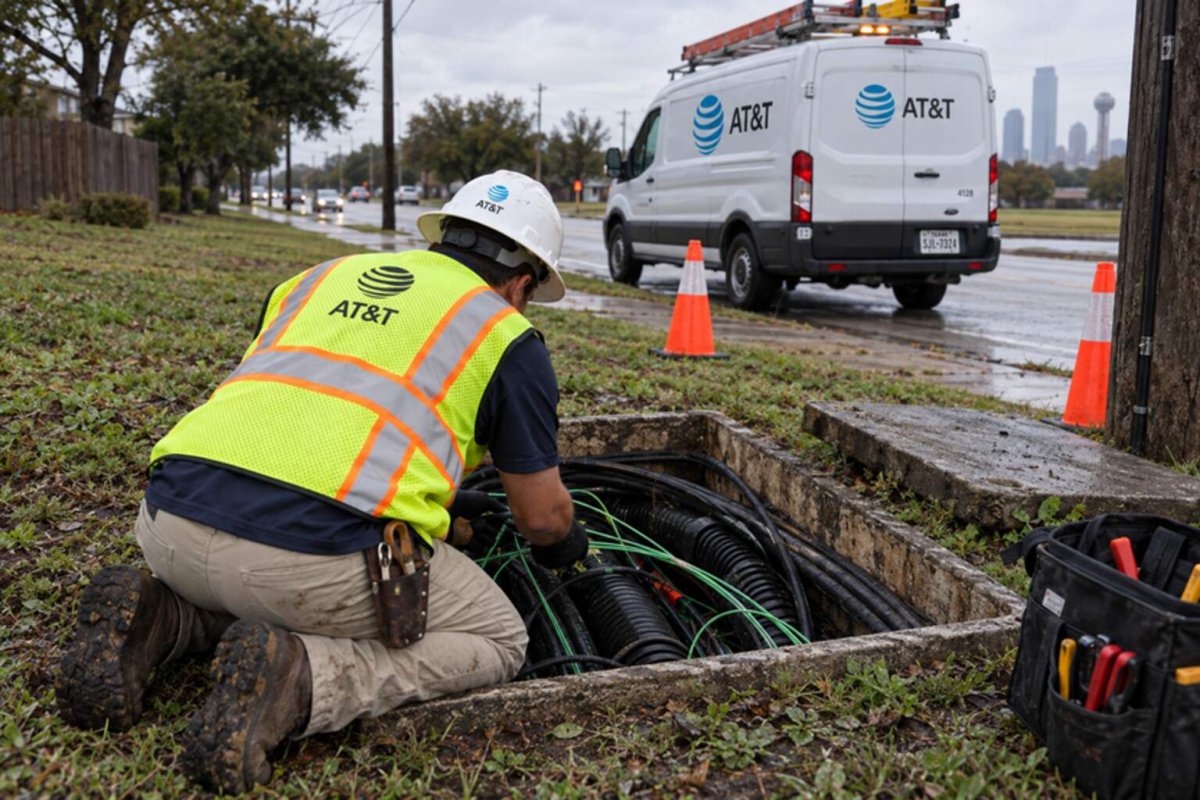
The disruption began on Monday, affecting fiber customers in Dallas and surrounding communities. At its peak, more than 7,000 households were without service. By Wednesday, AT&T reported that the network was operating normally and remained under monitoring, as noted in a statement covered by Chron.
An Iranian-linked hacker group claimed responsibility for the outage, but AT&T found no evidence to support this. Instead, the company's investigation pointed to attempted cable theft as the cause. This distinction is crucial: an unverified claim does not constitute a breach, and investors should not price in a cyber incident without concrete evidence.
A separate Houston Chronicle report suggested that the attempted theft contributed to internet problems in the Dallas area. However, AT&T did not clarify whether this incident was linked to a surge in Houston complaints involving Google services. The responsible takeaway is narrow: the Dallas outage had a physical cause and has been resolved, while broader Texas issues remain unexplained.
Why Fiber Reliability Matters for Earnings
While the outage is small relative to AT&T's national footprint, it directly impacts the business segment the company is investing in most heavily. As of June 30, AT&T reported 12.868 million fiber connections, including 12.144 million consumer and 724,000 business connections. The company added 367,000 net fiber customers in the second quarter, a 36.4% increase year-over-year.
Management highlighted that it expanded fiber availability by over one million locations during the quarter, driving quarterly capital investment up to $6.1 billion from $5.1 billion. AT&T maintains its 2026 outlook of $23 billion to $24 billion in capital expenditures, over $18 billion in free cash flow, and adjusted earnings per share between $2.25 and $2.35.
So far, AT&T has not disclosed repair costs, customer credits, or any changes to guidance related to this outage. Based on available information, it is not a measurable earnings event. However, it serves as a stress test for the economics of protecting a larger physical network. Theft deterrence, route redundancy, and rapid fault resolution require investment, but repeated failures could lead to customer churn and damage the company's reliability reputation.
Key Checks for Investors
Investors should monitor several factors in the coming weeks. First, watch for disclosure of outage duration, customer credits, or unusual repair expenses. Second, track whether similar incidents recur in the same area; a single damaged cable is an isolated event, but repeated failures could indicate systemic weaknesses. Third, examine fiber churn and net additions in the next quarterly report to gauge whether reliability issues have affected customer behavior.
The counterargument is that service has been restored, the affected families represent a tiny fraction of AT&T's fiber base, and no cyberattack or significant financial impact has been confirmed. This keeps the event below the threshold of changing the earnings thesis. However, AT&T is asking investors to fund an aggressive fiber buildout while supporting cash returns. The company must demonstrate that its network's physical safeguards and redundancy are scaling alongside its expansion.