AST SpaceMobile (ASTS) faces renewed pressure as trading resumes Monday following a dramatic sell-off triggered by a Blue Origin New Glenn rocket explosion during an engine firing test. The incident has reignited concerns over the satellite-phone company's ambitious 2026 deployment timeline.
Shares closed at $113.41 on Friday, a sharp 14.79% decline from the previous session's record high of $133.86. The stock had been riding a wave of optimism, climbing 13.1% on Tuesday, 8.3% on Wednesday, and 2.7% on Thursday before the news broke. Despite the setback, ASTS still managed a weekly gain of approximately 7.1%.
Market Context and Analyst Reactions
While broader markets remained resilient—with the S&P 500 edging up 0.2% for its ninth consecutive weekly gain and the Nasdaq Composite also rising 0.2%—AST's decline stood out as company-specific. The stock's valuation reflects its status as a high-growth deployment play rather than an established telecom operator, making it particularly sensitive to launch delays.
Deutsche Bank analyst Bryan Kraft downgraded AST to Hold from Buy, slashing the price target from $106 to an undisclosed level. Kraft had previously expected 26 AST satellites to launch on New Glenn this year, but now anticipates a roughly six-month delay. Other analysts echoed the caution, with Chris Quilty of Quilty Space calling the failure a “tough blow” given limited launch alternatives, and Tim Farrar of TMF Associates warning of a “huge” impact if pad repairs drag on.
Launch Flexibility and Satellite Production
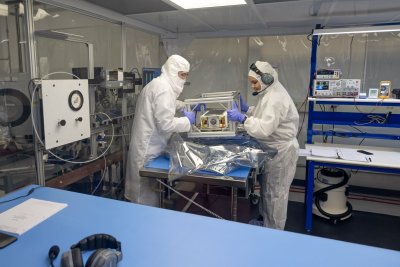
AST has sought to mitigate its reliance on Blue Origin by diversifying launch providers. The company confirmed that none of its upcoming missions involve Blue Origin, with BlueBird 8, 9, and 10 still slated for a mid-June flight aboard SpaceX's Falcon 9. An AST spokesperson emphasized that the satellites are “launcher-agnostic” and compatible with multiple rocket types. BlueBird 11 through 33 remain in advanced production and assembly, underscoring the company's manufacturing momentum.
However, the New Glenn rocket is one of the few vehicles capable of carrying large communications satellites, and its failure raises capacity constraints. This is not the first issue: in April, BlueBird 7 missed its target orbit due to an upper-stage anomaly, leading to a planned de-orbit. The cumulative effect of these setbacks has heightened scrutiny on AST's ability to meet its 2026 target of deploying approximately 45 BlueBird satellites.
Financial Position and Competitive Landscape
Despite the operational headwinds, AST maintains a strong financial footing. As of March 31, the company reported approximately $3.5 billion in cash, cash equivalents, and restricted cash. It reaffirmed its full-year revenue guidance of $150 million to $200 million. CEO Abel Avellan has cited accelerating manufacturing and regulatory progress as key pillars of the company's strategy.
The competitive backdrop adds another layer of complexity. Amazon's Project Kuiper was also expected to use New Glenn, but SpaceX's Starlink continues to dominate the low-Earth orbit broadband market. The broader space sector felt the impact, with shares of Rocket Lab and other space-related stocks declining Friday as investors reassessed launch and execution risks.
Outlook and Key Risks
The path forward hinges on two critical factors: the speed of Blue Origin's recovery and AST's ability to shift launches to alternative providers. If the Falcon 9 mission proceeds smoothly in mid-June and Blue Origin provides a credible repair timeline, Friday's sell-off may prove overdone. Conversely, if pad damage is extensive or AST cannot secure sufficient launch capacity, the 2026 deadline could slip, pushing revenue further into the future. With the stock trading at elevated multiples, there is little margin for additional setbacks.
Investors will be closely watching for updates from Blue Origin and any announcements regarding AST's launch schedule. The coming weeks will be pivotal in determining whether the company can navigate this latest challenge and maintain its trajectory toward commercial satellite service.