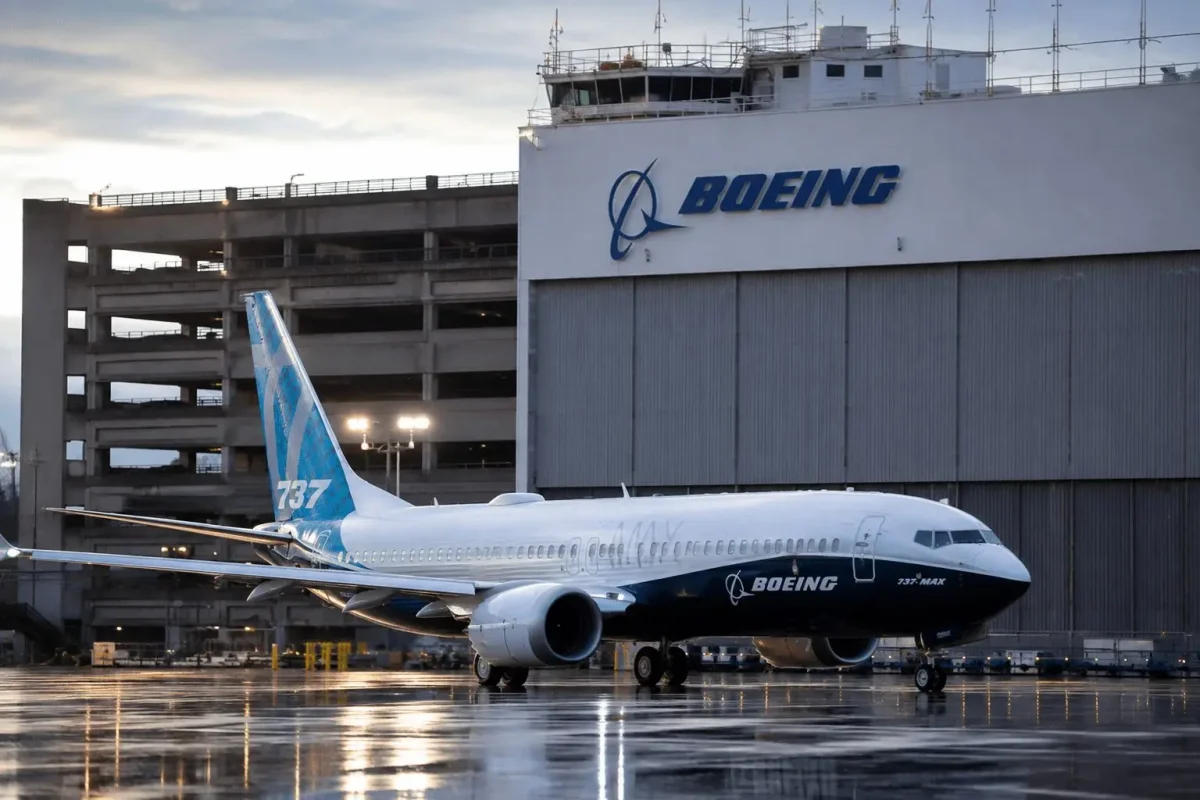
Boeing Co (NYSE: BA) shares closed higher on Friday, advancing 0.96% to $234.42, as investors shrugged off a regulatory directive requiring crack inspections on hundreds of 737 MAX aircraft. The stock posted an 8.5% weekly gain, driven largely by a double-upgrade from BNP Paribas and FAA certification of the smaller MAX 7 earlier in the week.
The Federal Aviation Administration (FAA) has mandated inspections for 471 U.S.-registered 737-8, 737-9, and 737-8200 aircraft, set to begin September 10. The directive targets a metal reinforcement near the forward galley door, where cracks could compromise fuselage integrity. No cracks have been detected on MAX aircraft to date, and the FAA projects initial visual inspections to cost $40,035 per aircraft, with detailed eddy-current checks potentially reaching $160,140 per cycle. Repair costs remain undetermined.
Market participants viewed the directive as a routine maintenance matter rather than a precursor to grounding. The estimated top-end inspection cost for the entire fleet amounts to roughly 0.025% of Boeing's $631 million free cash flow in the second quarter, underscoring the minimal financial impact. Airlines, not Boeing, are responsible for the inspection labor costs.
Strong Week Bolstered by Analyst Upgrade and MAX 7 Approval
Friday's advance capped a robust week for Boeing. On Monday, the FAA approved the 737 MAX 7, a key milestone for the company's narrowbody family. The same day, BNP Paribas analysts issued a double-upgrade, moving the stock to Outperform with a $300 price target, which triggered an 8.03% surge in Tuesday's session. That rally accounted for nearly all of the weekly gain.
Boeing's second-quarter results, released earlier in the month, reinforced the positive sentiment. Revenue climbed 8% year-over-year to $24.6 billion, with 171 commercial aircraft delivered. Free cash flow reached $631 million, and the backlog hit an all-time high of $715 billion. CEO Kelly Ortberg noted that operations are more stable and key certification programs remain on track, while Vertical Research Partners analyst Rob Stallard summarized the quarter as "the recovery continues."
Market Reaction and Analyst Sentiment
The broader market also rose on Friday, with the S&P 500 gaining 0.62% to 7,757.64. Airline stocks showed mixed performance: Southwest Airlines (NYSE: LUV) edged up 0.20% to $47.05, United Airlines (NASDAQ: UAL) rose 0.34% to $129.56, but American Airlines (NASDAQ: AAL) slipped 0.62% to $15.94. No widespread airline selloff was observed in response to the FAA directive.
Wall Street remains largely bullish on Boeing, with 80% of analysts rating the stock a Buy and an average price target of $276, implying about 17.7% upside from Friday's close. JPMorgan (NYSE: JPM) has an Overweight rating with a $290 target, while Jefferies (NYSE: JEF) maintains a Buy with a $295 target.
Operational Momentum and Key Catalysts
The investment thesis hinges on Boeing's ability to convert rising output into sustained cash generation. The company has accelerated 737 production to a pace near 47 jets per month and launched initial low-rate manufacturing at its new Everett facility in July. The next major certification milestone is the MAX 10, with certification expected in 2026 and first deliveries slated for 2027.
Investors will closely watch Boeing's upcoming July order and delivery report, which will provide the next comparable snapshot against rival Airbus (OTC: EADSY). Airbus delivered 67 aircraft in July, bringing its seven-month total to 418, while Boeing had delivered 314 through June, its best first-half performance since 2018.
Risk Factors
While the current market response is contained, risks remain. The FAA has yet to provide definitive repair cost estimates, and additional cracks or more frequent inspections could increase airline claims. Regulatory scrutiny could also delay production or certification of the MAX 10, which would have a more significant impact than routine inspection costs. For now, investors appear confident that Boeing can continue its recovery trajectory, focusing on the company's operational gains and cash flow generation.