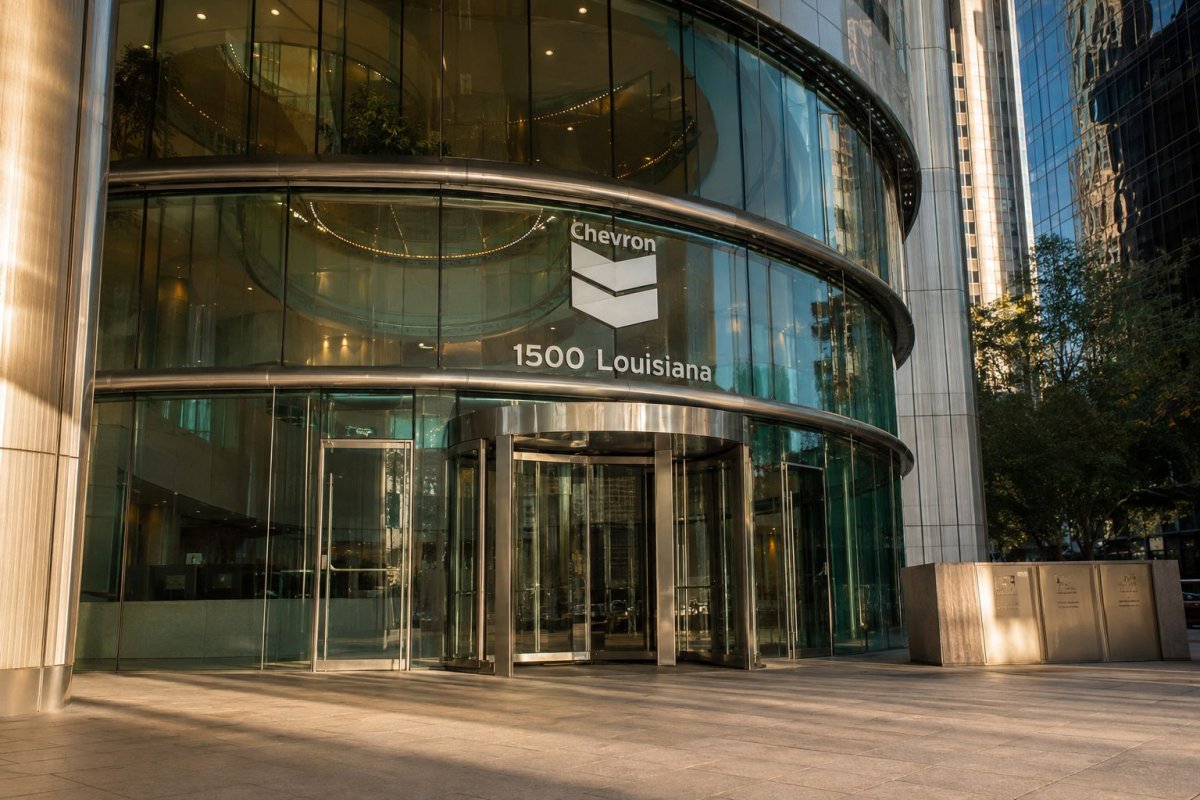
Chevron Corporation (NYSE: CVX) shares advanced 0.8% in late morning trading on August 18, 2026, reaching $204.32, as Brent crude held steady at $91 per barrel. The oil major's stock movement came amid ongoing geopolitical tensions in the Strait of Hormuz, which continue to support crude prices but remain below levels that would significantly boost Chevron's earnings.
Brent crude rose 0.4% to $91.23, while WTI climbed 0.66% to $85.06. Despite the uptick, crude prices remain 12.3% below Chevron's second-quarter average of $104, a gap that analysts say is crucial for the company's valuation. Chevron shares are trading 4.8% below their 52-week high of $214.71, and the average analyst price target of $216 implies a potential upside of just 5.7%.
Market Data at a Glance
- Chevron stock: $204.32, up 0.80%
- Brent crude: $91.23 per barrel, up 0.40%
- WTI crude: $85.06 per barrel, up 0.66%
- 52-week high: $214.71 (down 4.84%)
- Average analyst target: $216 (potential gain 5.72%)
The Strait of Hormuz remains the key driver of oil prices. Iran has stated it will not reopen the passage unless Washington meets demands such as removing oil sanctions and unfreezing assets. Prior to the conflict, the strait carried nearly 20% of the world's oil and liquefied natural gas. President Donald Trump has said no discussions are planned, and tanker crossings have remained below ten. Mohit Kumar, chief Europe strategist at Jefferies, noted that the parties have yet to reach critical points that might compel an agreement, and he anticipates short-term upward movement in oil prices.
Diplomatic Timeline
- June 17: U.S. and Iran agreed to a temporary memorandum, opening the door for easing tensions.
- July 7: Trump declared the deal terminated, increasing the likelihood of an extended shutdown.
- Mid-July: Iran halted the memorandum, undermining expectations of tanker market stabilization.
- August 18: Iran linked reopening to sanctions relief and asset terms, maintaining a higher oil risk premium.
Chevron began this period with strong earnings momentum. The company posted net income of $12.07 billion for the second quarter, compared to $2.21 billion in the first quarter. Upstream earnings more than doubled quarter-over-quarter, rising to $8.18 billion from $3.91 billion, while downstream profits swung to $4.87 billion from a loss of $0.82 billion. Free cash flow surged to $18.1 billion, and daily production increased to 4.07 million barrels of oil equivalent per day, up 5.5% sequentially.
The quarter demonstrated significant operating leverage. Average Brent gained $23 sequentially, which aligned with a $4.27 billion jump in upstream earnings. Production growth also contributed, highlighting volume as a key factor. However, the current $91 price of crude remains above first-quarter levels but falls short of the $104 mark that underpinned recent profits. A sustained premium linked to Hormuz would help close that earnings difference.
CEO Mike Wirth stated that Chevron is maintaining its focus on dependable energy amid continued geopolitical uncertainty. He cited disciplined investment, all-time high U.S. production, and record refinery throughput as key factors. The company also delivered $3 billion in yearly structural cost savings. Chevron's balance sheet provides flexibility, with $22.6 billion in operating cash flow and $18.1 billion in free cash flow last quarter, while debt was trimmed by $8.4 billion.
Analyst Sentiment
Among seventeen analysts tracked over the past three months, thirteen rate Chevron a Buy, four a Hold, and none a Sell. Price targets are tightly clustered, with the lowest at $205 (just 0.3% above the current price) and the highest at $227 (implying 11.1% upside). Barclays reaffirmed its Hold rating and $208 price target on August 17. The $1.78 per share quarterly dividend reflects a 3.48% indicated yield, with the record date set for August 19 and payment due September 10.
Risks remain: diplomatic progress could rapidly lower crude prices and reduce Chevron's valuation, while prolonged shutdowns might boost profit forecasts but also decrease demand, push up expenses, and heighten operational risk. Investors are advised to monitor tanker activity and shifts in Iran's circumstances. The share price has already priced in most of the short-term advantage, making sustained Brent prices at or above current levels more important than a single-day increase.