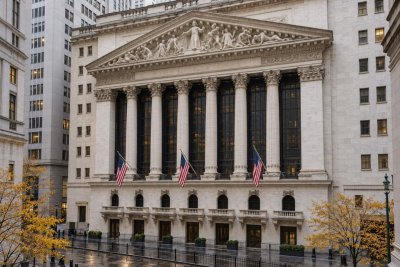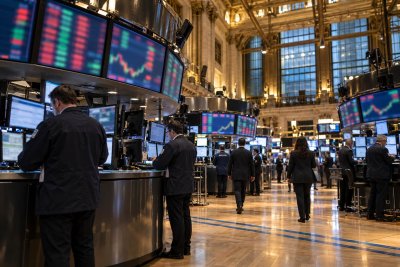
Stocks experienced a sharp decline by midday Tuesday following the opening of U.S. cash markets, with the Dow Jones Industrial Average falling 556 points, or 1.1%, to 51,663. The blue-chip index was heavily weighed down by two of its largest components, Alphabet (NASDAQ:GOOGL) and Amazon.com (NASDAQ:AMZN), which together accounted for nearly 38% of the Dow's drop.
The impact was magnified by the Dow's price-weighted structure. Alphabet's $22.95 decline translated into an estimated 136-point drag on the index, using the current multiplier of about 5.94 points per dollar change in a component stock. That single stock represented roughly a quarter of the Dow's total loss. Amazon's $12.10 drop contributed an additional 72 points.
Alphabet was added to the Dow on June 29, replacing Verizon Communications (NYSE:VZ). Because the index weights stocks by price, Alphabet's higher share price gives it outsized influence. This structural quirk amplified the market's reaction to concerns about artificial intelligence investment returns.
Growth stocks broadly underperformed the Dow, with the Nasdaq Composite falling 2.59% to 25,025, while the S&P 500 declined 1.46% to 7,390. Tesla (NASDAQ:TSLA) slid 14.05% to $321.45 after reporting negative free cash flow for the first time in over two years, heightening investor anxiety about cash-burning AI ventures.
Alphabet reported net income attributable to common shareholders of $112.1 billion, but the headline figure was boosted by $98 billion in unrealized equity gains. Cash metrics painted a less rosy picture: capital expenditures hit $44.9 billion in the quarter, while free cash flow turned negative at $5.9 billion. The company also raised its full-year capital spending outlook to approximately $200 billion, intensifying scrutiny of returns on AI investments.
CEO Sundar Pichai defended the strategy, stating, "Our AI investments are redefining what's possible across every part of our business." Cloud sales surged 82% to $24.8 billion, but investors remained skeptical. Russ Mould, investment director at AJ Bell, said there was "a healthy degree of scepticism" about the timing and magnitude of returns.
Selling pressure was broad. On the NYSE, decliners outpaced advancers by a ratio of 2.72-to-1, while on the Nasdaq the ratio stood at 2.2-to-1. The yield on the 10-year Treasury approached 4.70%, compressing valuations for growth stocks by reducing the present value of future profits.
Commodities added another layer of uncertainty. Brent crude futures rose above $100 per barrel following attacks on Saudi tankers in the Red Sea, stoking inflation fears. Markets now assign a 38% probability to a quarter-point Federal Reserve rate hike next week, up from about 12% the previous week.
Risks remain two-sided. A de-escalation in Red Sea tensions could push oil prices and yields lower, while faster-than-expected AI-driven cash returns might lift megacap stocks. However, further tanker assaults or higher-than-anticipated spending could amplify losses, keeping investors on edge.