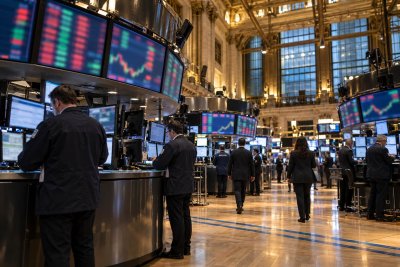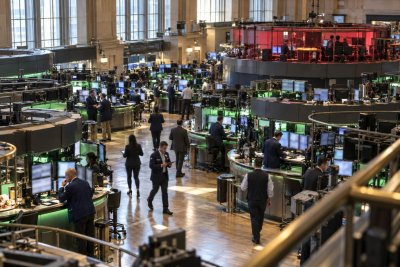
The Dow Jones Industrial Average closed virtually unchanged on Wednesday, edging down just 6.06 points to finish at 52,218.58. The index had climbed as high as 52,511.21 earlier in the session before giving back 292.63 points from its intraday peak.
The flat close masked significant divergence among components. Goldman Sachs Group (NYSE:GS) contributed roughly 75 points to the Dow, while Microsoft (NASDAQ:MSFT) and Salesforce (NYSE:CRM) together subtracted nearly 86 points. This divergence is particularly notable because the Dow is a price-weighted index, meaning that a $1 change in any component shifts the index by approximately 5.94 points, regardless of market capitalization.
Other notable movers included Johnson & Johnson (NYSE:JNJ), which added about 30 points, and Boeing (NYSE:BA), which contributed roughly 23 points. On the downside, IBM (NYSE:IBM) subtracted about 28 points, and Honeywell International (NASDAQ:HON) added roughly 19 points. The seven stocks tracked added a net of approximately 32 positive points, but the remaining 23 components offset those gains, leading to the flat performance.
The broader market also declined, with the S&P 500 falling 0.14% and the Nasdaq Composite losing 0.57%. Strength in chip stocks was outweighed by a broad decline in software shares. Charles Schwab (NYSE:SCHW) strategist Kevin Gordon noted that investors have become "a lot more discerning and specific" about artificial intelligence, and the sectoral split on Wednesday reflected that cautious approach.
Oil prices added to the pressure, with Brent crude rising nearly 3% to approach $94 per barrel, its highest level in six weeks. The 10-year Treasury yield edged up to near 4.66%. "Higher oil prices are the main near-term macro threat," said Wells Fargo (NYSE:WFC) strategist Sameer Samana, warning that increased energy costs could impede further disinflation and keep bond yields elevated.
As of the close, Alphabet (NASDAQ:GOOGL) and Tesla (NASDAQ:TSLA) had yet to release their quarterly earnings. Alphabet's conference call was scheduled for 4:30 p.m. EDT, with Tesla's Q&A session set for 5:30 p.m. EDT. Alphabet's results now carry direct weight on the Dow, as the company joined the index on June 29, increasing the index's exposure to major technology firms.
Over the past week, the Dow slipped roughly 0.9%, marking its second consecutive weekly loss. The S&P 500 declined 1.6%, and the Nasdaq retreated 2.9%. At Wednesday's close, the Dow stood just 0.1% higher than it did on Friday.
The Federal Reserve's meeting on July 28-29 is the main event on next week's calendar, with futures indicating about a 66% probability that officials will hold rates steady. Microsoft and Meta Platforms (NASDAQ:META) are scheduled to report results on July 29, followed by Apple (NASDAQ:AAPL) and Amazon (NASDAQ:AMZN) on July 30. Investors will watch to see if the software slump seen on Wednesday extends to these firms.
Risks remain balanced. Another surge in oil prices could push yields higher and accelerate losses in technology stocks. However, robust guidance from Alphabet or Tesla after the bell could quickly reverse that trend.