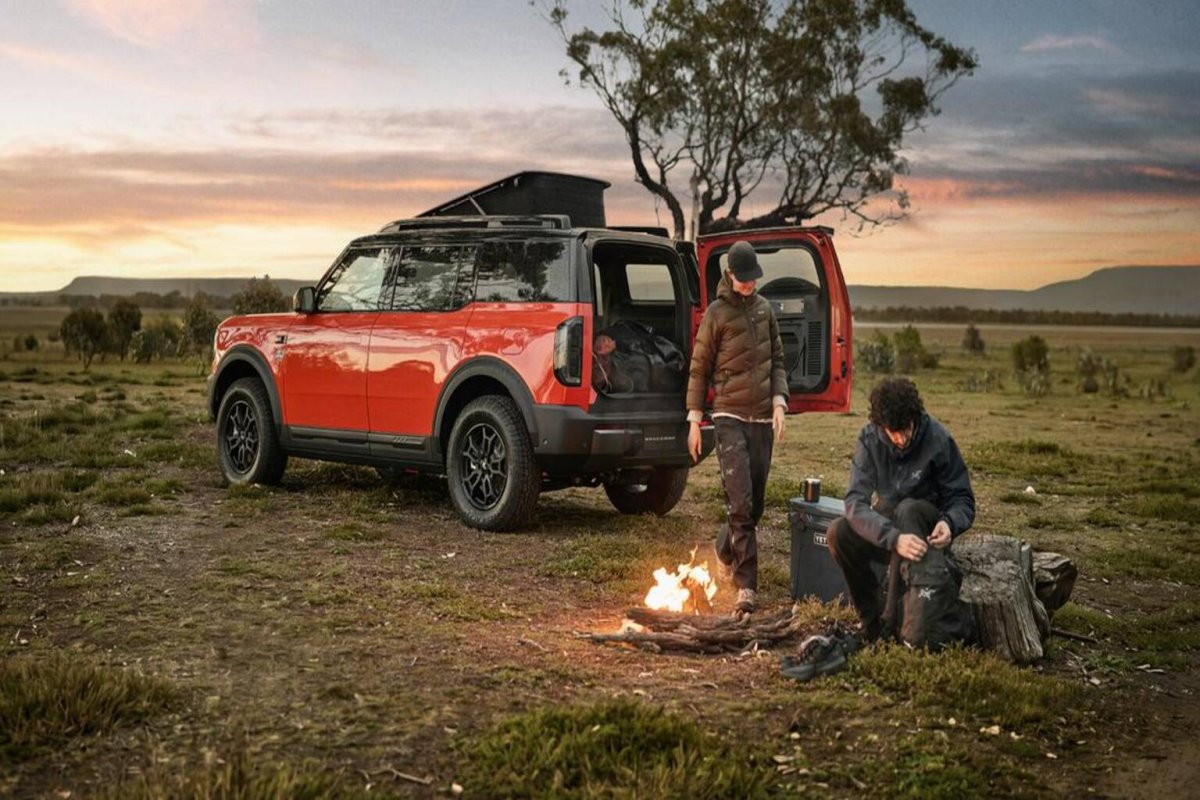
Ford Motor Company has provided a launch window and unusually detailed hardware specifications for its upcoming Bronco Basecamp, yet the vehicle still lacks the single number investors most urgently need: a price. The announcement comes as Ford shares closed Wednesday, September 9, at $13.45, down 3.93% in the regular session and 8.0% across two trading days. The decline was not triggered by the Basecamp news—the broader S&P 500 fell 0.5% as Brent crude moved back above $100—but the new SUV represents a timely test of whether a China-sourced electrified vehicle can broaden Ford's lineup without adding another low-return program.
The near-term answer appears modest. The Basecamp is unlikely to alter Ford's earnings estimates before it reaches Australia and New Zealand in mid-2027. Ford has not disclosed local pricing, order targets, final motor output, or expected revenue. Until those details arrive, the model is better viewed as evidence of a product-sourcing strategy than as a forecastable profit stream.
What Ford Actually Confirmed About the Bronco Basecamp
The official Ford disclosure describes a five-seat, all-wheel-drive SUV powered by two electric motors and a 49-kWh usable battery. A turbocharged 1.5-liter petrol engine serves as a range extender, generating electricity rather than directly driving the wheels. Ford calls the system a “super hybrid,” while more precise industry labels include extended-range electric vehicle (EREV) and range-extended plug-in hybrid.
Ford estimates 800–900 kilometers (497–559 miles) of combined range under the WLTP test cycle, but labels that figure preliminary. The company has not published an Australia-specific electric-only range. That distinction matters: a 49-kWh battery is far larger than the pack in a typical plug-in hybrid, yet the Basecamp's real fuel and charging economics will depend on how far it can travel before the generator kicks in.
The camping package is more concrete. The Outer Banks version gets a power-operated pop-up roof, the cabin can accommodate an accessory full-length mattress, and select versions offer a 7.5-liter heated-and-cooled storage compartment. A 6.6-kW Pro Power Onboard system can run campsite equipment, although Ford notes the exterior outlet requires an extra-cost adapter and total output drops when the interior outlet is also in use.
This is not the body-on-frame American Bronco exported to a new market. According to CarsGuide, the vehicle comes from Ford's joint venture with Jiangling Motors in China and uses a platform unrelated to both the U.S. Bronco and Bronco Sport. That allows Ford to fill a midsize-SUV gap more quickly, but it also makes sourcing, brand positioning, and local validation central to the investment case.
Why the Missing Price Matters More Than the 900-km Claim
Australia is a logical proving ground. The Federal Chamber of Automotive Industries reports the country bought more than 1.2 million light vehicles in 2025, with SUVs accounting for 60.7% of sales. Plug-in hybrids represented 4.2% of the market and conventional hybrids 23.6%. That is enough demand to justify a credible entrant, but not enough to make one regional launch material to Ford on its own.
For scale, Ford reported second-quarter revenue of $48.3 billion and adjusted EBIT of $2.5 billion. Ford Blue—the combustion and hybrid business that would be the closest economic home for Basecamp—earned $1.14 billion of EBIT on $26.1 billion of revenue. Ford Model e, by contrast, lost $919 million in the quarter. Management raised its 2026 adjusted-EBIT outlook to $10 billion–$11 billion, but still expects about a $4 billion Model e loss.
Those figures set a high bar for relevance. A successful Basecamp could help Ford broaden a regional showroom heavily dependent on Ranger and Everest, reuse development undertaken with a partner, and test an EREV architecture in a market suited to long-distance driving. But investors cannot translate any of that into earnings without a starting price, expected trim mix, dealer margin, and volume plan. A feature-rich launch that requires heavy incentives would expand market coverage while doing little for returns.
The Four Numbers to Watch Next
- Australian and New Zealand pricing: the clearest signal of whether Ford is prioritizing volume, margin, or brand positioning.
- Electric-only range and local output: necessary to compare the vehicle fairly with both PHEVs and battery EVs; Ford has not confirmed Australian motor ratings.
- Orders and deliveries: registrations of interest are useful, but paid orders and 2027 wholesale volume will show whether the Bronco name travels.
- Program economics: Ford has not said how revenue and profit are shared with Jiangling, or how much local engineering and homologation will cost.
The counterargument is that Ford does not need Basecamp to become a global blockbuster. If the joint-venture architecture shortens development time and gives dealers a competitive electrified SUV with limited incremental capital, even moderate volume could be strategically useful. The risk is that the Bronco badge raises expectations the China-built crossover cannot meet—or that price competition erases the benefit of faster sourcing.
Ford says final specifications, variants, pricing, and availability will come closer to the mid-2027 arrival. Until then, the 49-kWh battery and 900-km headline establish product credibility; they do not establish shareholder value. After an 8% two-session fall that has cut Ford's equity value to roughly $53.6 billion, investors should demand the commercial numbers before treating Basecamp as anything more than a promising regional option.