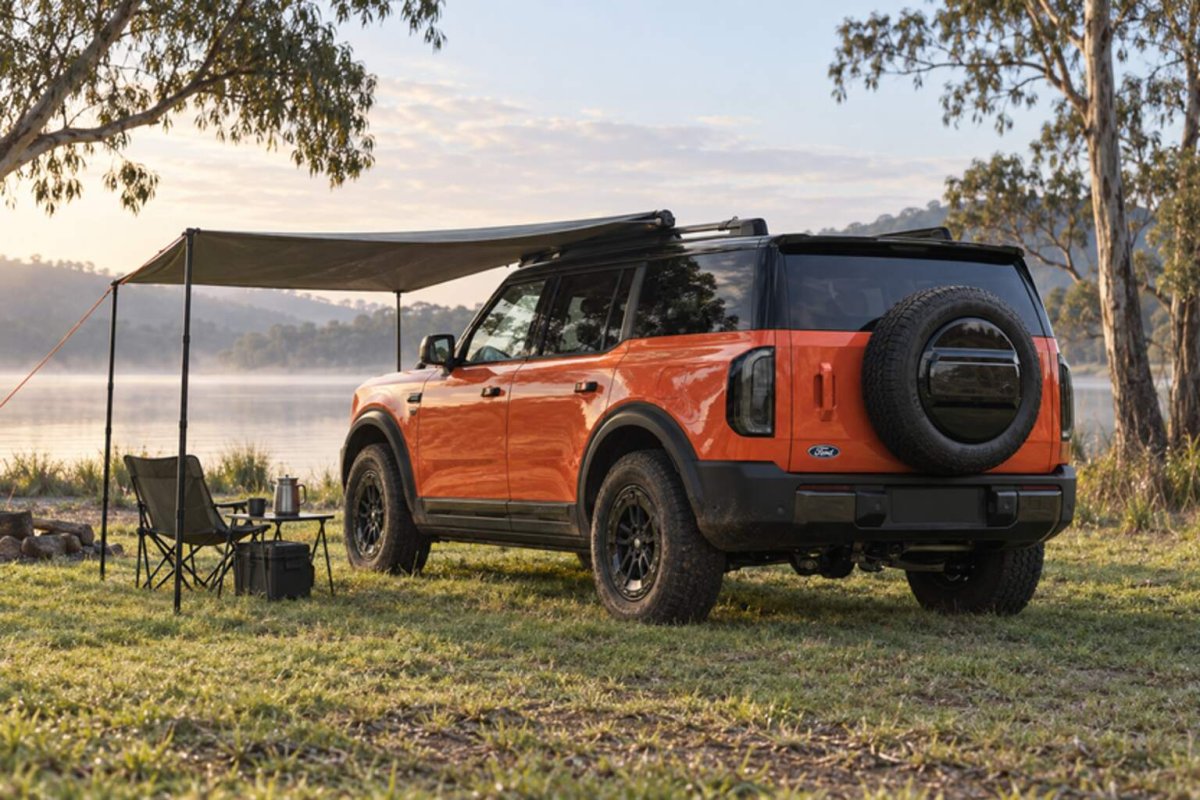
Ford Motor Company (NYSE: F) saw its shares close 4.2% lower at $14.00 on Tuesday, a decline that coincided with the automaker's confirmation that a new Bronco Basecamp range-extender will launch in Australia and New Zealand in 2027. While the stock drop may have been influenced by broader market sentiment rather than the announcement itself, the product news carries significant strategic weight for Ford's international operations.
Addressing a Regional Vulnerability
The Bronco Basecamp is not expected to move Ford's earnings needle in the near term, but it directly tackles a known weakness: Ford's Australian business relies heavily on the Ranger and Everest models. With consumer preferences shifting toward electrified SUVs, Ford faces the risk of being left behind in one of its most profitable export markets.
According to the Australian Automotive Dealer Association, SUVs accounted for 65% of year-to-date vehicle deliveries through August. In August alone, battery-electric vehicles outsold every other powertrain category for the first time, with more than 27,000 units sold, while the overall market grew 4.9% year-over-year.
A Strategic, Not Financial, Move
The Basecamp announcement is a clear signal that Ford intends to broaden its lineup without waiting for an all-new global platform. The vehicle, developed in partnership with China's Jiangling Motors, will feature a five-seat, all-wheel-drive configuration with two electric motors and a 1.5-litre turbocharged petrol engine acting as a range extender. It will offer a 49-kWh usable battery, and Ford expects deliveries to begin in mid-2027, with final pricing and specifications to be announced closer to launch.
Designed for camping enthusiasts, the Basecamp includes 6.6 kW of Pro Power Onboard, a powered pop-up roof on the Outer Banks trim, and fold-flat seating for an accessory mattress. Notably, this is not a right-hand-drive version of the US Bronco; it uses unibody construction and will be built by Jiangling Motors, a joint venture in China.
Market Context and Competitive Pressure
Ford's existing Australian lineup remains strong: the Ranger was the country's best-selling vehicle year-to-date with 32,796 deliveries through August, and the Everest added 14,490 units. However, August data from VFACTS revealed a sharp 50.6% year-over-year decline in Ranger deliveries to just 2,440 units. By contrast, the Tesla Model Y sold 6,414 units in August, more than double the Ranger's total.
The range-extender technology offers Ford a way to appeal to electrified-SUV buyers without requiring them to rely solely on public charging infrastructure—a practical advantage in Australia's vast geography. Sourcing an existing product from the Jiangling venture should also reduce development time and capital expenditure.
What It Means for Investors
From a financial perspective, the Basecamp is too small and too distant to alter Ford's current earnings trajectory. In the second quarter, Ford reported $48.30 billion in revenue and $2.50 billion in adjusted EBIT, but a significant equity-accounting loss contributed to a net loss of $1.33 billion. The company's June 10-Q showed $31.6 billion in cash, marketable securities, and restricted cash, including Ford Credit.
Investors should focus on three key disclosures in the coming months: Australian pricing relative to competitors like the Toyota RAV4 and emerging Chinese brands, official electric-range and fuel-economy figures, and dealer order volumes before launch.
On the bullish side, the Basecamp represents a broader, more electrified regional portfolio built from assets Ford already controls. The bearish perspective is that it's a niche product arriving after rivals have already captured the volume market, with potential brand confusion and imported-product margins that may limit profitability. Mid-2027 will be the first meaningful checkpoint; Tuesday's announcement is just the starting line.