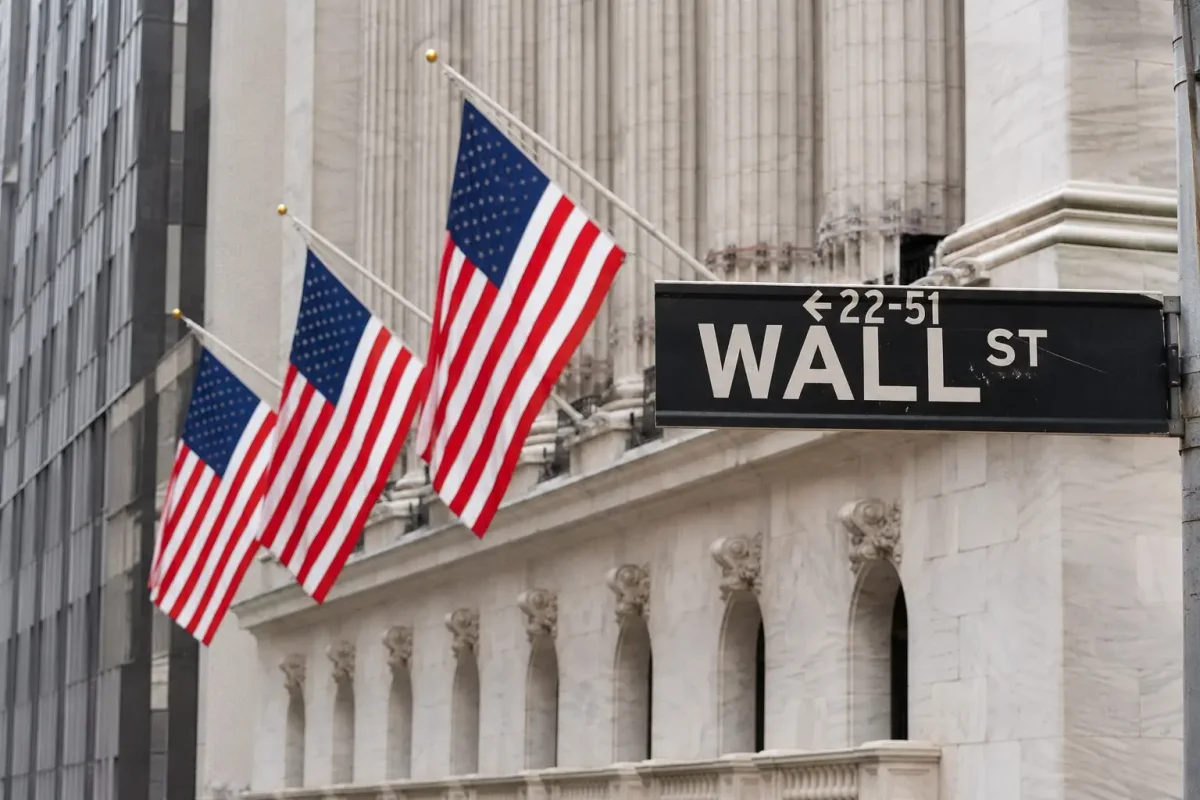
Wall Street futures pointed to a slightly lower open on Tuesday, as the S&P 500 and Nasdaq 100 took a breather after notching fresh record highs. The pullback came as investors weighed a surge in Hewlett Packard Enterprise (HPE) driven by artificial intelligence demand against a steep drop in Alphabet (GOOGL) following a major equity raise announcement.
Dow Jones Industrial Average futures lost 143 points, or 0.28%, to trade near 50,991. S&P 500 futures slipped 10.25 points, or 0.13%, to 7,603, while Nasdaq 100 futures declined 34.25 points, or 0.11%, to 30,532, according to data from Markets Insider. The modest declines followed Monday's record close, where the Dow rose 46.42 points (0.09%) to 51,078.88, the S&P 500 gained 19.90 points (0.26%) to 7,599.96, and the Nasdaq Composite added 114.19 points (0.42%) to 27,086.81. Technology stocks led Monday's gains, rising 2.5%, while most other S&P 500 sectors lagged.
HPE Soars on AI Server Demand
Hewlett Packard Enterprise (HPE) was the standout mover in premarket trading, surging nearly 29% after the company significantly raised its fiscal 2026 revenue-growth target to a range of 29% to 33%, up sharply from its prior outlook of 17% to 22%. The company also boosted its networking growth forecast to 72% to 75%, driven by robust demand for AI servers. The bullish outlook lifted other names in the server space, with Dell Technologies (DELL) gaining 3% and Super Micro Computer (SMCI) rising 5% in premarket action.
HPE Chief Financial Officer Marie Myers told Reuters that most of the quarter's gains came from the standard server segment, as enterprise clients increasingly adopted agentic AI tools—systems that operate with reduced human input—as a primary workload. Myers noted that HPE had been "agile" in passing on cost increases to customers, helping to protect margins amid rising input costs.
Alphabet Drops on Billion Equity Raise
Alphabet (GOOGL) shares fell about 2% in after-hours trading after the Google parent announced plans to raise $80 billion in equity, with $10 billion coming from Berkshire Hathaway (BRK.B). The move follows Alphabet's decision in April to raise its annual capital spending outlook to between $180 billion and $190 billion, underscoring the massive investments required to scale AI infrastructure.
Steven Check, who runs Check Capital Management, noted that companies often value having Berkshire as a strategic investor. Bill Stone of Glenview Trust pointed to the fresh Berkshire buying, suggesting that Greg Abel likely believes Alphabet will generate a "reasonable return" from its AI capital expenditures, even as the company dilutes existing shareholders through the equity sale. Alphabet itself stated that demand for its AI services continues to outpace available supply, reinforcing the rationale for the spending hike.
Nvidia Jumps on New AI Chip; Other Chip Stocks Mixed
Nvidia (NVDA) remained at the center of trading action, jumping 6.3% on Monday after unveiling a new chip designed to bring AI tools directly into personal computers. CEO Jensen Huang said the chip was developed in collaboration with Microsoft (MSFT) to "reinvent the PC" for the AI era. The news sent ripples through the semiconductor sector, with Qualcomm (QCOM) dropping 8.8% and Intel (INTC) slipping 4.7%, as investors reassessed competitive dynamics in the AI chip market.
Economic Data and Oil in Focus
Traders are closely watching a busy week for economic data. The Labor Department will release its Job Openings and Labor Turnover Survey (JOLTS) for April at 10:00 a.m. ET, which tracks job openings, separations, and hires. Job openings stood at 6.866 million in March, according to the Bureau of Labor Statistics. The May jobs report is scheduled for release on Friday at 8:30 a.m. ET, and could provide further clues on the strength of the labor market amid persistent inflation concerns.
Oil prices slipped, with Brent crude falling over 1% to hover near $94 per barrel, after President Donald Trump signaled that talks with Iran were still ongoing, even as Reuters reported that Tehran had paused indirect negotiations. The decline in oil helped ease some inflation worries, but investors remained cautious. The U.S. 10-year Treasury yield fell 4.4 basis points to 4.43%.
Geopolitical risks remain a key concern for markets. "We don't really know where things stand," said Thomas Martin, senior portfolio manager at GLOBALT in Atlanta, referring to the U.S.-Iran situation. A weak jobs report or hawkish comments from the Federal Reserve could trigger a sharp sell-off, analysts warned, as most market participants have already priced out any rate cuts for 2026.