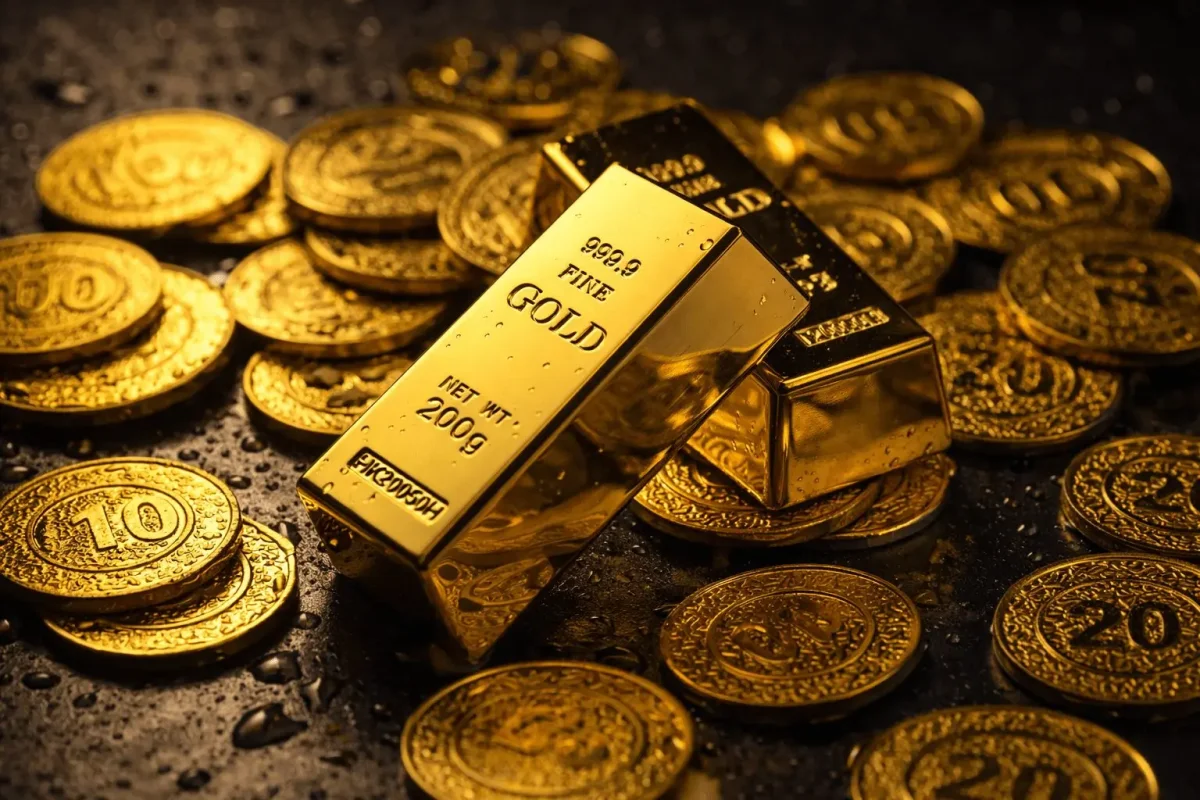
Financial markets opened the week under a cloud of geopolitical uncertainty as military actions in the Middle East triggered sharp moves across asset classes. Spot gold prices advanced approximately 2% to $5,384.41 per ounce by 1406 GMT on Monday, March 2, 2026, approaching recent record levels. U.S. gold futures saw an even steeper rise of 2.9%, reaching $5,397.40.
The price surge followed confirmed strikes by U.S. and Israeli forces against targets in Iran, marking a significant escalation in regional hostilities. In response, Iran launched missile and drone attacks targeting Israel and Gulf states, while Israel expanded its military operations into Lebanon following attacks by Hezbollah. This rapid exchange has injected fresh volatility into global markets, with investors seeking traditional safe-haven assets.
Energy markets reacted violently to the heightened risk of supply disruption. Brent crude oil futures surged nearly 9% to $78.90 per barrel, after briefly exceeding $82 earlier in the trading session. The spike reflects acute concerns over potential impacts on oil flows from the critical Persian Gulf region. U.S. President Donald Trump indicated the military campaign could persist for up to four weeks, adding to market anxiety about the conflict's duration.
Equity markets moved in the opposite direction as risk appetite waned. Europe's STOXX 600 index fell 1.6%, while futures for the U.S. S&P 500 pointed to an opening decline of 1.1%. "For now, the market will be trying to ascertain how long the conflict will be likely to last and whether it will draw in other nations," said Michael Field, chief European equity strategist at Morningstar.
Analysts emphasized that the rally in precious metals is being driven more by uncertainty than by specific headlines. "Right now, the market is attempting to figure out whether these attacks are going to be followed up over the next several weeks," noted David Meger, director of metals trading at High Ridge Futures. "I think it's that uncertainty that is more than likely to support prices." Other precious metals failed to keep pace with gold's ascent. Spot silver declined 0.6% to $93.23 an ounce, platinum shed 1.7% to $2,324.40, and palladium dropped 1.1% to $1,767.00.
The geopolitical fragmentation is influencing central bank behavior, particularly among BRIC nations. Analysts at SP Angel point to a sustained trend of central banks in Brazil, Russia, India, and China reducing their holdings of dollar-denominated assets in favor of gold. This structural demand is seen as a longer-term supportive factor for bullion.
Physical investment demand remains a key pillar for gold in 2026. BNP Paribas highlighted that physically backed gold exchange-traded funds (ETFs) have absorbed roughly 2 million ounces of bullion since January. The bank also observes increased purchasing of gold bars and coins by Chinese buyers compared to 2025 levels. With Indian commodity markets closed over the weekend, some traders turned to alternative proxies; the gold-backed crypto token Tether Gold reportedly surged close to 4% during that period.
However, the rally faces clear downside risks. A surprise diplomatic breakthrough, minimal actual disruption to energy supplies, or simply market exhaustion could swiftly reverse the bullish sentiment. Conversely, a protracted conflict presents a different set of challenges: a sustained oil price shock could rekindle inflationary pressures, potentially forcing the Federal Reserve to maintain higher interest rates for longer. This scenario would create a difficult environment for both bonds and non-yielding assets like gold.
Investor focus is now splitting between the unfolding geopolitical drama and key economic data. A wave of U.S. employment reports this week—including the ADP private payrolls, weekly jobless claims, and Friday's pivotal non-farm payrolls—will be scrutinized for signals about the strength of the economy and the likely path of Federal Reserve monetary policy. The interplay between geopolitical risk and central bank policy will define market direction in the coming sessions.