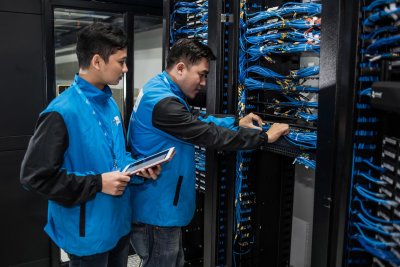
Meta Platforms (NASDAQ:META) is reportedly planning a move into the cloud computing market, a strategic shift that could transform how the company monetizes its massive investments in artificial intelligence. According to a Bloomberg report, the social media giant is considering offering AI computing power and models to other businesses, placing it in direct competition with cloud leaders Amazon (NASDAQ:AMZN), Microsoft (NASDAQ:MSFT), and Alphabet (NASDAQ:GOOGL). Meta declined to comment on the story to Reuters.
The news comes as Meta's capital expenditure guidance for 2026 has been raised to a range of $125 billion to $145 billion, up from a previous forecast of $115 billion to $135 billion. The company cited pricier components and higher data-center spending as the primary drivers. In the first quarter, Meta reported revenue of $56.31 billion and capital expenditures of $19.84 billion, representing a capex-to-revenue ratio of 35.2%. The 2026 outlook implies a capex-to-revenue ratio of 62% to 72%, based on last year's sales of $200.97 billion.
Meta's 2025 capex totaled $72.22 billion, meaning the 2026 target represents a 73% to 101% increase. The company's 10-Q filing reveals $182.88 billion in operating and finance leases not yet underway as of March 31, much of it for data centers, colocation, and network infrastructure. Additionally, Meta has $237.67 billion in non-cancelable commitments, primarily related to third-party cloud, servers, data centers, network, and Reality Labs hardware. Of that, $42.25 billion is due in 2026 and $47.65 billion in 2027. Meta signed another $24 billion in contracts this April.
The cloud initiative is seen as a pressure release valve for Meta's capacity glut. In May, CEO Mark Zuckerberg told shareholders that companies approach Meta "almost every week" wanting to buy API services or compute. He indicated Meta could consider sales if it ends up with "overbuilt" capacity. Bernstein analyst Madison Rezaei estimates Meta has 20 gigawatts of capacity worldwide, with another 14 gigawatts coming online. "This scale easily rivals cloud provider footprints," Rezaei wrote, as reported by Axios.
The potential cloud business has immediate implications for other players. CoreWeave (NASDAQ:CRWV) and Nebius Group (NASDAQ:NBIS) both saw their shares decline on the news, falling 4.6% and 5.9% respectively. Gil Luria, managing director at D.A. Davidson, noted that neocloud companies face increased risk. "Those companies like CoreWeave and Nebius rely on Meta for their growth and Meta may not need them anymore," he told Reuters.
SemiAnalysis analysts pushed back against the neocloud rout, noting that Meta has lined up over 5 GW of capacity in the first half of the year, with two major campuses comprising 2.5 GW under construction. In their analysis, 200 MW of outside compute could generate over $10 billion in annual revenue, or about 7%-8% of Meta's 2026 capex plan.
Despite the potential revenue, internal risks remain. Reuters reported that Zuckerberg told staff AI agents are lagging and restructuring bets haven't paid off yet. He expects bigger AI gains for Meta in three to six months. Investors must weigh whether Meta can sell its extra cloud capacity without cannibalizing resources needed for its own Muse Spark, ad-ranking, or AI agent tools. A $10 billion annual run rate would be significant for a new business, but it remains well below the $42.25 billion in commitments Meta faces in 2026.
Meta closed at $582.90 on Thursday, down 4.9%, as the initial rally from the cloud news lost steam. With U.S. equity markets closed for Independence Day on July 3, the next trading session will provide further clarity on investor sentiment.