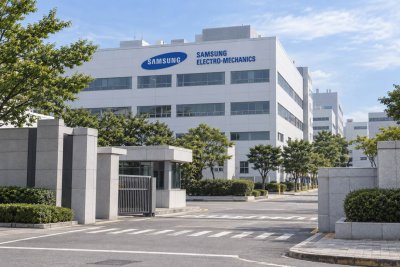
South Korea's two largest memory chipmakers diverged sharply on Tuesday, with Samsung Electronics (KRX:005930) falling 2.19% and SK Hynix (KRX:000660) advancing 1.03%. The 3.22-percentage-point performance gap between the rivals suggests that company-specific fundamentals are outweighing a blanket Korea risk discount, even as geopolitical jitters and rising oil prices weigh on the broader market.
The KOSPI index closed down 1.6% at 6,869.83, dragged by security concerns and higher energy costs. Samsung ended the session at 268,500 won, while SK Hynix climbed to 1,662,000 won. The divergence highlights how investors are differentiating between the two firms' earnings outlooks amid the ongoing AI-driven memory demand cycle.
Geopolitical and Oil Pressures
Markets were rattled by reports that President Donald Trump called for a significant reduction in joint military exercises with South Korea. U.S. Forces Korea commander Xavier Brunson met with the South Korean defense ministry to review the drills, according to media reports. South Korean President Lee Jae Myung responded by urging enhanced self-reliant defense while reaffirming support for the U.S. alliance.
Adding to the pressure, Brent crude oil rose to $91.35 per barrel following a 2.7% gain on Monday. Higher energy prices threaten to squeeze profit margins for Korean manufacturers and complicate inflation control efforts. However, the fact that SK Hynix rose despite these headwinds indicates that sector-specific demand dynamics are playing a more decisive role than geopolitical risk.
Samsung's Earnings Composition
Samsung's underperformance can be partly attributed to its earnings structure. In the second quarter, the chip business contributed nearly all of the group's operating profit, while the mobile division reported an operating loss of 700 billion won. Group-wide revenue rose 28% quarter-over-quarter to 171.5 trillion won, with operating profit of 89.5 trillion won. Device Solutions, the chipmaking arm, accounted for 74.3% of revenue and 99.7% of operating profit.
The heavy reliance on memory chips exposes Samsung to cyclical swings. Executive Vice President Jaejune Kim said nearly all clients now seek multi-year supply agreements, with the goal of locking in roughly two-thirds of memory production under extended contracts. Yet investors remain skeptical about the sustainability of record-high margins, especially with the chip division posting a 70% operating margin.
Analyst Optimism Persists
Despite Tuesday's decline, sell-side analysts remain overwhelmingly bullish. The consensus price target stands at 470,156 won, implying a 75.1% upside from the current level. Of 37 analysts covering the stock, 36 rate it a Buy, with one Hold and no Sells. Targets range from Macquarie's 480,000 won to UBS's 550,000 won.
This optimism is driven by sustained AI-related memory demand rather than expectations of a swift resolution to Korea's geopolitical risk premium. Analysts like Kim Seok-hwan of Mirae Asset Securities note that the chip narrative has weakened, but the long-term growth story remains intact.
Risks and Outlook
Key risks include a further deterioration in the U.S.-South Korea alliance, which could trigger foreign outflows and weaken the won. A sharper spike in oil prices would increase input costs. The main earnings risk remains a slowdown in hyperscaler spending or a reversal in memory prices.
Tuesday's session offered a clear signal: while Korea-specific concerns are weighing on the market, they are not overriding stock-picking strategies. Samsung now faces the challenge of proving that its record chip profits can withstand both geopolitical uncertainty and the evolving AI cycle. The coming weeks will be critical as investors watch for any changes in memory pricing, client orders, or geopolitical developments.