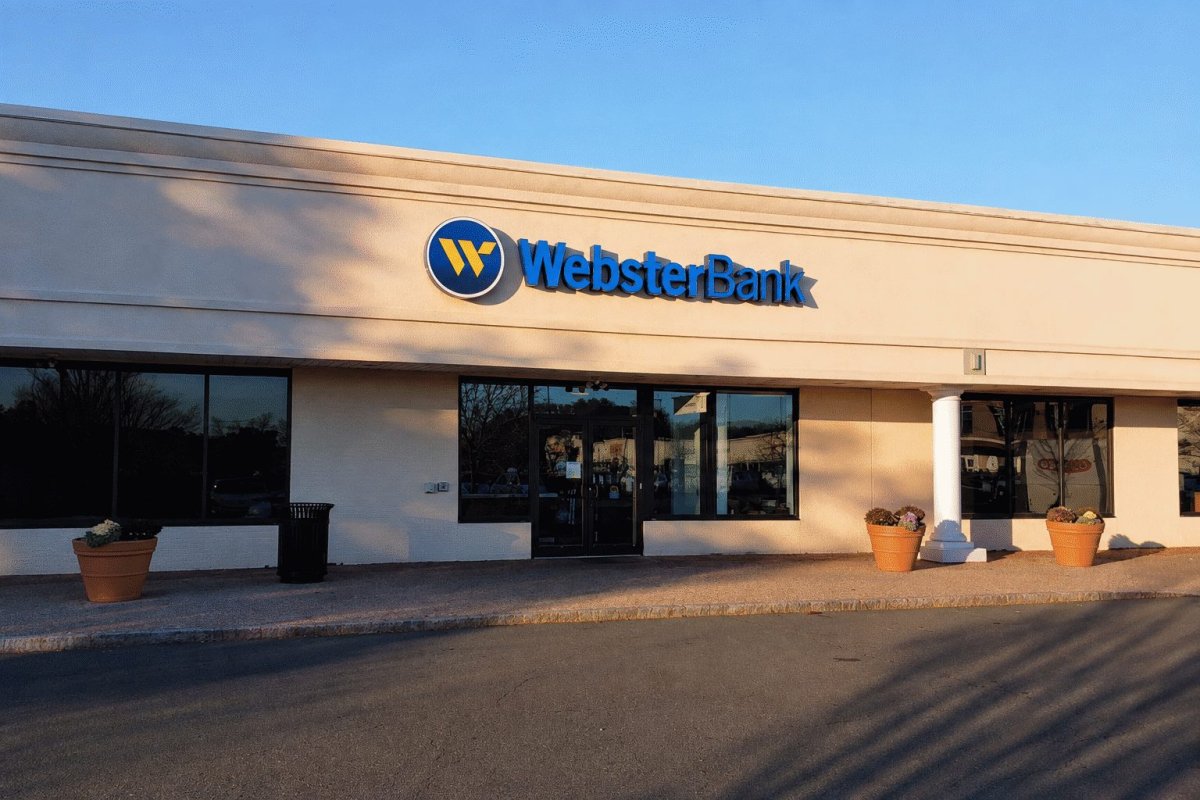
Banco Santander (NYSE: SAN) has officially closed its $12.2 billion acquisition of Webster Financial Corporation (NYSE: WBS), marking the end of Webster's trading on the New York Stock Exchange. The deal, which received regulatory approval from the Federal Reserve on August 4, was finalized on Thursday, August 21, 2026. Webster's shares had closed at $77.57 on Wednesday, representing a 0.5% discount to the deal's implied value of $77.95 per share.
Under the terms of the merger, former Webster shareholders received $48.75 in cash plus 2.0548 Santander American depositary shares for each Webster share. Based on Santander's closing price of $14.21 on August 20, the total package was valued at $77.95 per share. The spread between the market price and the deal value has now closed, as expected upon completion.
In premarket trading on Friday, Santander's shares rose 2.3% to $14.54, boosting the value of the ex-Webster package to approximately $78.63. This represents an 87 basis point increase from the deal's initial valuation. Investors who held Webster shares have now effectively swapped their merger spread exposure for direct exposure to Santander's performance.
Integration Challenges Ahead
With the acquisition complete, attention shifts to Santander's ability to deliver on its integration targets. The bank aims to achieve $800 million in annual cost savings, which would represent roughly 19% of the combined cost base. Additionally, management targets a U.S. return on tangible equity (RoTE) of approximately 18% by 2028, with an overall group earnings per share accretion of 7%–8%.
The combined entity will have substantial scale in the U.S. market, with total assets of $327 billion, loans of $185 billion, and deposits of $172 billion. These figures provide a strong foundation for revenue generation and funding stability. However, the integration will require careful management of deposit retention and loan performance, particularly as the bank works to reduce costs without compromising service quality or triggering customer attrition.
Webster's Financial Health
Webster reported solid second-quarter results ahead of the deal's completion. Deposits totaled $70.3 billion, up 6% year-over-year, while loans grew 7.8% to $57.9 billion. Revenue reached $740.0 million, with adjusted earnings per share of $1.60. The company's net interest margin stood at 3.26%, down 18 basis points from the prior year, and the efficiency ratio was 47.74%, up from 45.40% a year earlier.
Credit quality metrics showed some deterioration, with the nonperforming-loan ratio improving to 0.74% from 1.00% a year ago, but net charge-offs rose to 0.30% from 0.27%. These trends will be key early indicators of integration success, as Santander works to maintain asset quality while achieving cost synergies.
Analyst Perspectives
Prior to the deal's close, six analysts had published price targets for Webster, averaging $76.17 per share. The consensus was cautious, with four recommending a hold and one suggesting a sell. Notably, Wells Fargo's Mike Mayo had a sell rating with a $70 target, while KBW's Christopher McGratty was the most bullish, rating the stock a buy with an $81 target.
The analysts' targets were set before Webster ceased trading, and the stock ultimately closed above the average target, reflecting the market's confidence in the deal's completion. Santander Executive Chair Ana Botín described the merger as an “ideal fit,” highlighting the complementary strengths of the two institutions.
Brand and Operations
Webster's brand and branch locations will remain unchanged for now, and Stamford will continue to serve as a key U.S. office for the combined entity. This continuity is expected to support customer retention during the systems conversion process, which is often a critical period for deposit stability.
However, risks remain. Cost reduction efforts could impact service levels or lead to deposit withdrawals. Loan defaults may increase, and Santander's share price, along with euro-dollar exchange rate movements, will influence the value of the stock consideration. Achieving the projected synergies is an execution challenge that will be closely monitored by investors.
For former Webster shareholders, the completion of the deal marks a transition from a merger arbitrage position to an ongoing investment in Santander. The premarket rise on Friday provided a positive start, but the real test lies in whether Santander can deliver on its cost-saving targets without undermining the strength of the Webster franchise.