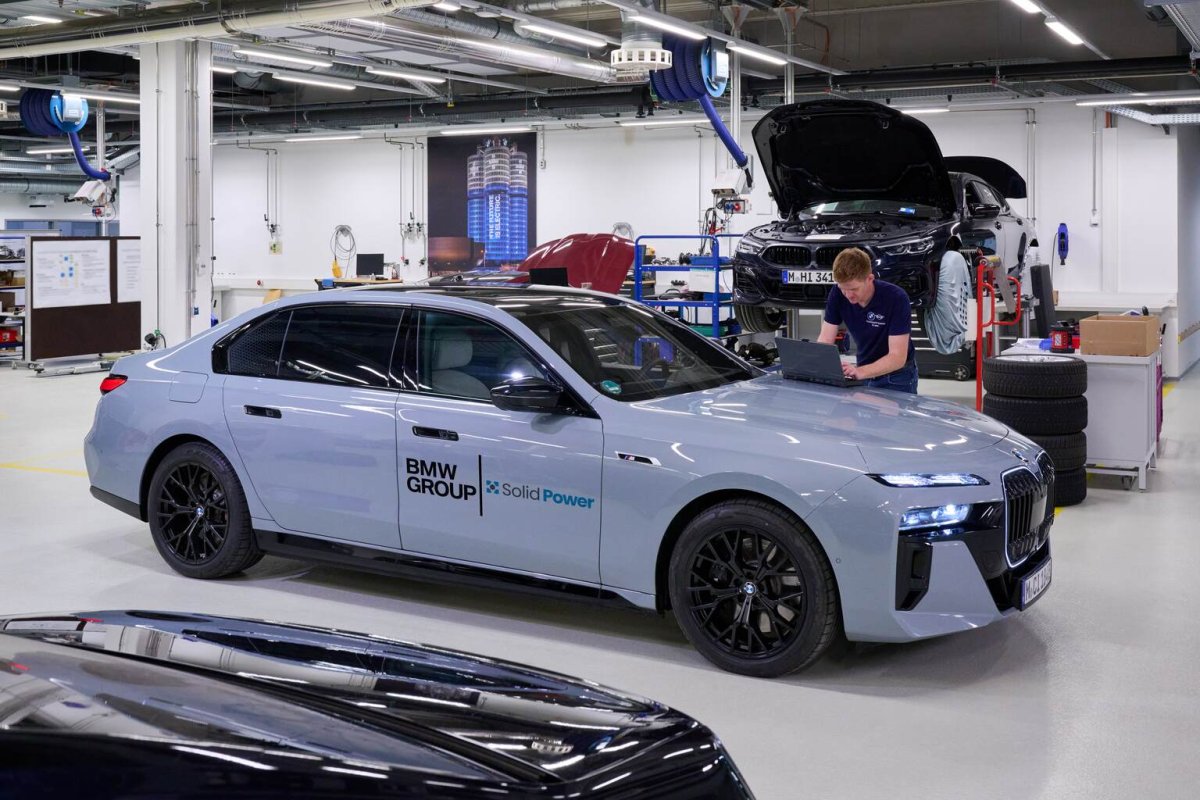
Solid Power's most visible achievement is a BMW i7 driving around Munich with its large-format all-solid-state battery cells. The milestone is real, but it's easy to misread: this is a development car gathering data, not a preview of a battery that buyers can order. As of September 19, 2026, Solid Power's journey is best understood as a shift from aspiring cell producer to specialist supplier.
The Colorado-based company wants to sell sulfide solid electrolyte and license cell designs to manufacturers that already know how to build batteries at automotive scale. Its September 2026 investor presentation puts the next test in concrete terms: start a continuous electrolyte line, qualify the process and turn partner trials into commercial supply agreements.
BMW i7 Proves Integration, Not Mass Production
Solid Power's relationship with BMW began in 2016. BMW invested in the company in 2021, then obtained a research-and-development license in 2022 to reproduce Solid Power's cell-manufacturing know-how on a prototype line in Germany. That arrangement mattered because it moved the technology outside Solid Power's own labs and into an automaker's development system.
The partnership reached the road in May 2025. BMW said the i7 test vehicle used large-format cells developed and manufactured by Solid Power with BMW engineers. The pack combined BMW's Gen5 prismatic-cell architecture with new module concepts. BMW was explicit about the work still ahead: the trial would study cell expansion, operating pressure and temperature control, and further development steps were required before the system could compete as a complete automotive battery.
A second path opened in October 2025. Under a joint evaluation agreement with Samsung SDI and BMW, Solid Power supplies sulfide electrolyte, Samsung SDI uses it in separators or catholyte and builds cells, and BMW helps set performance requirements for a possible demonstration vehicle. That division of work is a compact version of Solid Power's current strategy.
Why Solid Power Stopped Trying to Own the Whole Battery
Solid Power does not plan to manufacture commercial battery cells. Its 2025 annual report defines the model as electrolyte sales plus licenses for cell designs and manufacturing processes. Cell development continues because it gives engineers a way to test how changes in the material behave inside a working pouch cell, but the company expects established cell makers and automakers to carry the capital-intensive manufacturing burden.
SK On offers the clearest example. It licensed Solid Power's cell designs and processes for research, while Solid Power designed and installed a pilot cell line at an SK On facility in South Korea. SK On also agreed to buy at least eight metric tonnes of electrolyte through 2030 for validation work, with Solid Power expecting at least $8.3 million from those purchases depending on volumes. Solid Power completed the line-installation agreement and received its associated milestone payment in 2026; the companies were negotiating a new collaboration agreement when Solid Power reported second-quarter results in August.
The model reduces Solid Power's factory bill, but it transfers some control to its partners. The agreements are non-exclusive. BMW, Samsung SDI and SK On can develop other chemistries or work with competing suppliers, and Solid Power cannot dictate their vehicle programs or launch dates. Its annual report also says the company had not agreed key economic terms for commercial electrolyte sales or cell-technology licenses with any partner at the end of 2025.
Sulfide Electrolyte Offers a Useful Compromise with Difficult Edges
A conventional lithium-ion cell moves lithium ions through a liquid or gel electrolyte. Solid Power replaces that medium with a lithium-sulfide-based material. The attraction is not simply that it is solid. Sulfide electrolytes can combine high ionic conductivity with enough mechanical compliance for battery-manufacturing methods such as roll-to-roll processing. They may also allow higher-capacity electrodes, which could raise energy density without making the pack larger.
Those benefits remain conditional. Solid materials must maintain intimate contact with electrodes as a cell charges, discharges and changes dimensions. A 2026 peer-reviewed review of lithium-metal sulfide batteries describes externally applied pressure as a common way to preserve contact and ion pathways, while identifying pressure management as a barrier to practical cells. Sulfides can also react with moisture, and their interfaces with electrodes must remain chemically and mechanically stable through many cycles. BMW's decision to monitor pressure, temperature and expansion in the i7 is therefore central to the experiment, not a side issue.
Solid Power makes no claim that these questions are settled. Its filings warn that scaling the material requires consistent quality, acceptable yield, secure precursor supply and a production cost customers will accept. A good sample from a batch line does not establish that tonnes of material will behave the same way.
The Next Milestone Is a Production Line, Not Another Prototype
Solid Power currently describes 30 metric tonnes of annual batch capacity at its Thornton, Colorado, site. It is installing a continuous line designed to add 45 tonnes, taking total annual capacity to 75 tonnes if commissioning and validation succeed. In August, the company said major-equipment installation was advancing, equipment acceptance was targeted for the third quarter, and plant validation and startup remained planned for the fourth quarter of 2026. The same program is pursuing ISO 9001 certification.
The federal government is sharing part of that scale-up risk. A Department of Energy project description provides for up to $50 million toward continuous sulfide-electrolyte production in Thornton. The aim is to prove a process with better throughput and lower cost than pilot batch production.