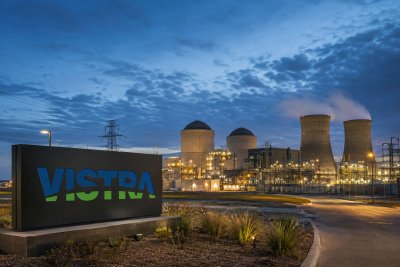
Vistra Corp. (NYSE: VST) is navigating another southern heat wave with a significant operational edge: its commercial fleet has maintained at least 97% availability during recent extreme weather events in Texas and the PJM region. This reliability is more than a temporary boost to spot prices; it underpins the company's ability to convert high demand into stable margins through its hedging strategy and integrated retail portfolio.
On Monday, heat advisories were issued across parts of 12 states, with heat-index values potentially reaching 115°F in Mississippi. Approximately 100 million people were under heat-related warnings, driving up electricity demand and putting pressure on the grid. Google Trends data showed rising search volume related to power usage, reflecting increased investor and consumer attention on grid stress.
The company's operational performance is backed by strong numbers. Generation adjusted EBITDA surged 67.6% year-over-year to $994 million in the second quarter, while retail EBITDA grew 2.2% to $773 million. Total adjusted EBITDA rose 31% to $1.767 billion. This outperformance was driven by favorable hedging that lifted average realized generation prices by about 5% per megawatt-hour.
Vistra's management attributes the strong results to proactive maintenance. The company completed three nuclear refueling outages and 92 scheduled gas and coal outages before the summer peak. CEO Jim Burke emphasized that these efforts led to "strong, reliable performance" during recent high temperatures, a statement supported by the fleet availability data.
The market has taken notice. Despite a 1.36% decline in shares to $146.11 on Monday, analysts remain overwhelmingly bullish. The consensus price target stands at $228.56, implying roughly 56% upside from current levels. Out of 17 analysts covering the stock, 16 rate it a Buy or Strong Buy, with price targets ranging from $187 to $298.
Recent analyst actions underscore this optimism. Goldman Sachs assigned a $206 target on August 12, while Wells Fargo set an Overweight rating with a $212 target on August 10. Morgan Stanley and TD Cowen both have $212 and $222 targets, respectively. These projections reflect confidence in Vistra's ability to benefit from structural demand growth and disciplined capital allocation, even as ERCOT forward prices have softened.
Looking ahead, Vistra's 2026 outlook remains robust. The company reported $3.261 billion in adjusted EBITDA for the first half, representing 45.3% of its $7.2 billion guidance midpoint. Management expects full-year results to meet or exceed the midpoint, with an adjusted free cash flow before growth target of $4.325 billion. The 2027 EBITDA opportunity is projected at $7.6 billion at the midpoint.
Long-term demand drivers are also favorable. The U.S. Energy Information Administration projects electricity consumption to reach 4,268 billion kilowatt-hours in 2026 and 4,391 billion in 2027, fueled by AI data centers and cryptocurrency mining. CEO Jim Burke anticipates annual load growth of 4%-6% in ERCOT and 2%-3% in PJM through 2030.
However, risks remain. A major outage during peak heat could negate the benefits of high availability. Mild temperatures, battery storage deployment, and softer ERCOT pricing could pressure margins. Additionally, execution on ongoing deals and data-center investment plans will be critical. The current heat wave serves as a real-world test of Vistra's operational resilience; any shortfall would highlight the market's reliance on flawless execution.